
Unbiased headlines. Facts, not spin.
Unbiased Headlines is an independently owned news organization. We bring you the facts, not opinions, written fresh from 110+ named sources. Sources linked so you can verify it yourself.
 health
Notable (5/10)
Event date: November 2, 2026 ·
Murphy's Stroke at 53 Fits a Pattern: Stroke Rates for Adults 20 to 54 Nearly Doubled Since 1993
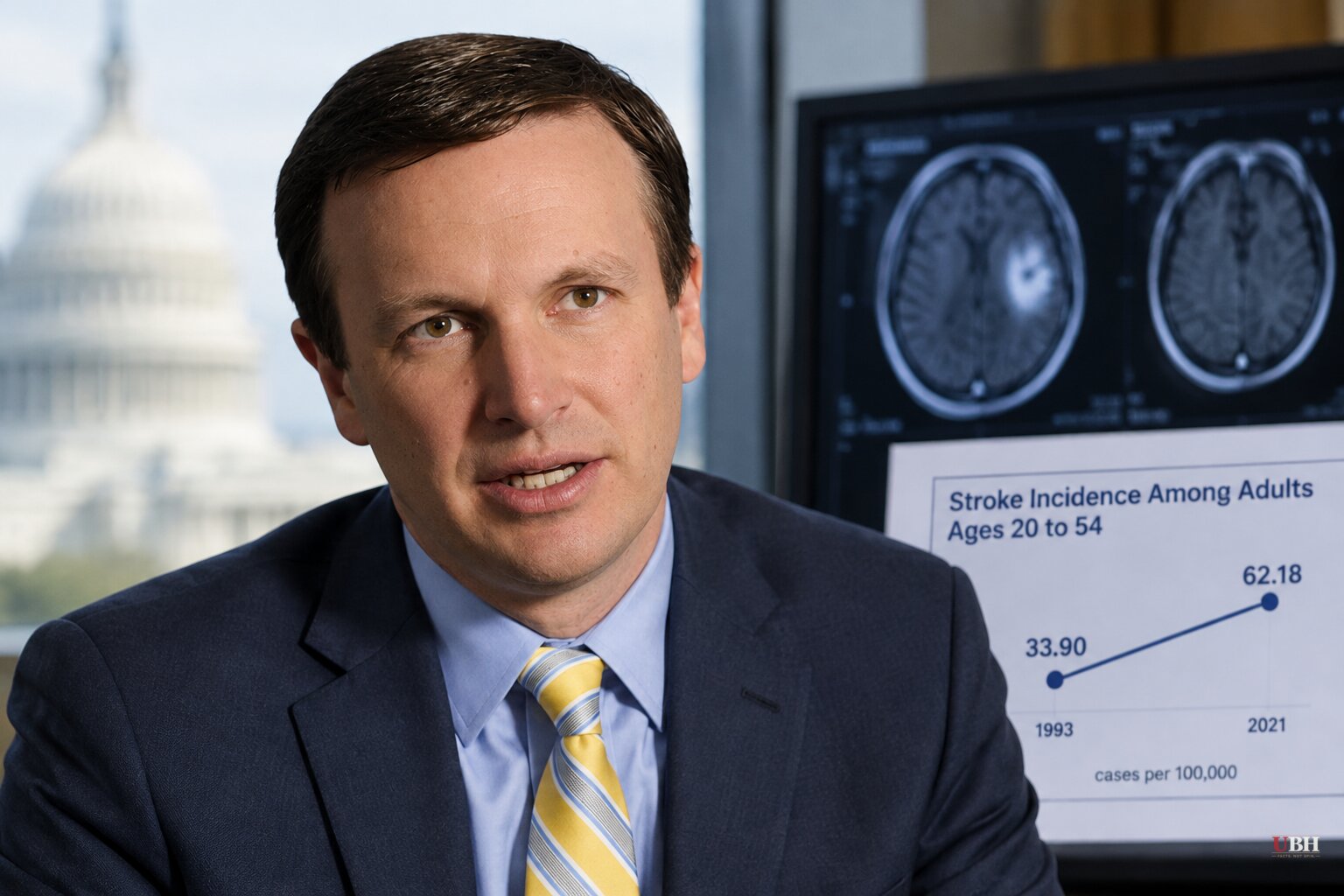
Since Sen. Chris Murphy, D-Conn., suffered a stroke on Oct. 31, doctors have used his case to point to a bigger problem: strokes are hitting younger Americans more often. On Nov. 6, Murphy released a statement saying he had been discharged from Johns Hopkins and would spend several weeks at a rehabilitation center.
Murphy is 53. Stroke is still far more common in older people, but the numbers for younger adults are moving the wrong way.
What happened to Murphy
Murphy felt numbness in his arm on Saturday afternoon, Oct. 31, while at his son's hockey game, according to his chief of staff, Allison Herwitt. He was taken to a local hospital, where doctors found he had suffered a stroke, then transferred to Johns Hopkins.
Herwitt said he was "awake and alert" and that the staff was "optimistic he will make a full recovery." He had been scheduled to campaign for Democrats in New Hampshire the next day. He is not up for reelection until 2030 and has been viewed as a potential 2028 presidential candidate.
His office has not said whether it was an ischemic stroke, a blockage, or a hemorrhagic stroke, a bleed. Johns Hopkins puts roughly 87 percent of all strokes in the ischemic category and 13 percent in the hemorrhagic one. Murphy's office has also not said what caused his stroke.
Sen. John Fetterman, D-Pa., who survived a near-fatal stroke, wrote on X that he understands "all too well how much this impacts your life." Sen. Chuck Grassley, R-Iowa, said he and his wife were praying for Murphy.
The numbers on younger adults
Researchers found that the stroke incidence rate among adults 20 to 54 nearly doubled between 1993-94 and 2020, from 33.90 cases per 100,000 people to 62.18. Over the same period, the rate for older adults declined.
CDC researchers who compared 2011-13 with 2020-22 found stroke prevalence rose 14.6% among people 18 to 44 and 15.7% among people 45 to 64.
The CDC also says about 34% to 38% of stroke hospitalizations involve people younger than 65. The National Institutes of Health says about 75% of strokes still occur in people 65 and older.
Stroke is the fourth-leading cause of death in the U.S., according to the CDC. Dr. Anna Hohler, regional director of neurology for Northwell in Westchester County, said stroke deaths have risen over the long term and called it "a concerning trend."
Why it's happening
No single explanation covers the rise. Risk factors are climbing in younger people: high blood pressure, obesity, diabetes, sleep apnea, high cholesterol and physical inactivity.
A Florida study of patients 18 to 55 who had the most common form of stroke found that from 2014 to 2022 they increasingly had existing vascular risk factors such as hypertension, coronary artery disease, diabetes or sleep apnea.
Dr. Rachel Forman, a stroke specialist at Yale New Haven Health, called high blood pressure "the silent killer." She said that often "the first time people know they're having high blood pressure is when they come in with a devastating stroke."
Forman also cautioned against assuming every stroke patient has a traditional risk factor. Clotting disorders and genetic predispositions can also contribute, she said. That matters for Murphy, since his office has released no medical history.
What doctors tell people to do
Forman recommends the FAST test: face drooping, arm weakness or numbness, speech trouble, and time to call 911. Symptoms that come and go should not be brushed off, she said. A transient ischemic attack, often called a mini-stroke, "oftentimes could be a warning for another stroke that's larger coming."
Health professionals point to the basics. Know your blood pressure, cholesterol and blood sugar. Don't smoke. Stay active. Dr. Aaron Shoskes of the University of Utah said regular visits to a primary care doctor can surface risk factors early, and that "early intervention makes a big difference."
Dr. Elizabeth Rosen, a neurologist at Tufts Medical Center, said some people feel completely healthy even while having hypertension.
Murphy's own timing helped. Sen. Martin Heinrich, D-N.M., said he was grateful the senator "sought medical attention as quickly as he did." Emergency treatment can reduce complications, according to the Mayo Clinic.
What comes next
Murphy said in his Nov. 6 statement that he would spend several weeks at a rehabilitation center.
Sources used for this briefing
7 links from 7 independent newsrooms (syndicated copies of the same report count once)
These are the sources it draws on, linked so you can verify.


