
Unbiased headlines. Facts, not spin.
Unbiased Headlines is an independently owned news organization. We bring you the facts, not opinions, written fresh from 110+ named sources. Sources linked so you can verify it yourself.
 health
Major Story (7/10)
Pelacarsen Cut Lp(a) 78% but Did Not Reduce Heart Attacks or Strokes in 8,322-Patient Phase 3 Trial
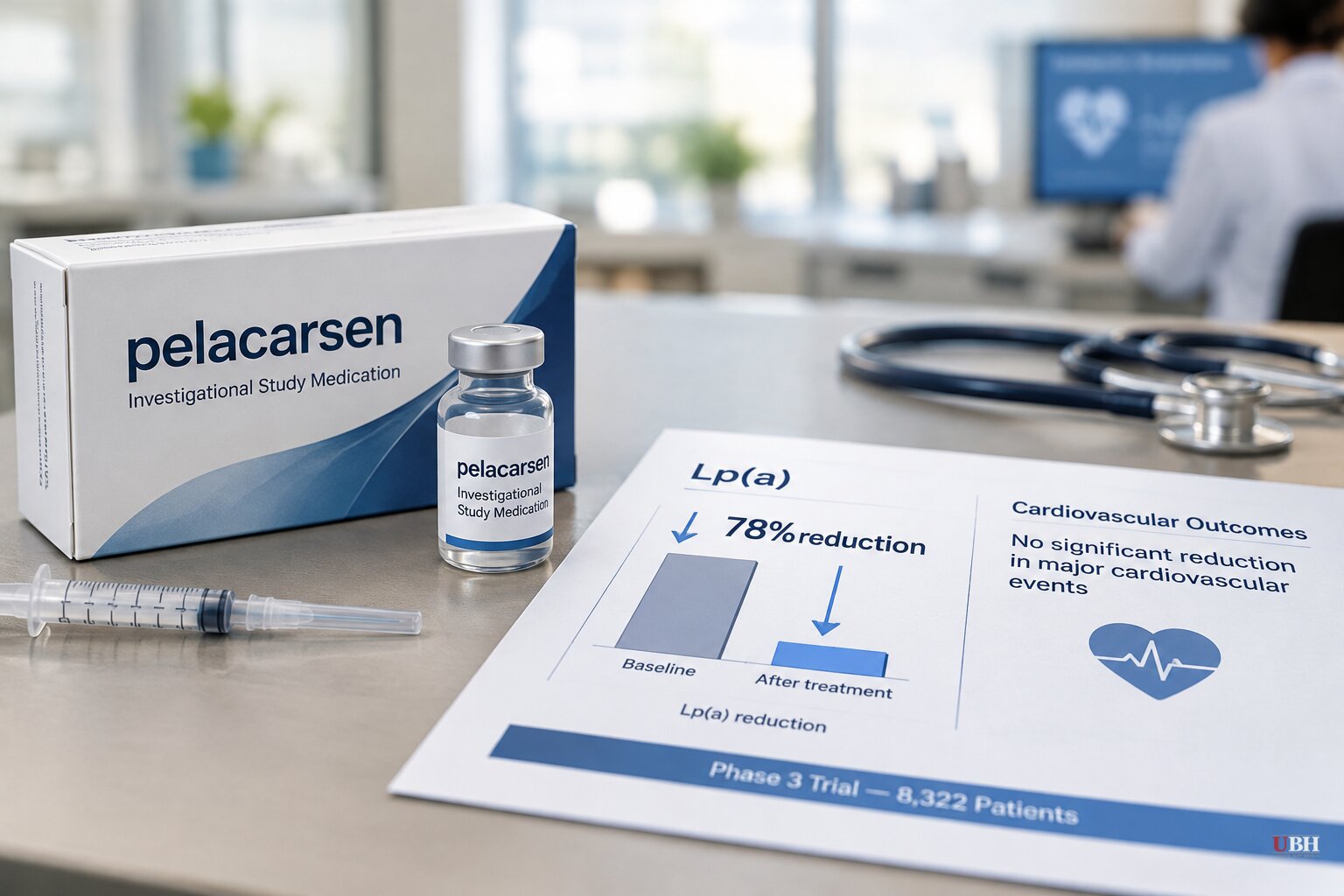
Since Novartis said the Phase 3 Lp(a)HORIZON trial missed its primary endpoint, the open question has been how badly. The full data arrived today, Saturday, Nov. 7, at the American Heart Association's Scientific Sessions in Chicago, published simultaneously in the New England Journal of Medicine. The drug cut the target. It did not cut the heart attacks.
What the trial found
The trial, led by Cleveland Clinic, randomized about 8,350 patients at 797 sites in 42 countries between December 2019 and July 2022. A total of 8,322 were included in the efficacy analysis. All had established cardiovascular disease and lipoprotein(a), or Lp(a), of at least 70 mg/dL.
Patients got 80 mg of pelacarsen or placebo by monthly injection and were followed for a median of 4.7 years.
Lp(a) fell 78.4% at 12 months on the drug. Median levels dropped to 64.4 nmol/L on pelacarsen while sitting at 233.4 nmol/L on placebo.
The primary endpoint was cardiovascular death, nonfatal heart attack, nonfatal stroke or urgent revascularization requiring hospitalization. It occurred in 12.3% of the pelacarsen group and 12.1% of the placebo group, according to Cleveland Clinic. The published hazard ratio was 1.02 (95% CI 0.90 to 1.15).
Nothing else moved either. A three-component composite hit 10.2% versus 10.1%. Death from any cause was 5.7% versus 5.9%. In patients with baseline Lp(a) of at least 90 mg/dL, the event rate was 12.3% in both arms. No prespecified subgroup showed a difference.
"The results were completely neutral across multiple analyses," said Dr. Steven Nissen, the study's senior author and Chief Academic Officer of the Heart, Vascular & Thoracic Institute at Cleveland Clinic. "There was basically no effect on outcomes, not even a trend, even in subpopulations."
Side effects and dropouts
Serious adverse events were actually lower on the drug, 37.3% versus 41.1%. The tolerability picture was still rough.
Influenza-like reactions hit 31.9% of pelacarsen patients versus 5.8% on placebo. Injection-site reactions were 25.6% versus 2.9%. Adverse events leading to permanent discontinuation were 20.6% versus 7.5%.
Adjudicated anaphylaxis occurred in 19 pelacarsen patients and none on placebo. Eight hypersensitivity reactions led to hospitalization. There were no deaths.
After a suspected anaphylaxis case in March 2023, injections moved to a medically supervised setting for six months before at-home dosing resumed. Overall, 35.1% of the pelacarsen group stopped the trial regimen early versus 18.3% on placebo.
The investigators listed that uneven discontinuation as a limitation, along with a population that was predominantly male and White (27% were women) and possible COVID-19 confounding.
An estimated 64 million Americans and 1.4 billion people worldwide have elevated Lp(a), according to Cleveland Clinic. Levels are 80 to 90% genetically determined. Diet, exercise and statins do not move them much.
Genetic studies had shown that people born with lower Lp(a) have fewer cardiovascular events across a lifetime. This trial tested whether lowering it with a drug in adults with existing disease, over roughly five years, delivers the same payoff. For pelacarsen, it did not. The investigators suggested short-term reduction may not confer the benefit linked to lifelong low levels.
Nissen said he was shocked. "I had high hopes for success," he told NPR. "Very disappointing, terribly disappointing."
Nissen also argued the result should not be read as the end of the idea. "A single trial does not provide definitive evidence of a lack of benefit of lowering lipoprotein(a) as a strategy to reduce cardiovascular risk," he said. He noted the trial enrolled only patients who had already had cardiovascular events, so it says nothing about primary prevention. The results apply only to pelacarsen, he said, and siRNA drugs may lower Lp(a) further and be better tolerated.
His advice to patients in other Lp(a) studies: "don't drop out because of these findings."
What Novartis and its competitors are doing
Novartis said in a statement that the trial "provides meaningful evidence" on the Lp(a)-heart disease relationship and may "help inform future approaches to cardiovascular management."
Novartis is discontinuing development of pelacarsen for atherosclerotic cardiovascular disease, according to a company statement reported by Bloomberg. The drug was discovered by Ionis Pharmaceuticals. A separate study of pelacarsen in calcific aortic valve stenosis is continuing. Novartis did not immediately respond to Bloomberg's request for comment.
Amgen is still advancing olpasiran, an RNA-targeting Lp(a) therapy, with Arrowhead Pharmaceuticals and Royalty Pharma. Whether a deeper, better-tolerated Lp(a) reduction can do what pelacarsen could not is now the central question for those programs.
Separate extended analyses of the trial, including on-treatment and uninterrupted-treatment results, were presented at the meeting and published in NEJM Evidence. Nissen said they are meant to complement the primary results and could inform ongoing and future trials.
Sources used for this briefing
7 links from 7 independent newsrooms (syndicated copies of the same report count once)
These are the sources it draws on, linked so you can verify.


