
Unbiased headlines. Facts, not spin.
Unbiased Headlines is an independently owned news organization. We bring you the facts, not opinions, written fresh from 110+ named sources. Sources linked so you can verify it yourself.
 health
Notable (6/10)
Roche: Divarasib Cut Risk of Death 44% Versus Sotorasib or Adagrasib in Phase 3 Lung Cancer Trial
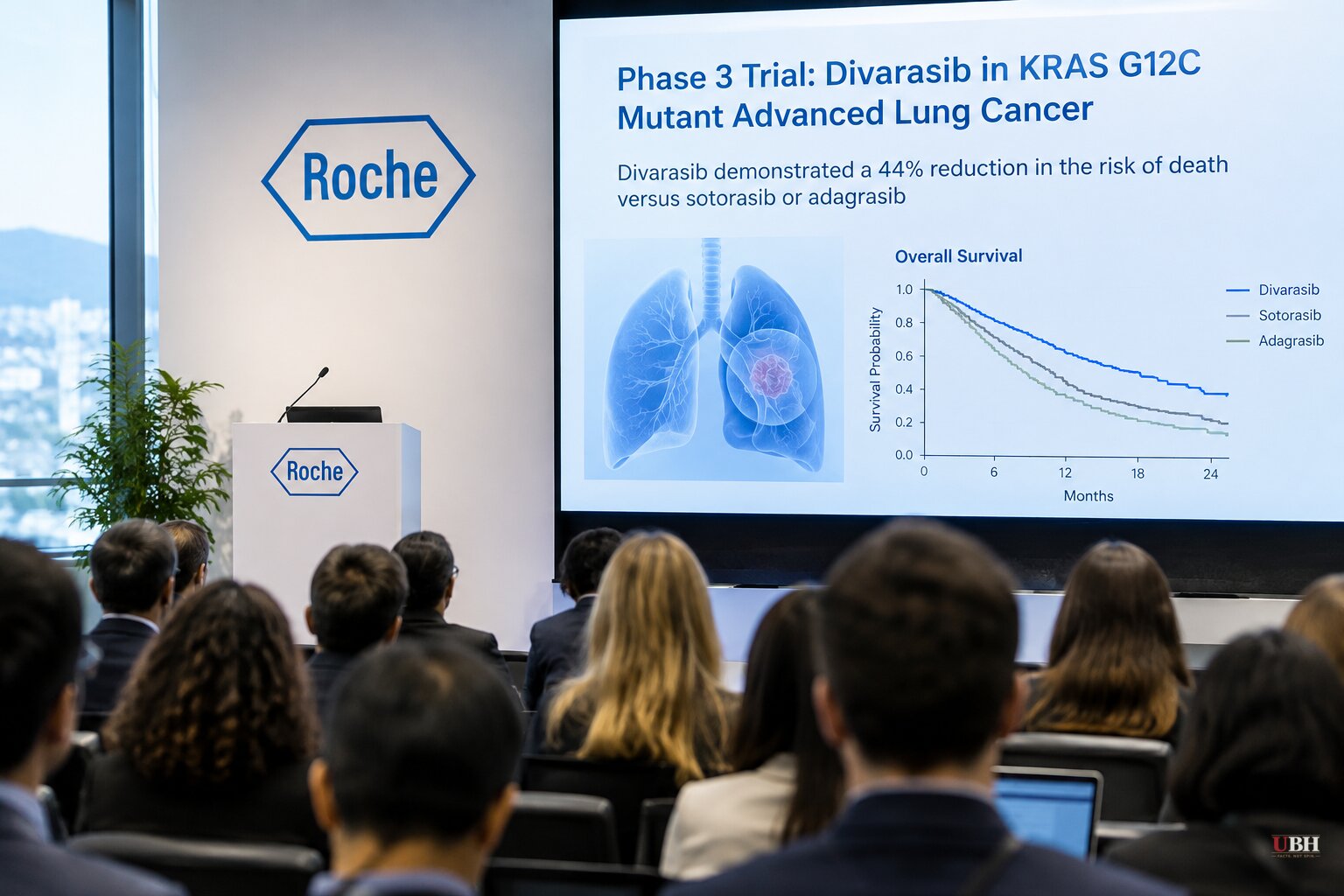
Roche said Sunday, Oct. 25, that its experimental lung cancer drug divarasib reduced the risk of death by 44% compared with existing treatments in a phase 3 trial.
The Krascendo 1 results were presented at the 2026 ESMO Congress in Madrid and published in the New England Journal of Medicine.
What the trial compared
Krascendo 1 enrolled 338 patients with previously treated, locally advanced or metastatic KRAS G12C-mutated non-small cell lung cancer. All had received one to three prior lines of therapy, including platinum chemotherapy and a PD-1 or PD-L1 inhibitor. None had previously taken a KRAS G12C inhibitor.
Of those patients, 167 received divarasib at 400 mg once daily. The other 171 got the investigator's choice of sotorasib (Lumakras) at 960 mg daily or adagrasib (Krazati) at 600 mg twice daily. In the control arm, 156 patients received sotorasib and 15 received adagrasib.
The trial was global, randomized and open-label. Crossover between arms was not permitted.
That makes it a head-to-head test of a newer drug against the two approved drugs in its class, not against chemotherapy. Ferdinandos Skoulidis, MD, PhD, presented the data at the ESMO Congress 2026 Presidential Symposium in Madrid. Coverage describes the study as providing direct phase 3 evidence comparing a next-generation KRAS G12C inhibitor with established targeted treatments.
The numbers
At a median follow-up of 14.3 months, median progression-free survival, judged by blinded independent central review, was 9.8 months with divarasib and 5.7 months with sotorasib or adagrasib. That is a hazard ratio of 0.58, a 42% reduction in the risk of progression or death (95% CI 0.44 to 0.76).
The 12-month progression-free survival rate was 43.9% versus 24.0%.
Overall survival, a key secondary endpoint, came in at 17.7 months versus 12.0 months. The hazard ratio was 0.56 (95% CI 0.41 to 0.78). The 12-month overall survival rates were 67.1% versus 49.2%.
The objective response rate was 58.4% for divarasib and 32.3% for the control arm, among 328 patients evaluable for response. Median duration of response was 11.9 months with divarasib versus 6.9 months with the control arm.
Benefits were generally consistent across subgroups, including patients with a history of central nervous system metastases, patients with liver metastases and patients with KEAP1-mutated tumors.
Safety
Roche said no new safety findings were observed. Treatment discontinuations due to treatment-related adverse events were 4.8% in the divarasib arm versus 11.7% in the control arm. Grade 3 or 4 treatment-related adverse events occurred in 24.6% of divarasib patients versus 34.5% of control patients. Gastrointestinal events were more frequent with divarasib but predominantly grade 1.
What the data do and do not settle
Skoulidis, the lead study author, said in his presentation: "Based on the results of the Krascendo 1 clinical trial, divarasib represents a new standard of care for patients with previously treated KRAS G12C-mutant advanced or metastatic NSCLC." That is the investigator's conclusion. No regulator has made that determination.
The overall survival result comes from the first interim analysis. The upper bound of the confidence interval for median survival in the divarasib arm was not estimable, meaning the data are not mature enough to pin down how long the longest-surviving patients lived.
The trial was also open-label, so patients and investigators knew which drug was being given. The primary endpoint, however, was assessed by blinded independent central review. Investigator-assessed progression-free survival was consistent with it: 11.1 months with divarasib versus 5.6 months with the control arm.
Sotorasib and adagrasib established the treatment strategy for previously treated KRAS G12C lung cancer. Most patients on them still progress eventually, and the durability of benefit has been limited. Krascendo 1 tested whether a next-generation drug in the same class does materially better.
What comes next
Divarasib remains investigational. Roche said it is working with health authorities to bring the treatment to patients, but it has not announced a filing date or an approval timeline. Further overall survival analyses are the next data point to watch, since the 17.7-month median rests on an interim cut.
Sources used for this briefing
6 links from 6 independent newsrooms (syndicated copies of the same report count once)
These are the sources it draws on, linked so you can verify.


