
Unbiased headlines. Facts, not spin.
Unbiased Headlines is an independently owned news organization. We bring you the facts, not opinions, written fresh from 110+ named sources. Sources linked so you can verify it yourself.
 tech
Major Story (7/10)
tech
Major Story (7/10)
Rigetti Hands U.S. Government 7.74 Million Shares in $100 Million CHIPS Act Quantum Deal
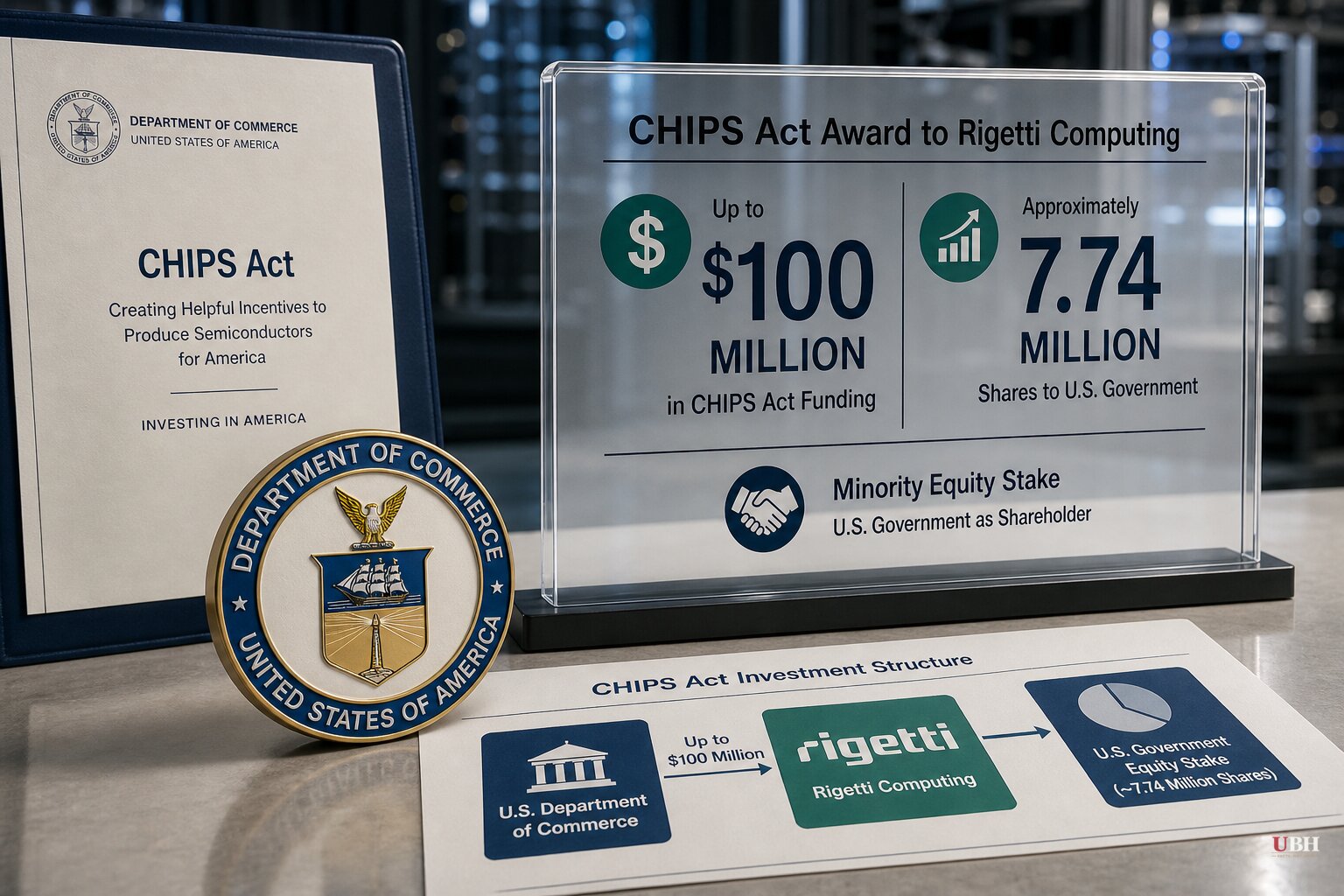
Rigetti Computing announced Tuesday, September 8, that its subsidiary Rigetti & Co, LLC signed a definitive agreement with the U.S. Department of Commerce for up to $100 million in funding to accelerate superconducting quantum computing research, according to a company statement distributed via GlobeNewswire.
The money comes from the CHIPS Research and Development Office's Broad Agency Announcement under the CHIPS and Science Act. The Commerce Department is taking equity.
According to Crypto Briefing, Rigetti will issue approximately 7.74 million shares of its common stock to the government, valued at roughly $12.92 per share, giving Commerce a minority, non-controlling stake in the Nasdaq-listed company. Rigetti's own statement confirms the equity stake is a condition of the funding, framed as a way "to enhance the return for the U.S. taxpayer."
The cash won't land all at once. Crypto Briefing reported an initial tranche of approximately $43.9 million, with the remainder tied to performance milestones and subject to clawback if Rigetti misses them. The agreement follows a letter of intent the two sides signed in May 2026, meaning the terms took roughly four months to finalize.
Three Technical Bets
Rigetti says the money funds three R&D projects targeting scaling bottlenecks in superconducting quantum systems. Per details reported by TradingView, those include shrinking the electronics used to read quantum chips, expanding the capacity of the extreme-cold environments quantum computers require, and developing chips that let more qubits communicate with each other.
Rigetti CEO Dr. Subodh Kulkarni called the award "pivotal for enhancing R&D capabilities, fostering a robust domestic quantum ecosystem, and facilitating the wider adoption of quantum technologies." He said shrinking the time and cost to build large-scale quantum systems would broaden adoption and strengthen the U.S. quantum supply chain.
Not the Only Winner
Rigetti is one piece of a larger federal push. Crypto Briefing reported the award is part of a $2.013 billion CHIPS Act quantum initiative spread across nine companies, including IBM and GlobalFoundries.
TradingView reported that D-Wave Quantum and Quantinuum each finalized matching $100 million agreements with Commerce on the same day, with the government taking a minority, non-controlling equity stake in each company. D-Wave's award targets a 100,000-qubit annealing system and a 10,000-qubit gate-model system designed to deliver 100 logical qubits. Quantinuum will use its funding to scale trapped-ion technology, working with GlobalFoundries on next-generation ion traps built on 300mm wafers, with Monarch Quantum developing lasers and optical components. Quantinuum remains privately held and does not have publicly traded shares.
According to TradingView, shares of Rigetti and D-Wave Quantum were indicated higher in pre-market trading Tuesday despite broader market weakness. RGTI was indicated up as much as 7% and D-Wave's QBTS around 4%, even as the SPDR S&P 500 ETF traded lower and the Dow-tracking SPDR ETF slipped 0.75% ahead of the open. GlobalFoundries shares were indicated up over 1%. Retail sentiment on Stocktwits for RGTI and QBTS remained in "bearish" territory over the prior day despite the pre-market pop.
The Equity Question
The government taking a direct ownership stake in a publicly traded tech company, rather than simply cutting a grant check, is not how federal R&D funding has traditionally worked. Crypto Briefing flagged the obvious tension: it aligns Washington's financial interest with Rigetti's stock price, but it also means Commerce now has skin in the game of a single company's success or failure.
This is industrial policy dressed up as fiscal responsibility. The government is still handing taxpayer money to a company with a market cap built on a technology that has yet to prove commercial viability at scale. Taxpayers are now exposed to that company's stock risk on top of it. If Rigetti's roadmap stalls, the equity stake doesn't protect anyone. It just means the government owns a piece of the stall.
The counter-argument, and the one Commerce itself makes, is that an equity stake beats a blank grant. If Rigetti's stock rises on the back of federally funded R&D, taxpayers capture some of that upside instead of watching private shareholders keep it all. Crypto Briefing's own reporting confirms the mechanism: milestone-based tranches with clawback provisions mean Rigetti doesn't get the full $100 million unless the R&D actually delivers.
For Rigetti's existing shareholders, the near-term effect is straightforward: 7.74 million new shares means dilution, full stop. Whether that dilution is worth it depends on whether the three funded R&D projects actually move the company toward the utility-scale quantum computing Kulkarni is promising. The milestone schedule and clawback terms governing that determination have not been made public in the company's disclosures so far.
Sources used for this briefing
7 links from 7 independent newsrooms (syndicated copies of the same report count once)
These are the sources it draws on, linked so you can verify.


