
Original briefings. Zero spin.
Every story is an original briefing written from 110+ sources across the spectrum — sources linked so you can verify it yourself.
 health
Low Interest (3/10)
Event date: September 8, 2026
health
Low Interest (3/10)
Event date: September 8, 2026
Radiocarbon Dating Confirms Three Separate Cannibalism Episodes in Neolithic Spain
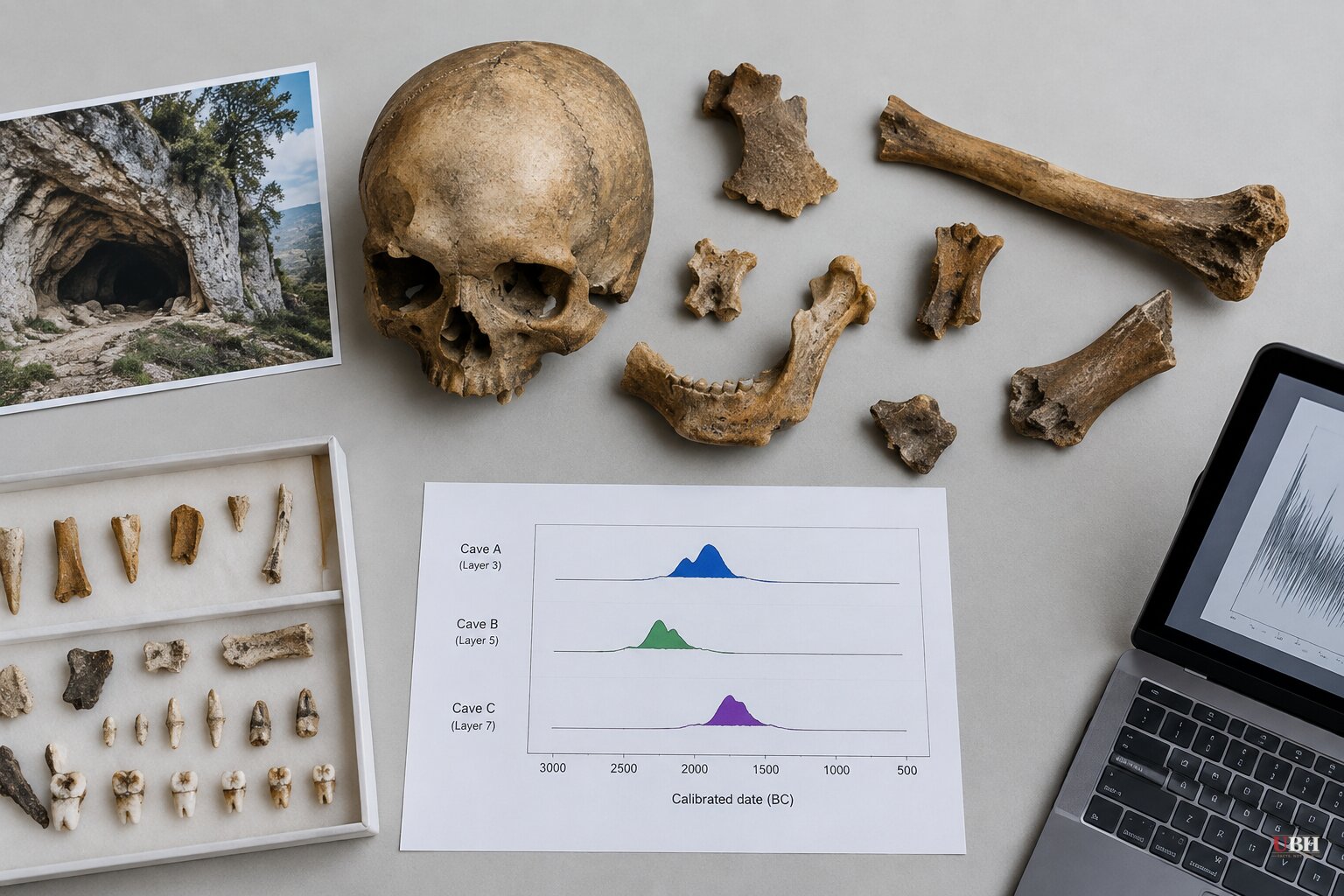
Spanish archaeologist Miguel Botella first spotted cut marks on bones from these caves back in 1973. He labeled them Copper Age and moved on. It took until this year for anyone to nail down exactly when the cannibalism happened, and it turns out he was working with a jumble of episodes separated by centuries.
A new study in the Journal of Archaeological Science, led by Antonio Rodríguez-Hidalgo of the Institute of Archaeology of Mérida, re-examined close to 1,000 human bone fragments from three caves in Granada province: Malalmuerzo, Carigüela and Majolicas. The project was a joint effort between the Mérida institute, part of Spain's National Research Council and the regional government of Extremadura, and the Catalan Institute of Human Paleoecology and Social Evolution.
Researchers combined direct radiocarbon dating with microscopic analysis of cut marks, fractures, blunt-force impacts and human tooth marks, then ran statistical models and machine learning to sort out which damage came from people and which came from scavengers or natural decay over thousands of years.
A single violent event at Malalmuerzo
The strongest evidence for outright massacre comes from Malalmuerzo. Researchers identified 714 bone fragments there, representing a minimum of 36 people, dated to roughly 5300 to 4950 BCE, the Early Neolithic.
The remains include infants, children and adults. The fractures are consistent with trauma at or near the time of death. That combination—all age groups represented, closely grouped dates, blunt-force injuries to the skull—points to one group being killed and eaten in a single episode rather than something spread out over time.
"At Malalmuerzo, we have found fractures that point to violent deaths," Rodríguez-Hidalgo told The Independent. "In addition, our analyses indicate the presence of remains from all age groups, which would suggest a violent event in which all or almost all the individuals in a group were killed and subsequently consumed."
A recurring practice at Carigüela
Carigüela tells a different story. Instead of one event, the cave shows repeated body processing across several phases of the Neolithic. Researchers found cut marks and fractures consistent with butchery, plus two human skulls modified into bowl-like containers, known as skull cups.
Two radiocarbon dates support the idea of separate, recurring episodes rather than a single outbreak of violence. A much older date recovered from the cave is harder to interpret.
Ritual staining at Majolicas
The most recent episode, dated to roughly 3950 to 3760 BCE in the Late Neolithic, comes from Majolicas. There, long bones were broken less intensely than at the other two sites, and some remains were stained red with cinnabar, a rare mineral tied to symbolic and mortuary practices.
Researchers see Majolicas as a probable ritual or funerary setting rather than a violent one. Combined with findings from other European sites, the team now places Neolithic cannibalism into three broad windows: the late sixth millennium BCE, the middle fifth millennium BCE, and the end of the Neolithic period.
What the study does and doesn't settle
"For decades, prehistoric cannibalism has tended to be interpreted as a single type of behavior," Rodríguez-Hidalgo said in a statement. "Our work shows that it is not possible to speak of a single form of 'Neolithic cannibalism,' because similar archaeological evidence may conceal very different social realities."
Scholars still debate two competing explanations for why any of this happened: exocannibalism, meaning the consumption of captured outsiders or enemies, versus endocannibalism, a funerary practice involving one's own dead. The study's own authors acknowledge that distinguishing violence from reverence in bone damage alone remains uncertain. Bones don't record motive, only what was done to them.
One divergence worth noting: a summary distributed by Ground News's AI tool attributed the research to "archaeologist Palmira Saladi of the Catalan Institute," a name that does not appear in the original study coverage from the Independent, Popular Science, archaeologymag or labrujulaverde. Every other outlet identifies Antonio Rodríguez-Hidalgo of the Institute of Archaeology of Mérida as the lead author and primary spokesperson for the findings. Readers relying on that particular summary got the wrong name attached to the research.
The unresolved question the study leaves on the table is whether Malalmuerzo's victims were killed by outsiders or by their own community during some kind of internal crisis. Nothing in the bone evidence, as reported, settles that. The research team says future work will need to combine chronology, site context and bone-level data on a case-by-case basis, since similar-looking evidence at different caves can point to completely different social realities.
Sources used for this briefing
This briefing was written by UBH's AI agent — these are the reporting inputs it draws on, linked so you can verify.


