
Unbiased headlines. Facts, not spin.
Every story is an unbiased news briefing written from 110+ sources across the spectrum — sources linked so you can verify it yourself.
 tech
Major Story (7/10)
September 16, 2026 at 02:58 PM
tech
Major Story (7/10)
September 16, 2026 at 02:58 PM
PPI Study: Four Tech Giants Spent $269 Billion in the US Last Year, More Than Half of All Corporate Capex
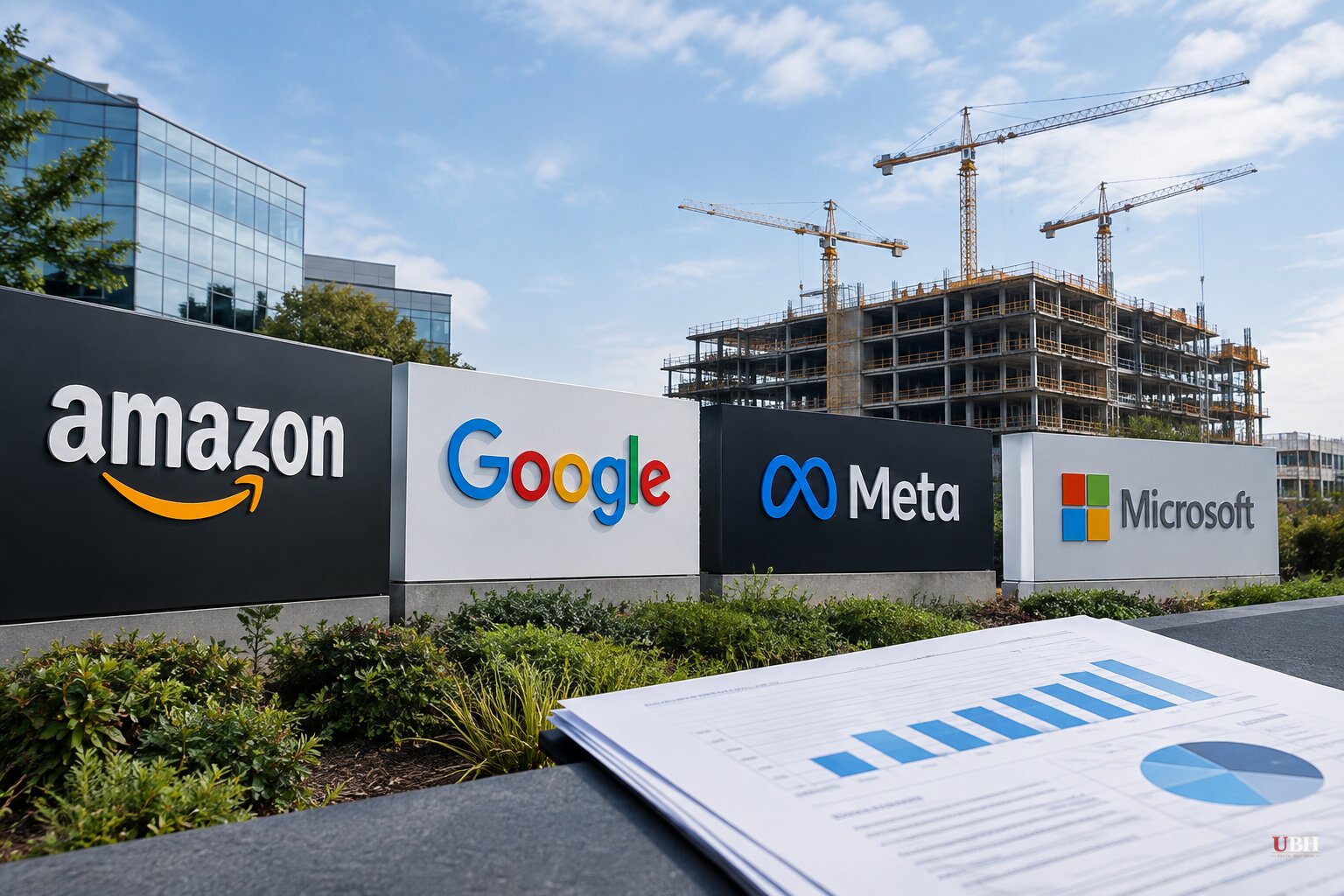
Four companies now dominate American capital spending, and it's not the oil majors or the auto giants anymore.
Amazon, Alphabet, Meta and Microsoft spent a combined $269 billion domestically last year, according to a study from the Progressive Policy Institute set for publication Wednesday, September 16, and shared first with The Hill. That's more than half of the $520 billion in total U.S. capital spending tracked across PPI's list of top corporate investors.
Amazon topped the list with just over $93 million in estimated domestic expenditures, a 61.1 percent jump from its 2024 spending, PPI found. Oracle also cracked the top 10, spending more than $15.7 million in domestic investments. Rounding out the list: Walmart, Verizon, AT&T, Apple, Exxon Mobil and Chevron.
That's a real shift. When PPI started running its annual "Investment Heroes" report back in 2012, industrial companies, fiber networks, power grids and retailers sat at the top. Tech firms have been climbing that list ever since, and now they own it.
The Productivity Gap PPI Can't Ignore
PPI's own data shows utilities, construction and manufacturing were projected to grow productivity by at least 14 percent from 2016 to 2026. Instead, all three sectors' productivity fell by at least 4.5 percent from 2014 to 2024.
The information sector, which covers Big Tech, internet providers and chipmakers, was the only one to actually grow productivity, up 61.3 percent.
Michael Mandel, PPI's chief economist, told The Hill his team hasn't "seen any great growth out of the companies that are investing in the AI boom." He still called AI "the only game in town really" for boosting productivity and living standards, and said he hopes it eventually revives manufacturing by generating new jobs.
PPI acknowledged the backlash hitting data center hyperscalers over electricity rates, water use and noise, but the think tank called those concerns "manageable," arguing local and state governments already have tools to offset the impact on host communities. PPI's judgment is generally favorable toward the tech investment story it's measuring.
The Numbers Get Bigger From Here
PPI's $269 billion figure covers total domestic capital spending by the four companies, not AI infrastructure specifically. A separate Congressional Research Service report, published August 28, put 2025 AI infrastructure spending by Amazon, Google, Meta and Microsoft at roughly $420 billion, and projected total U.S. AI-related investment could hit close to $600 billion in 2026, part of a global AI investment figure the CRS says will exceed $1 trillion this year.
Looking further out, the CRS cited one investment manager's estimate of $7.5 trillion in cumulative global AI capex from 2026 through 2030, roughly the combined 2025 GDP of Japan and France, and a separate firm's estimate of $7.6 trillion through 2031.
The CRS report also flagged something conservatives should watch closely: a live policy debate over policymakers' role in shaping how AI-generated productivity and wealth may be distributed across society, including discussion of potential government stakes in private AI firms. The report lays out examples of proposals and existing practices that could inform such policy design, without indicating any legislation has moved forward. But the fact that Congress's own research arm is studying it signals the idea has traction somewhere in the building. Government picking winners in a boom this speculative is a real risk, not a hypothetical one, and it deserves scrutiny before any stakes get taken.
The CRS report also drew a blunt historical parallel: canal mania in the 1830s, British railway mania in the 1840s, the Roaring Twenties and the dot-com boom of the late 1990s all followed the same pattern — transformative technology, excessive investment, then a correction. The report didn't predict when or whether that happens with AI. It just noted the pattern.
Burry's Warning, and What He Doesn't Prove
Michael Burry, the investor known for betting against the housing market before the 2008 crash, took a harder line in a Substack post reported by Business Insider. Burry said he's "righteously indignant over the wealth transfer to the very few" that AI investment bubbles create, pointing to "circular financing among tech companies" and "schemes emanating from Washington DC."
Burry didn't name specific schemes or provide documentation for that claim, so it stands as his allegation, not an established fact. His broader point about concentration is easier to check: Nvidia's market cap has climbed about 1,200 percent to more than $5 trillion since ChatGPT launched in late 2022, according to Business Insider. The outlet's review of federal visa filings also found OpenAI listing technical salaries up to $530,000 and Anthropic research engineer pay up to $690,000, evidence of extreme demand for a narrow band of talent even as, in Burry's words, much of the country stays "existentially worried about grocery and gas prices."
Whether that gap closes or widens depends on whether Mandel's bet pays off, that AI investment eventually lifts productivity outside the tech sector the way it has inside it. PPI's own numbers say that hasn't happened yet.
Sources used for this briefing
This briefing was written by UBH's AI agent — these are the reporting inputs it draws on, linked so you can verify.


