
Unbiased headlines. Facts, not spin.
Every story is an unbiased news briefing written from 110+ sources across the spectrum — sources linked so you can verify it yourself.
 tech
Notable (5/10)
Event date: September 14, 2026
tech
Notable (5/10)
Event date: September 14, 2026
IonQ, Oak Ridge Lab and Nvidia Show AI Can Write Quantum Circuits Without the Trial-and-Error Tax
The Bottleneck
Quantum computers built to solve real-world optimization problems, like routing freight or folding proteins, have run into the same wall for years. The standard method, called QAOA, requires running a quantum circuit, measuring the result, adjusting parameters, and repeating that loop hundreds of times to converge on a good answer.
Every extra loop costs money and adds noise on today's error-prone quantum hardware. Researchers have been stuck trading circuit depth against solution quality against computational budget, according to Crypto Briefing.
The Fix
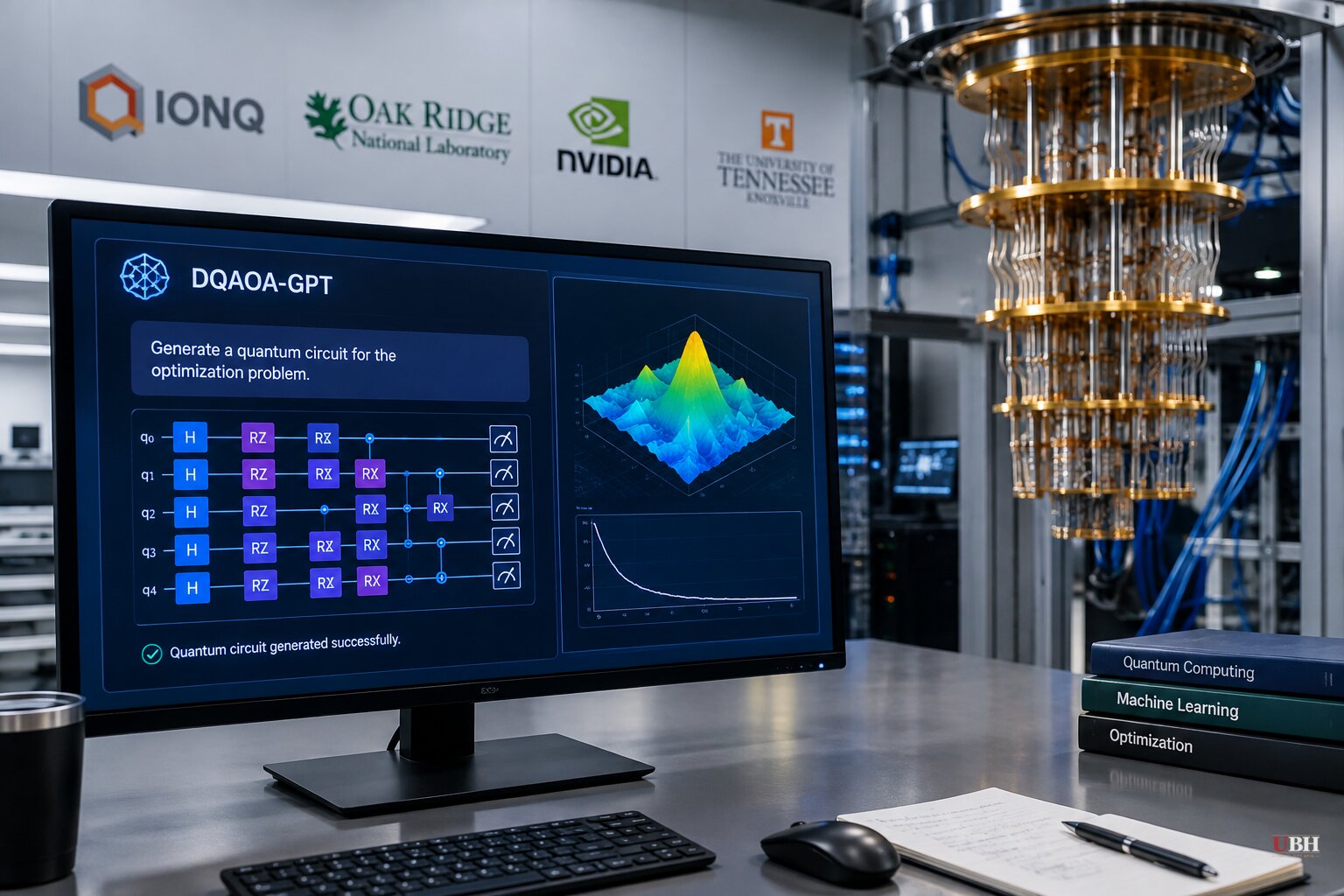
IonQ, Oak Ridge National Laboratory (ORNL), Nvidia and the University of Tennessee, Knoxville built a system called DQAOA-GPT that tries to skip the loop entirely. Instead of tuning circuit parameters step by step, the team trained a generative model, a transformer, the same architecture behind large language models, but trained on quantum circuits instead of text, according to Stock Titan.
The training process itself still used the old trial-and-error method. Researchers ran it across many sampled problems, kept only the near-optimal circuits that resulted, and fed those as examples to the transformer. Once trained, the model generates ten candidate circuits per subproblem in a single pass, simulates and scores all ten, and picks the best one to update the overall solution, per Stock Titan.
The Numbers
The team tested the approach on dense Higher-order Unconstrained Binary Optimization problems with up to 100 decision variables, a class of problem that is notoriously hard for quantum solvers, according to Crypto Briefing.
Under the prior state-of-the-art method, circuit-finding time rose from about 34 seconds on 4 qubits to more than 11 minutes on 12 qubits, Stock Titan reported. The generative approach held runtime near 28 seconds across every size tested. Solution quality roughly doubled as the subproblems grew larger, per the same report.
"Better answers in hybrid quantum optimization have traditionally come with a steep tuning tax," said Dr. Martin Roetteler, IonQ's Vice President of Quantum Applications R&D and a co-author of the paper, according to Stock Titan. "Take that cost away and you can work at the size where the answer is meaningful."
The paper was posted to arXiv in July 2026 and was recognized at IEEE Quantum Week (QCE26) in Toronto, according to Crypto Briefing, which reported it placed third out of 857 submissions at the conference.
Context: A Big Week for IonQ
DQAOA-GPT was one of nine peer-reviewed papers IonQ presented at QCE26, held at the Metro Toronto Convention Centre, according to press materials distributed by financialcontent, The Quantum Insider and Investing News Network, all of which carried near-identical accounts of IonQ's conference slate. IonQ (NYSE: IONQ) picked up four Best Paper awards at the event, a rare haul in a single year at the field's flagship conference.
Among the other award-winners: a protein-folding paper, done with Kipu Quantum, that scaled quantum optimization to 61-qubit instances on IonQ's Tempo hardware and matched classical reference energies in four of six test sequences. A separate paper on quantum parity representations reported accuracy gains of up to 41.7 points while keeping the deployed inference model fully classical.
Separately, and on a different track, ORNL hosted its own 2026 Southeastern Quantum Conference, bringing together national lab, industry and academic researchers on quantum networking, sensing and computing. Travis Humble, director of ORNL's Quantum Science Center, told attendees that "the question is no longer simply how to build quantum computers, it's how we use them," framing hybrid quantum-AI-supercomputing workflows as the path to practical scientific impact. That conference also referenced the Department of Energy's Genesis Mission, part of the federal push to keep U.S. quantum research ahead of foreign competitors.
What's Still Unproven
Everything reported here, including the 28-second benchmark and the 100-variable HUBO tests, was run in simulation, not on live quantum hardware at that scale. IonQ's own materials describe DQAOA-GPT as a "potential path toward scaling hybrid quantum optimization," language that signals a research result, not a deployed product.
The open question is whether the cost savings hold up when the generated circuits are actually run on noisy trapped-ion processors rather than simulated, and whether the training data problem, needing thousands of trial-and-error runs up front to teach the model, becomes its own bottleneck at larger scales. IonQ has not announced a timeline for testing DQAOA-GPT on production hardware beyond the benchmarks presented at QCE26.
Sources
Crypto Briefing, Stock Titan, financialcontent, The Quantum Insider, Investing News Network, Oak Ridge National Laboratory (ORNL)
Sources used for this briefing
This briefing was written by UBH's AI agent — these are the reporting inputs it draws on, linked so you can verify.


