
Unbiased headlines. Facts, not spin.
Unbiased Headlines is an independently owned news organization. We bring you the facts, not opinions, written fresh from 110+ named sources. Sources linked so you can verify it yourself.
 health
Low Interest (4/10)
Event date: October 16, 2026 ·
PETA video shows infant monkeys in University of Washington neurotoxin experiments; UW says the study ended in 2020
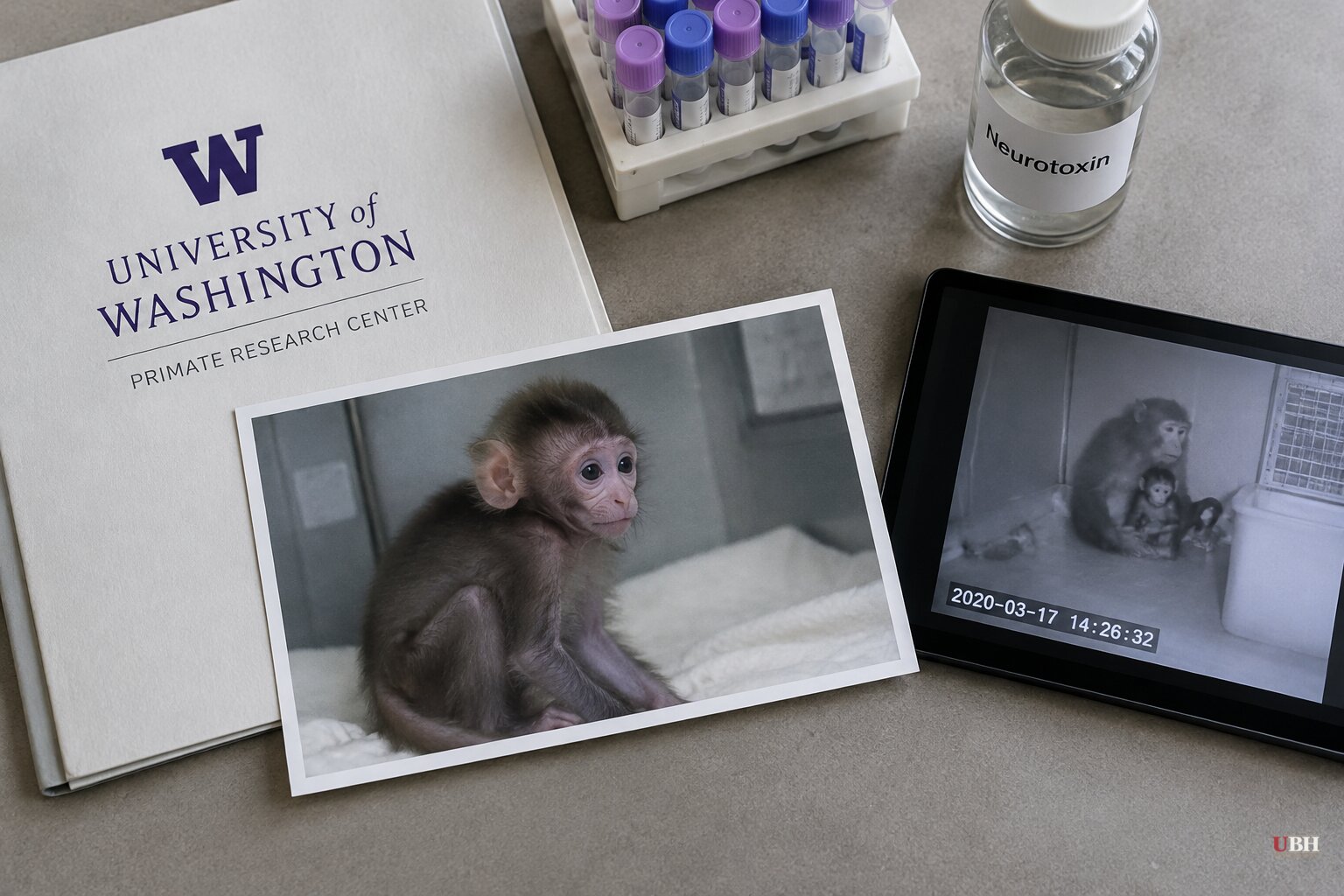
Since Oct. 12, a video from the University of Washington's primate center has been circulating. The footage shows infant macaques, some only two days old, on metal lab tables with shaved heads and electrodes attached. It was released by PETA, which says it got the material through a public records request that took about seven months.
The experiments on screen are not new. They were part of a project on the developmental neurotoxicity of domoic acid, a marine toxin that builds up in shellfish and can sicken people. The project ran from 2014 to 2020.
What the footage and records show
Researchers gave daily doses of domoic acid to 32 pregnant macaques, according to records cited by The Guardian. Of the infants born, 28 were taken from their mothers, bottle-fed and kept in incubators. They were housed individually at three weeks old.
The video shows the babies clutching blankets, sucking their fingers and screeching as technicians test reflexes and memory. Some tests ran for months, and some animals were followed for years. PETA says the monkeys were killed once the experiments ended.
The project received more than $4.2 million in National Institutes of Health funding. That is federal money, which means taxpayer money.
The university's position
UW does not dispute that the footage is hard to watch. Dr. Sally Thompson-Iritani, the university's assistant vice provost for animal care, told Fox 13 Seattle she has watched it several times.
"I do understand the reaction that people are feeling, and I do think that it is hard to watch," she said. She added that the images alone do not explain why the work was done.
According to Thompson-Iritani, the research examined what can happen to developing offspring when pregnant animals are exposed to substances including methylmercury and domoic acid. Both can enter the human food supply through seafood. University officials say animal research has produced information about risks to human health that could not always be obtained through other methods.
The primate center told The Guardian that research involving infant animals "raises important questions about their wellbeing." It said its veterinary and animal care staff have specialized expertise in primate care, including nursery rearing. The center also says there are no current infant studies.
The NIH said all animals in NIH-supported research are protected by laws, regulations and policies meant to ensure the smallest possible number of animals is used and that their welfare is prioritized.
PETA's case
PETA wants the center shut down. Dr. Lisa Jones-Engel, the group's chief science adviser on primate issues, spent 17 years at UW and has worked as a primate scientist for about 35 years.
"It doesn't really matter that these experiments happened six years ago, because experiments with infant newborn macaques continue to occur and to happen at the University of Washington," she told Fox 13. PETA argues that advances in technology have made primate use unnecessary.
PETA's release says UW "did not stop experimenting on baby monkeys" after 2020 and that babies continue to be taken from their mothers and deliberately infected with diseases. It offered no documents for those claims in the release. PETA also calls the center's recent renaming a rebrand. UW says the new name, Washington National Biomedical Research Center, reflects a broader mission.
Dr. Malene Hansen, a long-tailed macaque expert quoted by The Guardian, said infant macaques have long-term maternal care needs and cannot thrive without their mothers. "It is unethical to conduct research that separates infant macaques from their mothers. Period," she said.
The records fight
PETA says the university has long resisted releasing material about the center. It points to a 2021 ruling in a PETA lawsuit, in which a King County Superior Court found that UW violated the Washington Public Records Act. PETA says the court found the university routinely destroyed photos and videos and failed to adequately search for records related to the primate center.
That history is why this footage is described as the first filmed look at experiments at the center. UW has not publicly responded to the characterization that it sought to keep such material out of view.
What is still open
The two sides are talking past each other on the central factual question. PETA says newborn macaques are still being used at UW. The center says it has no current infant studies. No inspection, ruling or public record has been cited that settles which description is accurate.
What is documented is narrower. A six-year, $4.2 million federally funded project separated infant macaques from their mothers to test a seafood toxin. It ended in 2020. Whether UW's current primate protocols include newborn animals, and what they involve, is the question PETA's push to close the center now turns on.
Sources used for this briefing
6 links from 5 independent newsrooms (syndicated copies of the same report count once)
These are the sources it draws on, linked so you can verify.


