
Unbiased headlines. Facts, not spin.
Unbiased Headlines is an independently owned news organization. We bring you the facts, not opinions, written fresh from 110+ named sources. Sources linked so you can verify it yourself.
 defense
Major Story (8/10)
Event date: October 28, 2026 ·
Pentagon Puts Iran War Cost at $47.1 Billion, Excluding Gulf Base Repairs, as Study Questions Gulf Defenses
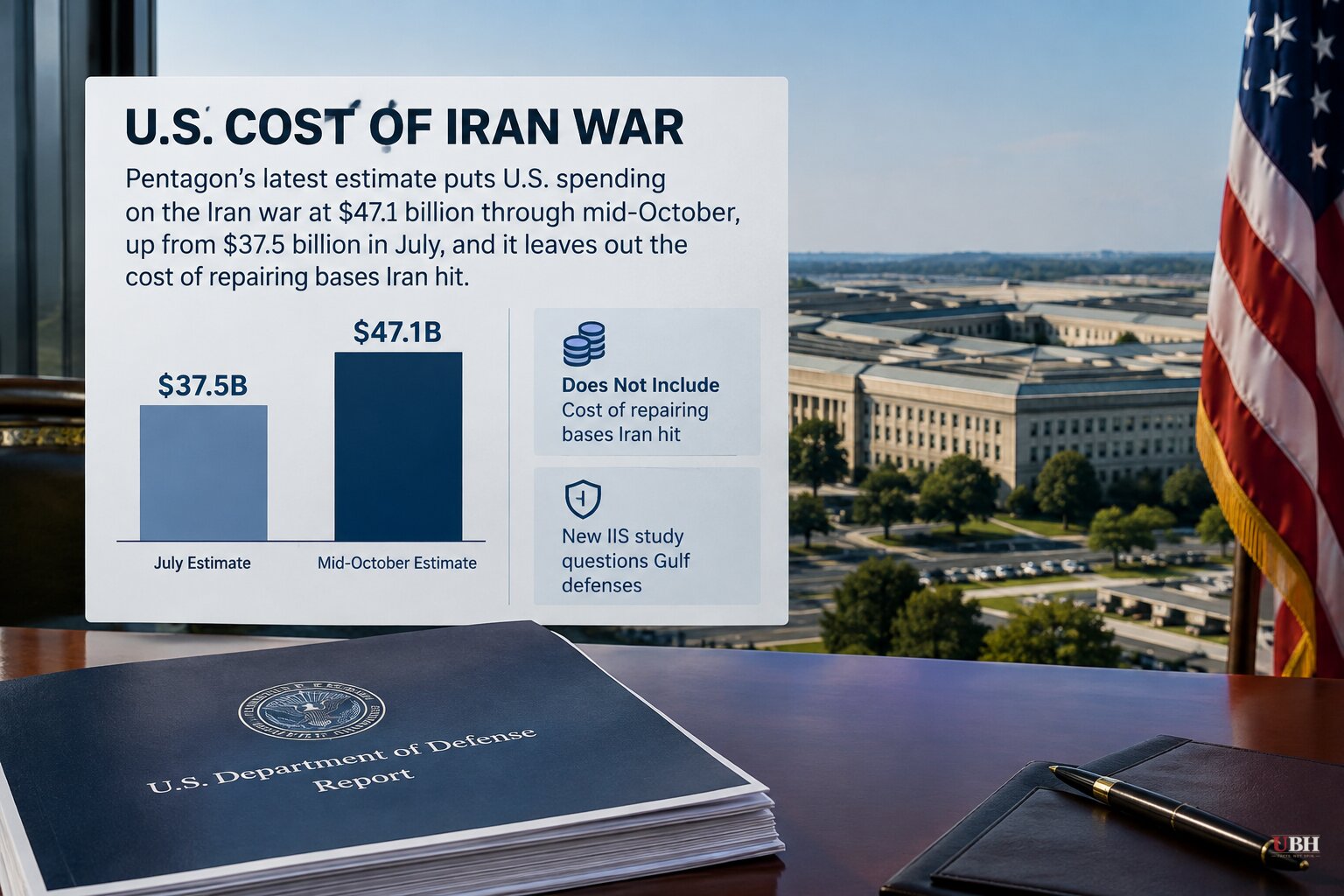
The U.S. war with Iran has cost at least $47.1 billion, according to Pentagon figures provided to lawmakers and disclosed Wednesday, Oct. 28. The estimate is dated Oct. 16.
That number does not include repairs to American bases in the Middle East damaged by Iranian missiles and drones. The final bill is higher, and nobody in the Pentagon has said by how much.
Where the money went
US Central Command's breakdown: roughly $29 billion to replenish expended munitions, $6.1 billion to replace lost equipment, and $11.9 billion in other operating costs, including support for deployed personnel.
The figure has climbed fast. Defense Secretary Pete Hegseth told lawmakers in July the war had cost about $37.5 billion. By early September the military's estimate was $43.6 billion. That is an increase of more than 25% since July.
The nonpartisan Congressional Budget Office put the cost at about $38 billion through Aug. 1 and projected another $2 billion to $3 billion a month, depending on intensity. The CBO also said the Pentagon had not supplied information it requested for its analysis. The Pentagon did not respond to Reuters' request for comment on the latest figures.
The U.S. and Israel struck Iran on Feb. 28. American forces leaned heavily on expensive precision-guided weapons early on. An April 8 ceasefire let Tehran recover some buried weapons and restore parts of its air defenses, which complicates any renewed attack.
The $29 billion munitions line is the number that should worry planners. Interceptors and precision weapons are costly and slow to replace, and every one fired at Iran is not available for other commitments.
The Gulf defense picture
A study from the International Institute for Strategic Studies lays out what Iran threw at its neighbors. In the weeks before the April 8 ceasefire, 12 regional states, overwhelmingly in the Gulf, faced 4,670 Iranian one-way attack drones and more than 1,400 ballistic missiles. Nearly half were aimed at the United Arab Emirates.
Most were intercepted. One estimate cited in the report puts damage to energy infrastructure as high as $58 billion.
The IISS says Gulf states' trillion-dollar purchases of U.S. weapons "not only" failed to translate into U.S. protection at the crucial time, but left their own militaries "not adequately prepared for the new kind of attritional air war." It lists the gaps: reliance on U.S.-supplied air and missile defense, no real regional integration, a shortage of minesweeping capability, limited retaliatory options, and the cost of using expensive high-end systems against cheap drones and missiles.
The report goes further on the U.S. presence itself. It says American bases and defense partnerships "have provided Iran with another pretext for attacks against the Gulf states," and that Gulf public opinion of the U.S. has shifted "from security provider to strategic liability."
The IISS also warns that any U.S. drawdown would be portrayed by Iran as "a strategic success and vindication of its steadfastness." Tehran would use it, the report says, to embarrass Gulf states over their decades-long courtship of U.S. protection. The institute takes no position on whether Gulf states should seek a new non-aggression pact with Iran.
Rebuild or relocate
Sen. Chris Murphy, a Connecticut Democrat on the Senate Foreign Relations Committee, said a debate is under way inside the U.S. military over whether to rebuild the damaged Gulf bases. Gulf leaders, he said, "want us to rebuild" and keep a presence in the region.
Murphy questioned the logic. He asked what good a base is for protecting American interests if it is knocked out within 24 hours of a hot war starting. He suggested a smaller footprint or relocation farther from Iranian missiles, such as in the eastern Mediterranean.
That is one senator's account of an internal debate. The Pentagon has not announced any decision on the bases.
Diplomacy has not moved the blockade
President Trump has imposed a naval blockade meant to choke off Iranian oil exports. Iran says the U.S. must lift it before peace talks can begin. Washington wants concessions on Iran's nuclear program.
Iran's Supreme Leader Mojtaba Khamenei has called for an end to the state of "neither war nor peace," according to Iranian state media, and described the moment as a "crossroads." Reuters reported, citing an unnamed official briefed on the talks, that Qatari mediators floated a seven-day plan of daily confidence-building steps. An Iranian official told Reuters the ideas "did not amount to an offer."
Trump has defended the war. At a rally in Ohio, he said Iran started it in 1979 and claimed Iranian drone production is suffering because the country lacks electricity. His claim about Iran's electricity and drones is his own; no independent figure on Iranian output was provided.
U.S. officials told Reuters the Pentagon has prepared options for renewed large-scale combat if the president orders it. That would add to a bill that has already outrun every earlier estimate.
What comes next
Congressional elections are Nov. 3, less than a week away, with rising energy prices adding political pressure on Trump and Republicans. Benchmark U.S. crude was trading above $100 a barrel in recent sessions, per Reuters.
The open questions are specific. What will base repairs cost, and will Congress get a full accounting of military construction and force-protection spending? The Pentagon has not answered either.
Sources used for this briefing
7 links from 6 independent newsrooms (syndicated copies of the same report count once)
These are the sources it draws on, linked so you can verify.


