
Unbiased headlines. Facts, not spin.
Unbiased Headlines is an independently owned news organization. We bring you the facts, not opinions, written fresh from 110+ named sources. Sources linked so you can verify it yourself.
 health
Notable (6/10)
Event date: October 28, 2026 ·
Oyster Salmonella Outbreak Reaches 27 People in 12 States, Butter Recalled in 10, Organ Donation Rules Change Nov. 18
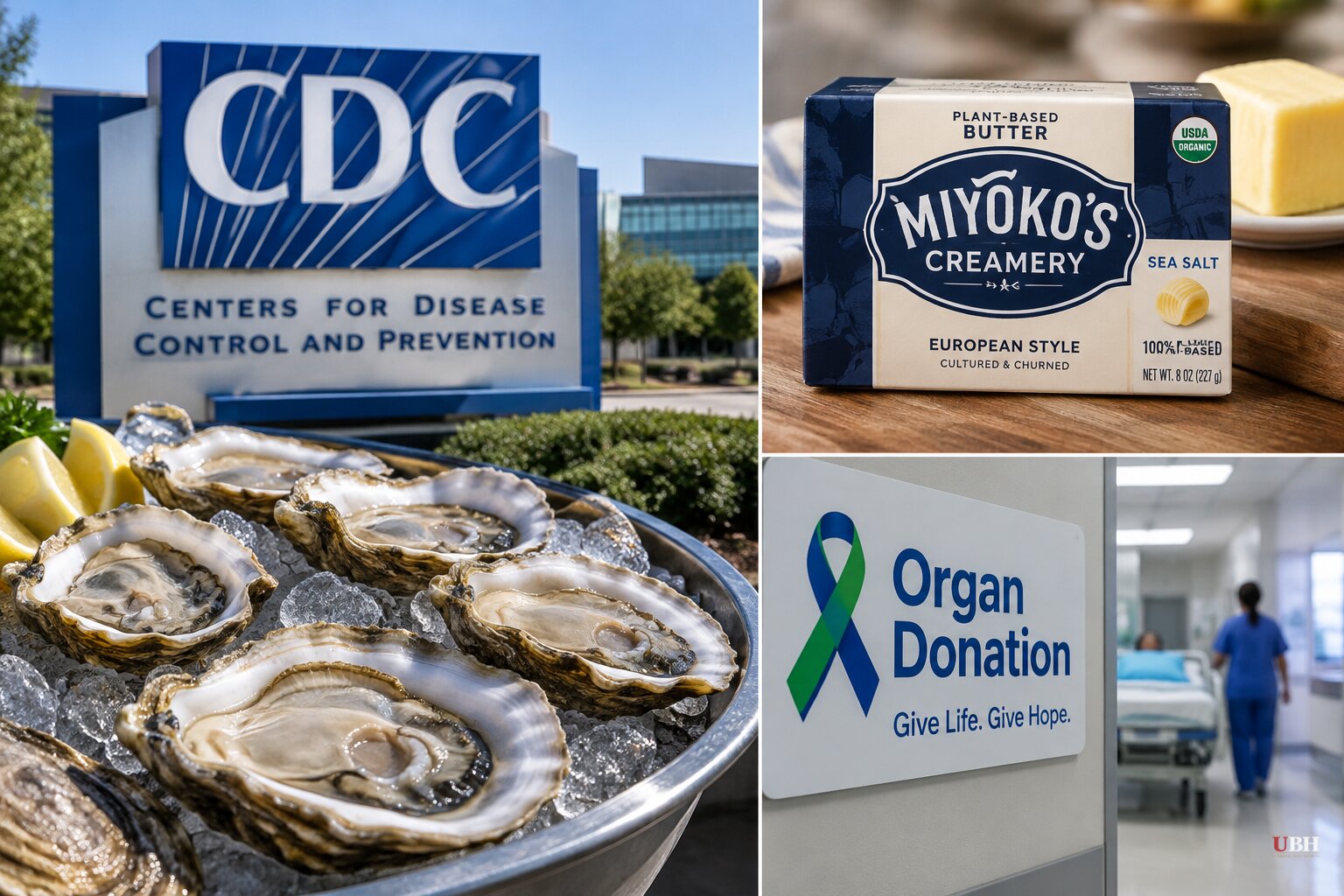
Oysters: 27 sick, 5 hospitalized
The Centers for Disease Control and Prevention said in an Oct. 19 update that raw oysters harvested by the Little Wicomico Oyster Company in Virginia's Little Wicomico River area are tied to a multi-state Salmonella outbreak. The agency counts 27 illnesses across 12 states, five hospitalizations and no deaths.
Pennsylvania has the most cases with eight, followed by New York with four and Virginia with three. Cases were also reported in New Jersey, Maryland, Indiana, Kentucky, Illinois, Colorado, Iowa, Florida and Connecticut.
The company announced a voluntary recall of its raw oysters on Oct. 9. According to a Virginia Department of Health notice, the oysters were harvested from Sept. 18 through Oct. 8. Virginia officials also shut down the harvest area as a precaution.
The Food and Drug Administration said the oysters went to retailers in California, Colorado, Connecticut, Florida, Georgia, Illinois, Maryland, Missouri, North Carolina, New Jersey, Nevada, New York, Pennsylvania, Texas and Virginia, plus Washington, D.C. Pennsylvania's Department of Agriculture first detected the outbreak, the FDA said.
The CDC's instruction is blunt: "Do not eat, sell, or serve recalled oysters." The FDA also told anyone who handled the product to clean and sanitize surfaces and containers that touched it. The company says it has stopped harvesting in the affected area and is cooperating with health officials. Oysters from other Virginia growing areas are not part of the recall.
Most Salmonella patients recover within a week without treatment, according to the Mayo Clinic. It warns the infection can be more severe for infants, young children, older adults, pregnant women and people with weakened immune systems.
Butter recall: 1,304 cases
Separately, the FDA lists a recall of Miyoko's Creamery European Style Salted Plant Milk Butter, made by Prosperity Organic Foods, Inc. in Boise, Idaho. The reason given is contamination concerns involving yeast, mold and E. coli.
The recall covers 1,304 cases of 8-ounce packages sold in Connecticut, Florida, Georgia, Iowa, Illinois, Indiana, Maryland, New Jersey, New Hampshire and Wisconsin. The FDA classified it Class II, meaning exposure "may cause temporary or medically reversible adverse health consequences or where the probability of serious adverse health consequences is remote."
The FDA did not release expiration dates or identifying details. Customers who have the butter should stop using it and return it for a refund.
Other infectious-disease items are also on the board. CDC data show the cumulative national flu hospitalization rate is the highest for this point in the season in 16 years. The Department of Agriculture reported the first New World screwworm detection in Arizona, a confirmed case in a dog.
Healthcare costs and the Nov. 3 vote
Healthcare ranks second among voter concerns heading into the midterms, according to Gallup. Half of respondents called it extremely important and 27% very important.
A KFF poll from September found six in ten registered voters worry about affording care, tying healthcare with gasoline prices as the top economic concern. A Morning Consult poll of 2,022 registered voters commissioned by the Healthcare Financial Management Association found 54% said healthcare became less affordable this year. Some 83% of Democrats and 61% of Republicans said affordability will affect their vote. Another 57% expressed concern about hospital closures.
The HFMA is urging providers, insurers, employers and fintech leaders to sign a declaration to stop blaming each other for rising costs. Richard Gundling, the group's chief mission impact officer, said cost-shifting is not savings. "If an employer lowers its costs by increasing employees' deductibles, the bill hasn't gone away, the employee is paying more of it," he said.
On the political front, Rep. Frank Pallone Jr. (D-N.J.) asked the Government Accountability Office to review the TrumpRx platform and determine how much money it has actually saved Americans. The request itself is not a finding. The saving claim itself remains unaudited in public.
A new law is expected to require pharmacy benefit managers to disclose granular details on what they pay for drugs and the payments they receive from drugmakers, according to the Wall Street Journal. Separately, the New York Times reported that after industry lobbying, the Trump administration will let products containing a kratom-derived opioid stay on the market up to a certain level.
Organ donation: the firewall comes down
The Organ Procurement and Transplantation Network, which runs the U.S. transplant system, will relax a strict barrier between the doctors and nurses treating a patient and the team waiting to procure organs. Its board voted Aug. 20, and the rules take effect Nov. 18.
Until now, no one from the procurement team was supposed to speak with family members until they had decided to withdraw life support. The rule was meant to prevent pressure that could alter a patient's care and to dispel doubts that doctors are doing everything they can.
The change is part of new guidelines for donation after circulatory death, which now accounts for about half of donations. The policy will "allow discussions for organ donation to take place once end of life discussions are taking place with the potential deceased donor's agent."
Dr. Raymond Lynch, director of transplantation at the Health Resources and Services Administration, which oversees the network, defended the change. "Insisting on a bright line without focusing on what's happening on either side of that line is a false sense of security," he told NPR.
Lynch said the package is meant to prevent errors that have occurred, including patients wheeled into operating rooms for organ removal while still alive. It also makes it easier to pause retrieval if anyone sees a problem and standardizes testing used to determine death.
Critics worry the loosened firewall could endanger patient care, NPR reported. The rules take effect Nov. 18, 15 days after Election Day.
Sources used for this briefing
7 links from 7 independent newsrooms (syndicated copies of the same report count once)
These are the sources it draws on, linked so you can verify.


