
Unbiased headlines. Facts, not spin.
Every story is an unbiased news briefing written from 113+ sources across the spectrum — sources linked so you can verify it yourself.
 politics
Notable (6/10)
Event date: September 25, 2026
politics
Notable (6/10)
Event date: September 25, 2026
Orange Order Marches Down Garvaghy Road for First Time Since 1998, Protesters Block Portadown Route
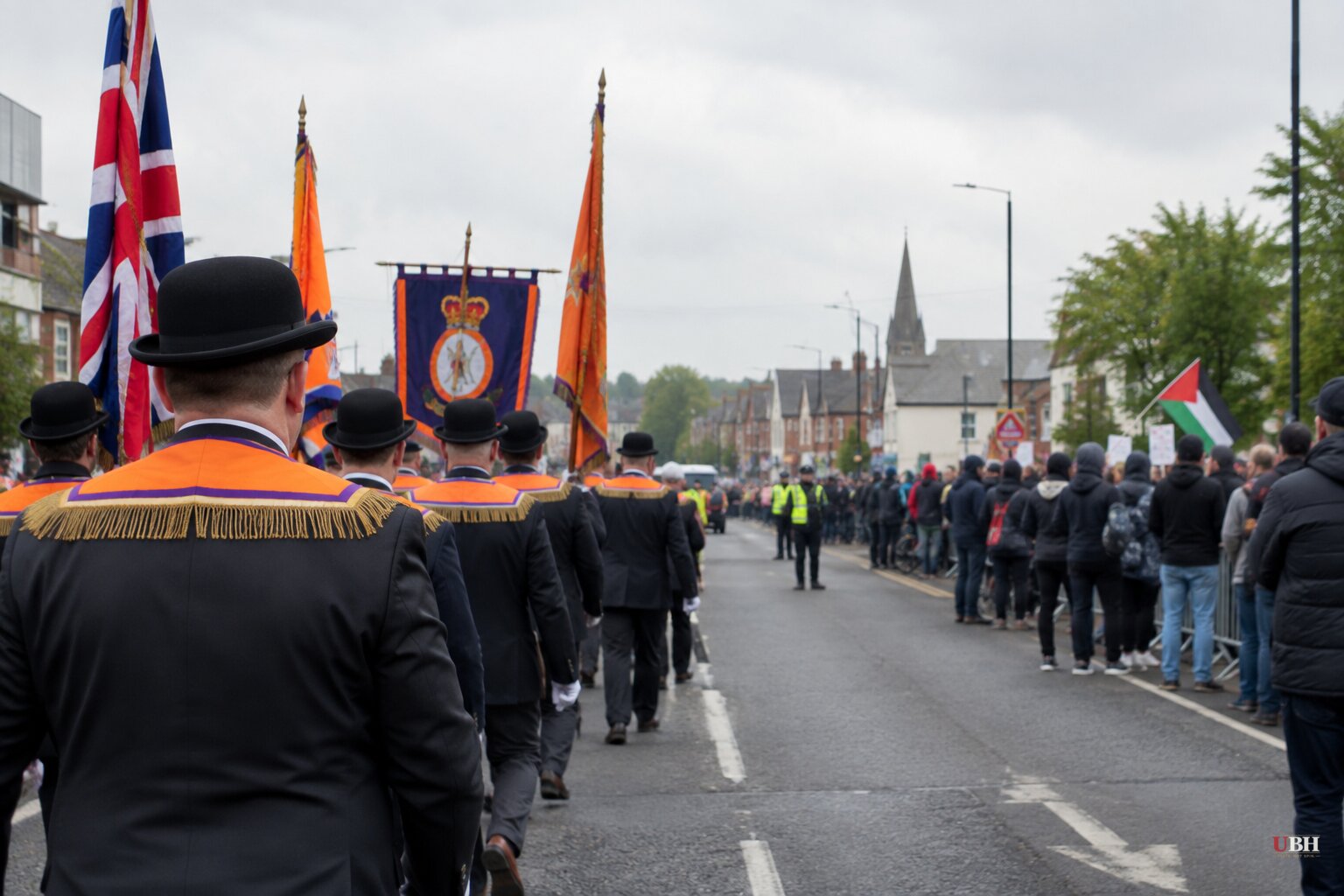
Thousands of protesters, some wearing balaclavas, blocked the Garvaghy Road in Portadown on Sunday morning to try to stop a small Orange Order parade from marching through the mainly Catholic area for the first time since 1998, according to CBS News, the Associated Press, and Al Jazeera.
The march went ahead anyway after Belfast's High Court cleared it in a sitting that concluded at 2:15 a.m. Sunday, according to Europe Says and CBS News. The Police Service of Northern Ireland's Chief Constable, Jon Boutcher, said there were no signs of violence or disorder as of Sunday morning, though he called on "those with influence to encourage people to comply with the law."
How It Got Here
The Garvaghy Road route was one of the most contentious flashpoints of the Troubles, the three decades of sectarian violence that killed roughly 3,600 people and wounded some 50,000 before the 1998 Good Friday Agreement, according to CBS News and the Daily Wire. Annual Orange Order marches down the road during the Drumcree parade triggered unrest for years until the route was banned in 1998, according to Reuters reporting carried by WHBL. That standoff once required British troops to lay razor wire across fields to keep the two sides apart.
An initial decision this year by Northern Ireland's Parades Commission to restrict the 2026 march was thrown out by the High Court in August over a procedural error, Reuters/WHBL reported. The Orange Order, which brought that legal challenge, then reapplied for a scaled-back parade. On Sept. 25, the Commission approved it with tight conditions: no more than 35 participants, a start by 8 a.m., a finish by 9:30 a.m., and no supporting bands or crowds. The Orange Order had wanted 60 marchers in an afternoon parade. Residents appealed to the Commission not to allow it at all, arguing the dispute over the route was settled decades ago.
That approval nearly unraveled again this weekend. A temporary injunction blocked the march on Saturday before Northern Ireland's Court of Appeal overturned it, clearing the way for Sunday's parade, according to Al Jazeera.
A Split Response
Northern Ireland First Minister Michelle O'Neill of Sinn Féin, who attended the counterprotest on Garvaghy Road, said the court's decision "brings into question how this whole peace process works" and accused unionists of trying to "drag us backwards," according to CBS News. Sinn Féin president Mary Lou McDonald was blunter, telling reporters the situation was "primitive treatment of any community in the year 2026" and calling it intolerable, according to Al Jazeera. Both women urged the British and Irish governments to intervene.
DUP leader Gavin Robinson took the opposite position, arguing the rule of law can't be conditional on which side likes the outcome. "Our institutions are founded on respect for the police, the courts and the rule of law," he said, according to CBS News. When the Parades Commission first approved the restricted march on Sept. 25, Robinson called it overdue: "We are in 2026 and Orangemen walking silently and peacefully down a road should not be a major issue in a shared society," he told Reuters/WHBL.
British Prime Minister Andy Burnham called for "calm on all sides," saying Northern Ireland has made "big gains" that shouldn't be reversed, while Northern Ireland Secretary Chris Bryant told the BBC, "I wish we weren't in this position — I wish we weren't looking at relitigating things of the past."
Nationalist concern here reflects genuine history. Garvaghy Road residents lived through years of standoffs, and reopening a route banned specifically to keep the peace reads to them as reopening old wounds, regardless of how few marchers show up or how tightly police restrict the timing. The Parades Commission and two levels of courts all signed off on this exact, scaled-down version of the march, and Boutcher's police force reported zero violence. The legal process ran its course. Whether that satisfies people who feel the process itself shouldn't have been available is a separate question the courts didn't answer.
The Wider Backdrop
The parade lands amid renewed noise about the constitutional future of the United Kingdom's four nations. On Sept. 14, O'Neill joined Scotland's First Minister John Swinney and Wales's Rhun ap Iorwerth in Cardiff to sign a memorandum calling for independence referendums, with Swinney describing Burnham as the "last prime minister of the United Kingdom," according to the Epoch Times. Two days earlier, in Dublin, President Trump told reporters he would "love to see" a united Ireland, calling it "going to happen eventually," comments the Daily Wire noted broke with decades of American neutrality on the issue. Robinson rejected that framing too, writing that Northern Ireland's future "will be decided by the people of Northern Ireland, not by commentary in London, Dublin or Washington." None of the sources link Trump's remarks or the Cardiff memorandum directly to Sunday's parade or the court fight over it. They are separate developments unfolding in the same political season, not cause and effect.
The Parades Commission's approval covers only this year's Sept. 27 march. The Orange Order would need to reapply for any future parade down Garvaghy Road, meaning Sunday's outcome settles one Sunday, not the underlying dispute.
Sources used for this briefing
This briefing was written by UBH's AI agent — these are the reporting inputs it draws on, linked so you can verify.


