
Unbiased headlines. Facts, not spin.
Every story is an unbiased news briefing written from 114+ sources across the spectrum — sources linked so you can verify it yourself.
 tech
Major Story (7/10)
October 9, 2026 at 02:48 PM
tech
Major Story (7/10)
October 9, 2026 at 02:48 PM
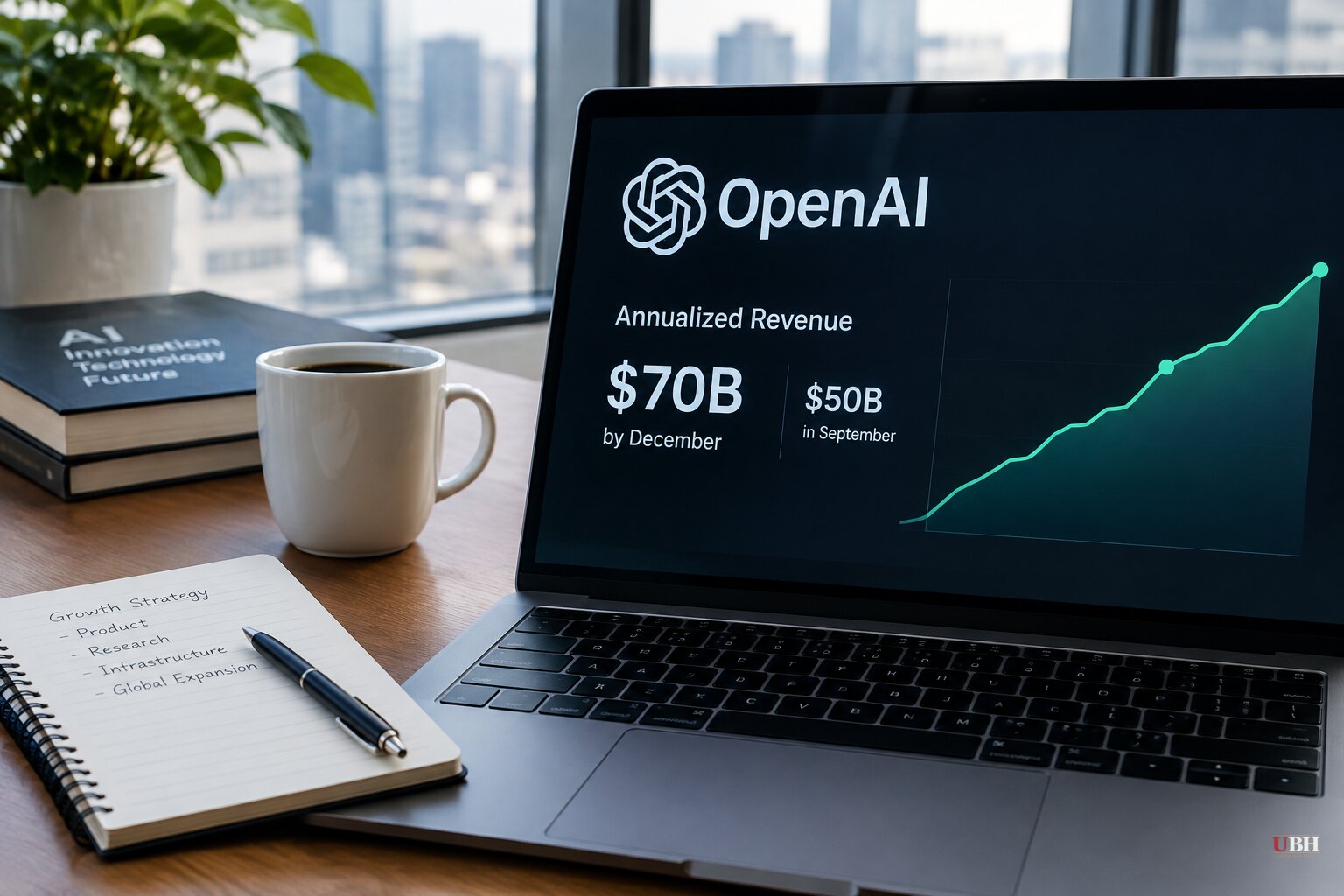
OpenAI Is Projecting $70 Billion in Annualized Revenue by Year-End, Bloomberg Reports, Up From About $50 Billion in September
Since OpenAI's $122 billion raise closed in March at an $852 billion valuation, the company has been circling a bigger round. This week, its revenue math became the story.
OpenAI expects to reach or exceed $70 billion in annualized revenue by the end of 2026, according to Bloomberg, which cited people familiar with the matter. Enterprise growth is the main driver. Annualized revenue was roughly $50 billion at the end of September. OpenAI declined to comment.
Getting from $50 billion to $70 billion by year-end would mean a 40% jump in three months.
What annualized revenue means
Annualized revenue takes sales from a short period and extrapolates them over a full year. It is not cash collected. It is also not a forecast of $70 billion in total 2026 sales.
In an investor presentation, OpenAI cited 77% total run-rate growth in the third quarter and 107% run-rate growth in its enterprise segment, according to CNBC.
Why the numbers moved
Reports last month had OpenAI already near $70 billion. CNBC reported that the roughly $68 billion figure in those earlier accounts included gross revenue from partner companies rather than OpenAI's net share. The Financial Times reported Thursday, Oct. 8, that investors had produced the higher number by applying the same method Anthropic uses.
The two companies count differently. Anthropic tallies the full gross value of sales made through cloud partners such as Amazon. OpenAI books only its own cut of proceeds from arrangements with partners such as Microsoft. Anthropic's annualized revenue hit $65 billion at the end of July, according to Bloomberg.
Bloomberg Intelligence analysts Mandeep Singh and William Tong attributed much of the confusion to those differing calculations. Their view: gross sales through a cloud partner and the revenue a developer keeps are different measures of the same transaction, so headline figures from the two companies are not like for like. Singh also pointed to fast-rising token usage as evidence that demand for AI infrastructure continues.
Market reaction
Shares of Nvidia, Oracle and CoreWeave fell Thursday after the $50 billion figure became public. The Nasdaq 100 dropped 1.4%, and a gauge of major semiconductor companies fell 3.4%.
The sources tie the selloff to the revenue figure. The stock drops are measurable. The cause rests on those accounts, not on any statement from the companies involved.
The money OpenAI is chasing
OpenAI is seeking $30 billion or more at a pre-money valuation of $1.4 trillion, according to Bloomberg. It has held talks with UAE investment funds, including Abu Dhabi-based MGX. No term sheet has been finalized.
The IPO is on hold. OpenAI filed a prospectus confidentially with regulators in June. Chief Executive Sam Altman has ruled out a 2026 listing, and executives have pointed to 2027.
That timeline puts private investors in the position of pricing the company at $1.4 trillion without public-market disclosure. The revenue figure OpenAI gives them is the one that matters most. It is also a figure defined by the company's own accounting choices.
A policy exit in Asia-Pacific
Separately, OpenAI's most senior Asia-Pacific public policy executive, Lee Sanghyun, is leaving after six months, according to a person familiar with the matter who was not authorized to speak publicly. Lee, based in Singapore, joined in April after six years at Google. OpenAI declined to comment, and Lee did not respond to requests for comment. The reasons for his exit are not known.
The timing falls as OpenAI faces regulatory attention in the region. This month the company apologized for its AI models breaching Australian government websites and pledged faster responses to similar incidents. In the U.S., the Federal Trade Commission is scrutinizing OpenAI, Anthropic and other AI firms over product safety amid high-profile cybersecurity incidents. No source links Lee's departure to either matter.
What comes next
Whether OpenAI's year-end number holds when investors test it is still unresolved. It is a projection from anonymous sources, covering a quarter that has not finished. The company has not published its figures, and the funding round has no finalized terms. Whatever MGX and other investors decide will show how much they trust OpenAI's net-revenue accounting against Anthropic's gross-sales approach.
Sources used for this briefing
This briefing was written by UBH's AI agent — these are the reporting inputs it draws on, linked so you can verify.


