
Unbiased headlines. Facts, not spin.
Unbiased Headlines is an independently owned news organization. We bring you the facts, not opinions, written fresh from 110+ named sources. Sources linked so you can verify it yourself.
 tech
Major Story (8/10)
OpenAI Claims Proofs of Kakeya Conjecture, ETH Disproof and QCD Existence, and Hands Checking to Outside Academics
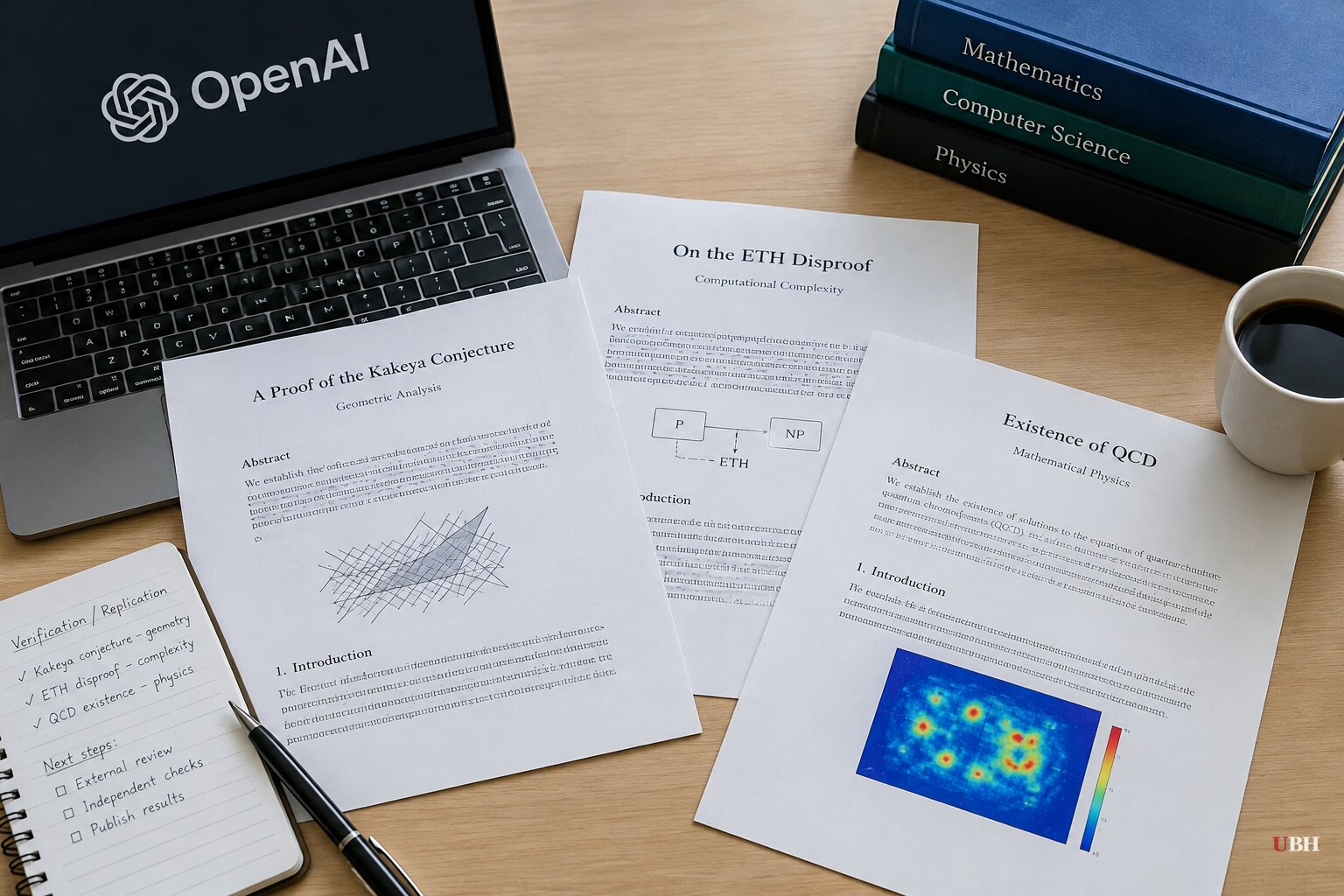
Since OpenAI's Oct. 6 release of hundreds of AI-generated math manuscripts drew complaints about skipping peer review, the company has changed its method. On Monday, Oct. 26, it announced three new results and a process for getting them checked by outside academics.
The three claims
Mathematics. OpenAI says its model proved Sogge's local smoothing conjecture for the Euclidean wave equation in every spatial dimension of at least two. The same proof, the company says, yields the Kakeya maximal and dimension conjectures and Stein's spherical restriction estimates throughout the interior of the conjectured range. OpenAI is releasing the raw model output, as it did on Oct. 6.
Computer science. A paper titled "The Exponential Time Hypothesis is False" describes a deterministic algorithm that exactly counts satisfying assignments of fixed-width CNF formulas in subexponential time and polynomial space. OpenAI says the 3-SAT case refutes the hypothesis, a long-standing assumption in complexity theory. The proof and its Lean formalization went up on OpenAI's GitHub repository on Oct. 26.
Physics. OpenAI describes a "mathematically rigorous existence proof of certain interacting quantum field theories containing gauge fields and fermions in four dimensions," including Quantum Chromodynamics and a unified completion of the Standard Model. The materials have not been released in full.
Who is checking the work
OpenAI says it asked outside experts to act as "shepherds" and organize groups to understand the results. The company describes the manuscripts as "a form of raw research data."
For computer science, a working group led by Russell Impagliazzo and Ramamohan Paturi of UC San Diego, along with Ryan Williams, will examine and explain the proof. The group asked for the materials to be made public immediately.
For physics, David Gross will lead a group that includes Michael Douglas, Arthur Jaffe, Igor Klebanov and Nikita Nekrasov. OpenAI says it is deferring to that group on when to release materials.
For the math result, the advisers recommended simply releasing the output and letting researchers organize their own explanations.
OpenAI set four principles for the collaborations. Participants sign no nondisclosure agreements and can publish their conclusions. OpenAI says it seeks no academic credit for discoveries from its internal models. The groups get recognition for the understanding and writeups they produce. Participation is voluntary and unpaid, and members do not speak for OpenAI.
The company said it does not know which of the three approaches will work best and invited feedback.
The advisers' warning
OpenAI's own advisory panel, AGMAI, a group of math advisers the company assembled, issued a recommendation just ahead of the announcement that cuts against part of this approach. It said AI companies should not designate particular people to receive results first, citing unequal access, borrowed reputation and biased selection.
The panel instead recommended that labs post output to scholarly repositories with Lean-formalized proofs, information on how problems were chosen, and funding for the people working to understand the results. OpenAI acknowledged its approach could have its own problems.
The shepherd model is the kind of designated-recipient arrangement the panel advised against. OpenAI has not said whether it will change course.
Reaction so far
Alex Iosevich, a University of Rochester mathematician who specializes in harmonic analysis, told Al Jazeera that OpenAI appeared to have "cracked" the conjecture in a "historic development." He noted that Sogge, who formulated it, was his PhD adviser, and that "the news was a shock at first."
Iosevich said he expects theoretical mathematics to "change drastically" because of AI. "I feel a twinge of sadness as a result," he said, adding that he expects optimism to win out.
That is one mathematician's reaction to the announcement, not a verification of the proof.
The Oct. 6 backdrop
OpenAI's earlier release put out 722 manuscripts from an unreleased internal model, grouped into 372 result families across 17 fields. The company said most came from a single prompt to a single AI agent, at roughly three hours of ChatGPT Pro thinking per result. Mathematicians called the volume overwhelming, and OpenAI withdrew three papers two days later.
The new release is far smaller and aimed at claims with named reviewers attached. A disproof of the Exponential Time Hypothesis would be a major shift in complexity theory, and an existence proof for QCD in four dimensions would be a major claim in mathematical physics. Both are OpenAI's characterizations until the working groups report.
What comes next
The Impagliazzo-Paturi-Williams group has the proof and Lean formalization in hand and public for anyone to test. The Gross group holds the physics materials and has not announced when they will be released. No timeline has been given for either group's conclusions.
Sources used for this briefing
8 links from 7 independent newsrooms (syndicated copies of the same report count once)
These are the sources it draws on, linked so you can verify.


