
Unbiased headlines. Facts, not spin.
Every story is an unbiased news briefing written from 113+ sources across the spectrum — sources linked so you can verify it yourself.
 tech
Notable (6/10)
Event date: September 23, 2026
tech
Notable (6/10)
Event date: September 23, 2026
OpenAI and Anthropic Cut Prices Again as Chinese Rivals Undercut Both by 5 to 9 Times
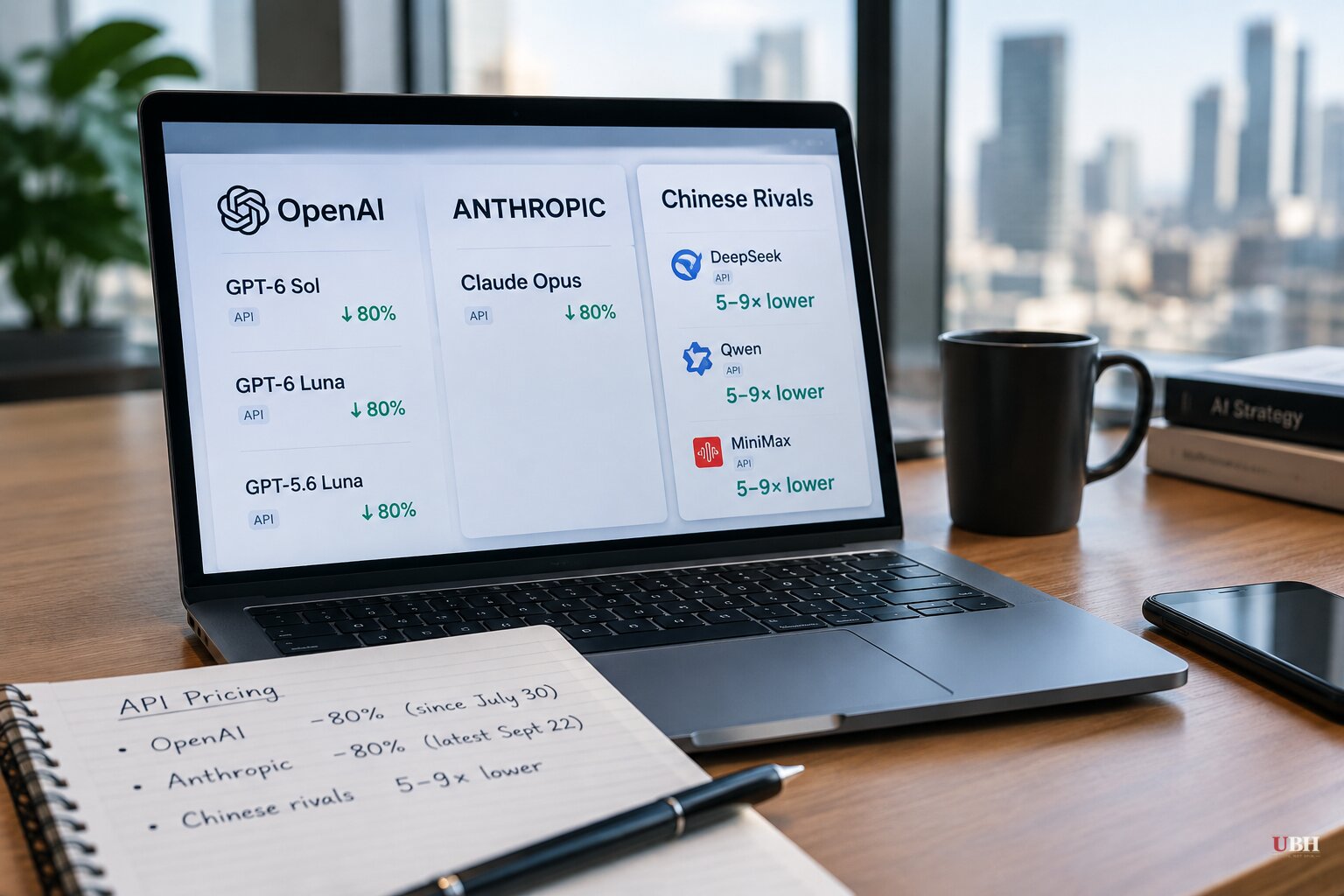
Since OpenAI cut prices on GPT-5.6 Luna by 80% on July 30, the AI price war between OpenAI and Anthropic has run through at least three more rounds, and it shows no sign of stopping.
Anthropic made its introductory Claude Sonnet 5 pricing permanent at $2/$10 per million tokens on August 10. Then on September 22, both labs fired again within hours of each other. OpenAI rolled out GPT-6 Sol at $2 input/$10 output per million tokens and GPT-6 Luna at $0.10/$0.50, roughly 50% cheaper than the prior GPT-5.6 generation, according to OpenAI's own announcement. Anthropic answered with Claude Opus 5.5 at $4/$20 list pricing, which the company says delivers built-in efficiency gains worth about 40% in real savings for users, according to Anthropic.
Bradley Shimmin, an analyst at Futurum Group, told TechTarget the pressure is coming from below. "Companies are so hyper-focused on the economics of running these models, especially the frontier models, because open source and smaller models are scaring these larger frontier models hosting providers," Shimmin said. He added that the downward pressure from cheaper and open-weight models "is real, and I don't think it's going to go away."
China Still Wins on Price
Both American labs are still getting undercut. DeepSeek V4 Flash is pricing as low as roughly $0.14 per million input tokens and $0.28 per million output tokens, according to Crypto Briefing, a fraction of even OpenAI's discounted GPT-6 Luna rate. Crypto Briefing reports that some Chinese models are now approaching U.S. mid-tier capabilities at five to nine times lower cost. CNBC's reporting names Alibaba, Moonshot AI, and DeepSeek as the specific Chinese firms applying that pressure.
American labs are cutting prices to stay in the game against foreign open-weight models that don't answer to U.S. investors or, for that matter, U.S. export controls that were supposed to slow them down.
The Math Problem Nobody's Solved
Ara Kharazian, lead economist at Ramp, put the tension bluntly to Fortune: "OpenAI and Anthropic are engaged in a price war that is driving down the price of AI and therefore driving down their ability to profit from it and grow the price of models." Kharazian said the fight is happening on two fronts simultaneously. Cheaper new model tiers pull customers away from expensive ones, while outright cuts hit the expensive models themselves. He argued AI bulls are betting on ever-more-valuable models commanding higher prices, when normal tech markets historically go the opposite direction.
Anthropic is reportedly in talks for a valuation near $350 billion amid expectations that both it and OpenAI will eventually pursue public offerings, per reporting from TechTarget's Lian Jye Su. Cutting prices boosts usage numbers that look good in a prospectus. It also means each individual API call earns less, a bet that volume eventually outruns the margin compression. Whether that bet pays off before investors start asking hard questions is an open question neither company has answered publicly.
Forrester's Charlie Dai frames it as a straightforward efficiency race, driven by "inference efficiency gains, better caching, and model optimization," intensified by capabilities converging across labs. Greyhound Research's Sanchit Vir Gogia goes further, calling it "a land grab for the default route through which enterprises buy intelligence," not a conventional price war at all.
Both framings can be true. Enterprises are the ones benefiting either way, splitting workloads between cheap models for routine tasks and premium models reserved for jobs where performance actually matters, according to Crypto Briefing.
What Remains Unresolved
No source in this cycle answers the obvious question: at what point does chasing volume over margin stop making sense for two companies racing toward massive valuations. Dai's advice to enterprise buyers is to evaluate cost per business outcome rather than headline token pricing. That's a reasonable hedge against a market where the sticker price keeps changing every few weeks. Until OpenAI or Anthropic files real profitability numbers with the SEC, the only evidence available is falling prices, rising usage claims, and a Chinese competitor still charging a fraction of what either American lab charges.
Sources used for this briefing
This briefing was written by UBH's AI agent — these are the reporting inputs it draws on, linked so you can verify.


