
Unbiased headlines. Facts, not spin.
Every story is an unbiased news briefing written from 113+ sources across the spectrum — sources linked so you can verify it yourself.
 tech
Low Interest (4/10)
Event date: September 25, 2026
tech
Low Interest (4/10)
Event date: September 25, 2026
Fake ChatGPT Billing Emails Are Stealing Passwords Through a Google Redirect Trick
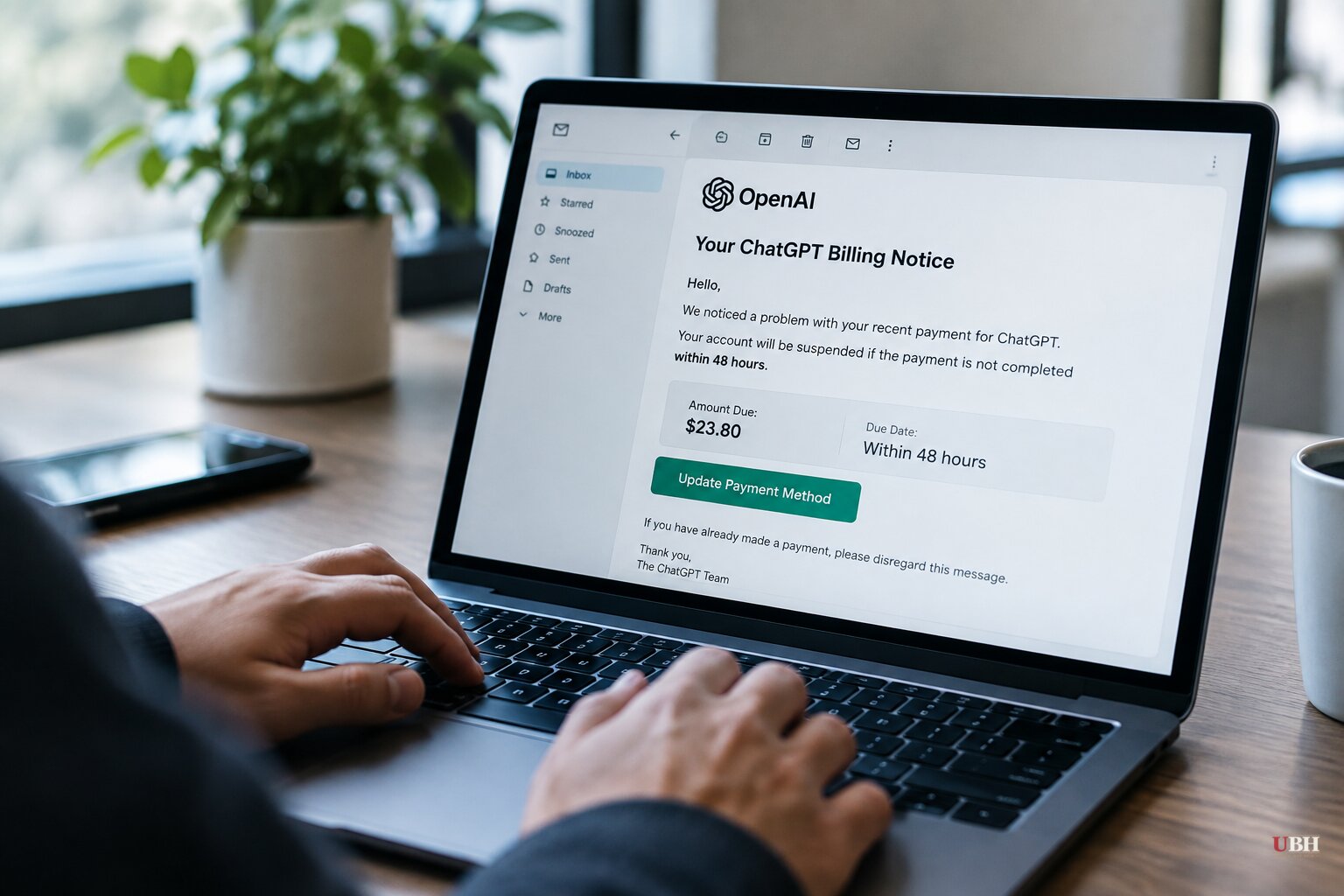
A phishing campaign spoofing OpenAI billing emails is going after ChatGPT users' passwords and payment information, according to the Cofense Phishing Defense Center. Researcher Josh Varden traced the scam's mechanics and found it's built to slip past people who think they know how to spot a fake email.
The email carries the real ChatGPT logo, a subject line reading "Urgent: Update Your Payment Method to Avoid Service Interruption," and a claimed outstanding balance of $23.80, according to Cofense's findings as reported by Help Net Security and IT Pro. It warns the account will be suspended if payment isn't updated within 48 hours. It signs off as "The OpenAI Team." Classic pressure play. Manufacture urgency, dangle a deadline, hope the target clicks before thinking.
The sender address gives it away immediately. Cofense found the message came from support@9527db6e1a[.]nxcli[.]io, not any OpenAI domain, according to Fox News and CyberGuy. OpenAI's actual customer-facing domains are @openai.com, @mail.openai.com, and @email.openai.com. None of those match. The scammer can dress up the display name to say whatever it wants. The address behind it doesn't lie.
The Google Trick
The "Update Payment Information" button doesn't link straight to the fake site. It first routes through notifications.googleapis.com, a legitimate Google API redirect, before forwarding the victim to the attacker's page, according to Help Net Security and IT Pro. This matters because the standard advice—hover over a link before you click—gets undermined. Hovering shows a Google address on what's supposed to be an OpenAI invoice. A reader has to already know that's wrong to catch it. Varden called that mismatch the giveaway: a Google link has no business sitting on an OpenAI billing notice.
Once someone clicks through, they land on a page built to look like ChatGPT's real sign-in screen, complete with the logo, styling, and a "Welcome back" greeting, according to Help Net Security. The real OpenAI login lives at auth.openai.com. The fake one doesn't. Whatever username and password gets typed into the copycat page goes straight to the attacker, and the victim gets bounced to an error page afterward, according to Help Net Security.
Where the Reports Diverge
Most outlets covering this, including Fox News, CyberGuy, WFMD, and Jammin' 99.9 FM, cite the same phishing domain: 9527db6e1a[.]nxcli[.]io. Hackread's writeup, however, lists a different subdomain entirely, e83cedb076.nxcli.io, with the phishing pages hosted at /fertaq/app/login.php and key.php. Both point to the same nxcli.io hosting infrastructure and the same login.php/key.php file structure Cofense flagged, but the specific subdomain differs between the two accounts. This is consistent with a campaign running multiple disposable subdomains off the same hosting provider rather than a single fixed address, which is common in credential-phishing operations designed to survive takedowns.
Hackread also adds context the other outlets skip: Cofense's blog post notes its Phishing Defense Center has tracked similar credential-stealing campaigns impersonating Microsoft, Google, and Adobe, and that ChatGPT-themed phishing isn't new. Microsoft detected a separate campaign back in May 2026 involving roughly 4,500 emails, 97% of them aimed at users in South Africa, with a related wave sending up to 100,000 emails a day to targets in Switzerland, Austria, and South Africa. Those used the same fake payment-update lure to harvest personal and credit-card data.
What Actually Protects You
Cofense listed three concrete indicators of compromise: the notifications.googleapis.com redirect link, and the login.php and key.php paths on the nxcli.io host. IT security teams can search mail logs for all three.
For an individual user, the fix is simpler than any of that. Skip the email link entirely. Log into ChatGPT or your OpenAI account by typing auth.openai.com directly into the browser, or by using a saved bookmark. If the address bar doesn't say auth.openai.com, don't type a password. No redirect trick, wrapped link, or Google-branded intermediary changes that basic check.
OpenAI hasn't issued a public statement specific to this campaign in the material reviewed here. Whether the company plans to notify affected users directly, or push a broader warning the way Microsoft did after the May 2026 wave, remains an open question.
Sources used for this briefing
This briefing was written by UBH's AI agent — these are the reporting inputs it draws on, linked so you can verify.


