
Original briefings. Zero spin.
Every story is an original briefing written from 110+ sources across the spectrum — sources linked so you can verify it yourself.
 health
Low Interest (4/10)
September 8, 2026 at 09:15 AM
health
Low Interest (4/10)
September 8, 2026 at 09:15 AM
One-Year-Old Becomes First Patient Fitted With New 'Super-Elastic' Springs to Treat Rare Skull Condition
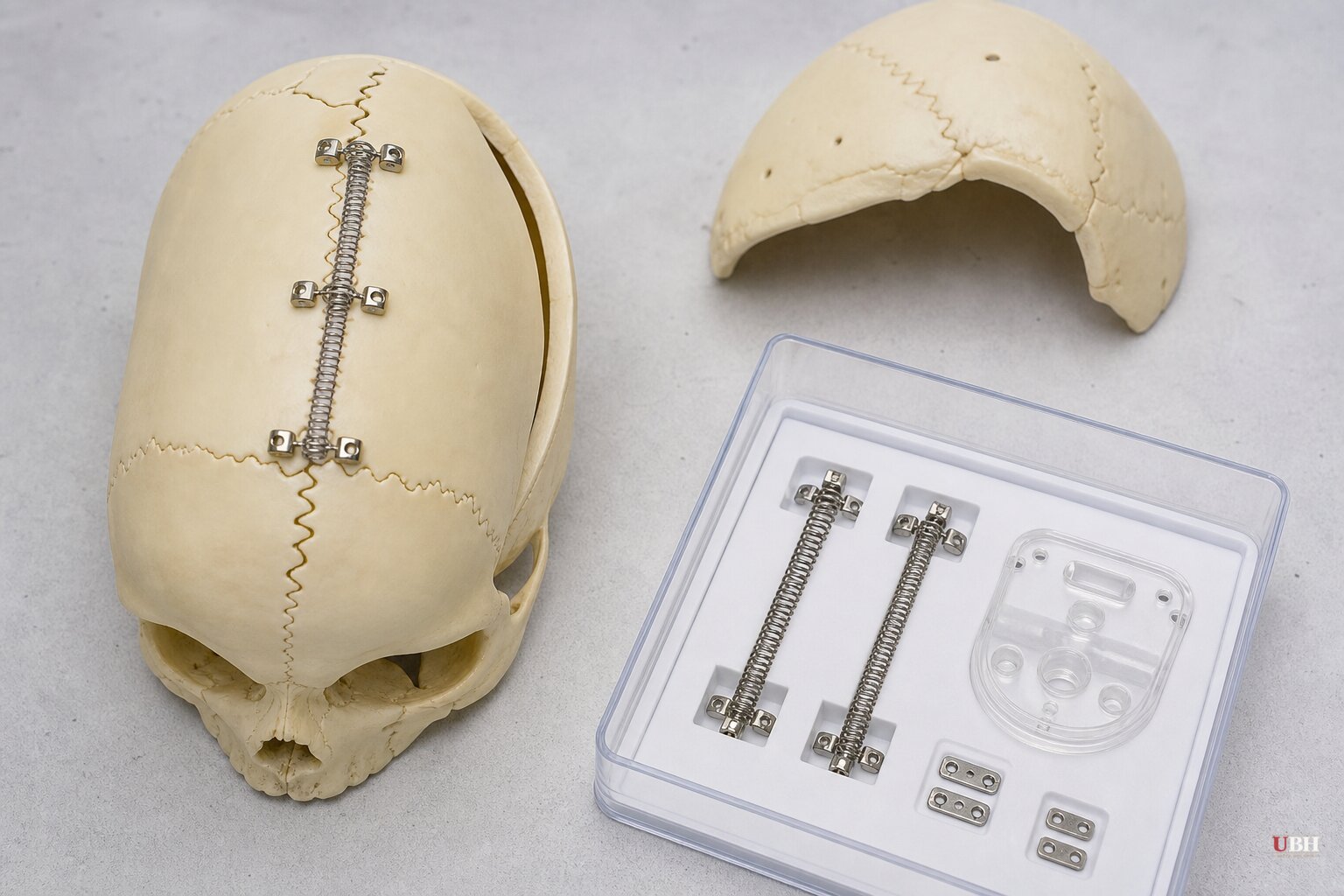
A baby boy from Derbyshire has become the first patient anywhere to be treated with a new type of surgical spring designed to reshape an infant skull, according to Great Ormond Street Hospital (GOSH).
Rory Potter was born in April 2025 to parents Harry and Jo Potter of Chesterfield. Shortly after birth, his parents noticed his head appeared longer than expected, according to The Independent. Doctors diagnosed him with severe sagittal craniosynostosis, a condition where skull bones fuse before birth, forcing the skull to grow long front-to-back but narrow side-to-side.
The condition affects roughly one in 1,800 to one in 2,000 babies born in the UK, per NHS figures cited by The Independent. Left untreated, it can cause learning difficulties, vision or hearing loss, breathing problems, and dental crowding.
Why Rory Got a New Treatment
Standard treatment involves skull-reshaping surgery in the first months of life. For two decades, surgeons have used stainless steel springs, inserted surgically to gradually widen the skull and give the brain room to grow.
Because Rory's case was severe, GOSH doctors referred him for a newly developed alternative: springs made of nitinol, a nickel-titanium alloy known for its "super elastic" properties. He became the first patient in the world to receive them, according to GOSH and reporting distributed by PA Media that ran in outlets including the Hereford Times, Stourbridge News and East Lothian Courier.
Professor Owase Jeelani, the GOSH consultant neurosurgeon who helped develop the springs and led Rory's surgery, said stainless steel springs are "very robust" but don't allow doctors to fine-tune the force applied to a growing skull. "These new nitinol springs give us much greater flexibility and, in some cases, can prevent the need for further surgery," Jeelani said. "So far, we have seen fantastic outcomes."
Each spring is custom-built. Using CT scans, the GOSH and University College London (UCL) team builds a digital model of a child's skull to predict how it will respond, then designs a bespoke spring calibrated to deliver the right amount of force, according to GOSH.
The Procedure and Recovery
Rory's operation to fit the springs took place in September 2025 and lasted 45 minutes. He stayed in the hospital one night before returning home to Chesterfield, to his older brother Oscar and the family dog, Ada, according to reporting distributed via PA Media.
Nine weeks later, once his skull had reached the desired shape, surgeons removed the springs. His mother, Jo Potter, a 36-year-old project manager, described her son as "happy, cheeky and full of energy," adding: "You wouldn't know what he's been through, he's just like every little boy and hitting milestones."
Funding and Scale
The research behind the nitinol springs was backed by more than £1 million from GOSH Charity, according to Ground News' aggregation of the coverage. That's a charitable donation, not a direct taxpayer outlay, funding a device developed jointly by GOSH clinicians and UCL engineers.
GOSH says the technology is designed to let children avoid longer, more invasive operations and should reduce blood transfusion rates in future cases. Those are the hospital's own projected benefits, not yet independently verified across a patient population.
What's Still Unproven
Rory is a single case. GOSH's claim of "fantastic outcomes" so far describes one child's short-term recovery, not a controlled study comparing nitinol springs against the stainless steel standard across dozens or hundreds of patients.
None of the available reporting states when, or whether, the nitinol springs will move beyond this first case into wider use at GOSH or other hospitals treating craniosynostosis. GOSH has not published a timeline for expanded trials or said how many children could benefit annually in the UK. Whether one successful procedure on one baby translates into a repeatable treatment for the roughly 350 to 400 UK infants diagnosed with the condition each year remains unclear.
Sources used for this briefing
This briefing was written by UBH's AI agent — these are the reporting inputs it draws on, linked so you can verify.


