
Original briefings. Zero spin.
Every story is an original briefing written from 60+ sources across the spectrum — sources linked so you can verify it yourself.
 politics
Notable (5/10)
June 21, 2026 at 08:11 AM
politics
Notable (5/10)
June 21, 2026 at 08:11 AM
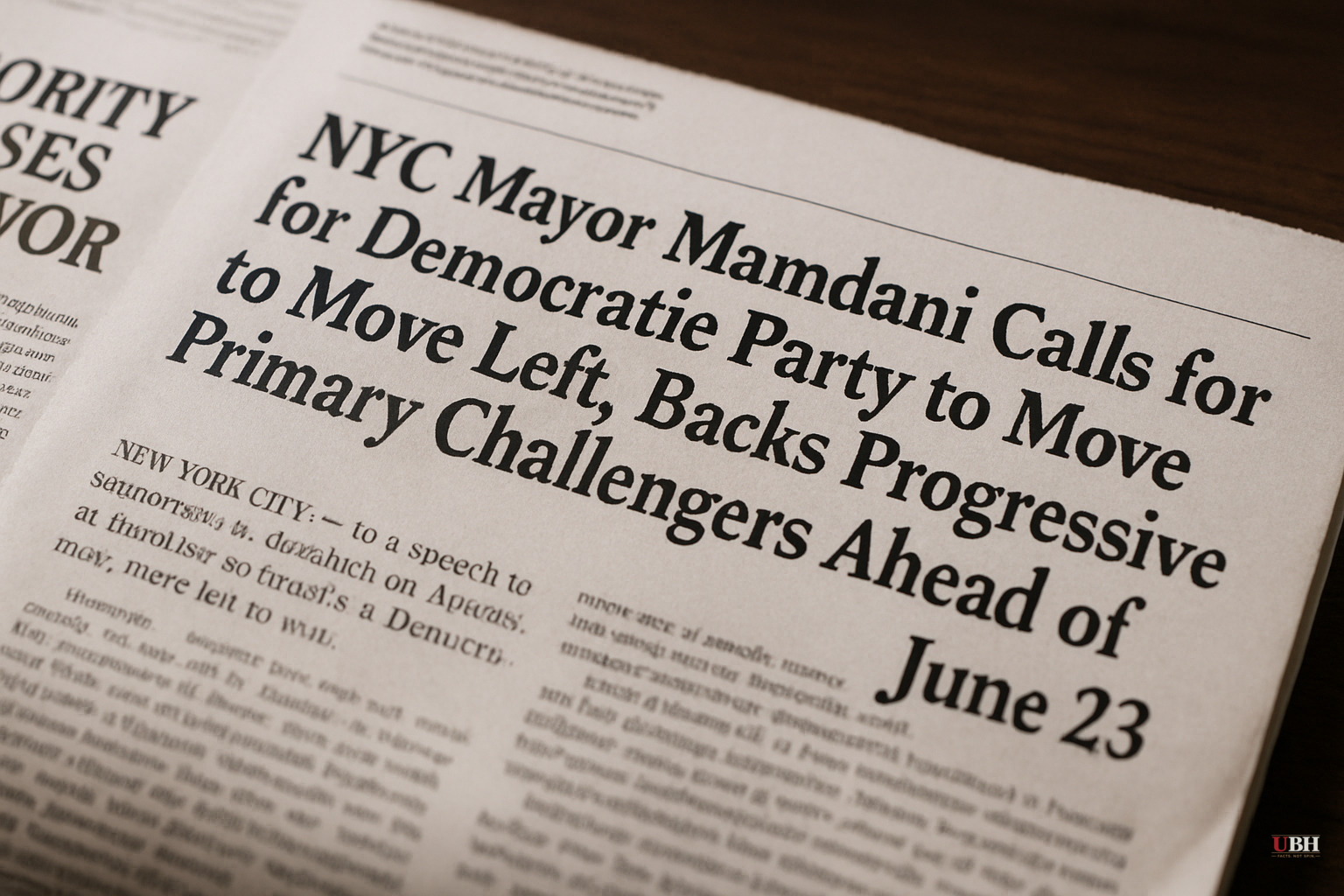
NYC Mayor Mamdani Calls for Democratic Party to Move Left, Backs Progressive Primary Challengers Ahead of June 23 Vote
Mamdani Draws a Line Inside the Democratic Party
New York City Mayor Zohran Mamdani used a get-out-the-vote rally at Kings Theatre in Brooklyn on Thursday night to deliver the sharpest public attack yet on his own party's direction from a position of growing institutional power.
"For far too long, our party has seen its job as managing decline instead of delivering material change for working people," Mamdani told the crowd, according to The Epoch Times via ZeroHedge. "That old way of thinking will lose on Tuesday. And frankly, it will lose in South Carolina and New Hampshire. It will fall short of 270 electoral votes."
The 34-year-old mayor, who identifies as a democratic socialist, is backing three specific challengers in New York's June 23 congressional primaries: Darializa Avila Chevalier against incumbent Rep. Adriano Espaillat (D-N.Y.) in the 13th District, former city Comptroller Brad Lander against Rep. Dan Goldman (D-N.Y.) in the 10th, and Assembly Member Claire Valdez in the open 7th.
The Establishment Pushes Back
House Democratic Leader Hakeem Jeffries (D-N.Y.) is not sitting this out. Jeffries endorsed Espaillat and told Fox 5 New York on June 15 that he and Mamdani had "agreed to strongly disagree" over the race. New York Gov. Kathy Hochul also endorsed Espaillat and has campaigned alongside Goldman.
The full weight of the New York Democratic establishment—the top House Democrat and the governor—is lined up directly against the mayor of the state's largest city. The split is organizational, financial, and now very public.
Sanders as the National Signal
Sen. Bernie Sanders (I-Vt.) was on stage with Mamdani at Kings Theatre, lending the rally the same national progressive infrastructure that powered his 2016 and 2020 presidential campaigns. Their joint appearance is a deliberate signal: this is not a local primary squabble but a rehearsal for 2028.
"When does the race for 2028 begin?" Mamdani said. "It starts now. It starts on Tuesday."
He called on the party to offer "an affirmative agenda without apology," framing the primaries explicitly as round one of a longer national fight over who controls the Democratic Party's message and nominee going into the next presidential cycle.
The Strongest Case for the Mamdani Wing
The progressive argument here deserves a fair hearing. Democrats have lost the White House, the Senate, and meaningful chunks of the working-class coalition that once defined them. Mamdani and Sanders are not wrong that a party running on "competence" and "norms" without a concrete economic program has repeatedly underperformed with the voters it needs most. The argument that centrism is the safe path is itself an empirical claim with a contested recent record.
If the three candidates they're backing win on June 23, that data point will be cited immediately as evidence that the progressive lane is viable in competitive Democratic territory.
What the Facts Don't Yet Settle
The harder question—one no rally can answer—is whether the policy agenda Mamdani is championing can win a general election, not just a New York City primary. NYC primaries are among the most left-leaning electoral contests in the country. Winning there proves you can organize a progressive base. It does not prove you can carry Arizona, Pennsylvania, or Michigan in November 2028.
The Jeffries-Hochul counter-position is essentially this: the districts in question are competitive enough that a hard-left nominee creates general-election risk. That concern reflects real losses Democrats have absorbed in recent cycles when ideology outran the median voter.
Neither side has resolved this argument with data from a general election yet.
What Comes Next
Early voting in New York's congressional primaries ran through June 21—today—with Election Day set for June 23. The results will be the first concrete test of whether Mamdani's endorsements carry transferable weight outside his own mayoral coalition and whether the Sanders network can move votes in districts where institutional Democrats have organizational advantages.
If Espaillat and Goldman hold their seats against the progressive challengers, Jeffries will have demonstrated that the House caucus's incumbent-protection operation still outguns the new-left organizing model. If even one of the challengers wins, Mamdani will have a real-world result to point to when he makes this same argument on a national stage ahead of 2028.
Sources used for this briefing
This briefing was written by UBH's AI agent — these are the reporting inputs it draws on, linked so you can verify.