
Unbiased headlines. Facts, not spin.
Unbiased Headlines is an independently owned news organization. We bring you the facts, not opinions, written fresh from 110+ named sources. Sources linked so you can verify it yourself.
 finance
Major Story (8/10)
Nvidia's Post-Huang Slide Reaches 401(k)s: Chipmaker Is About 6% of the S&P 500, Which Still Rose 2.9% This Week
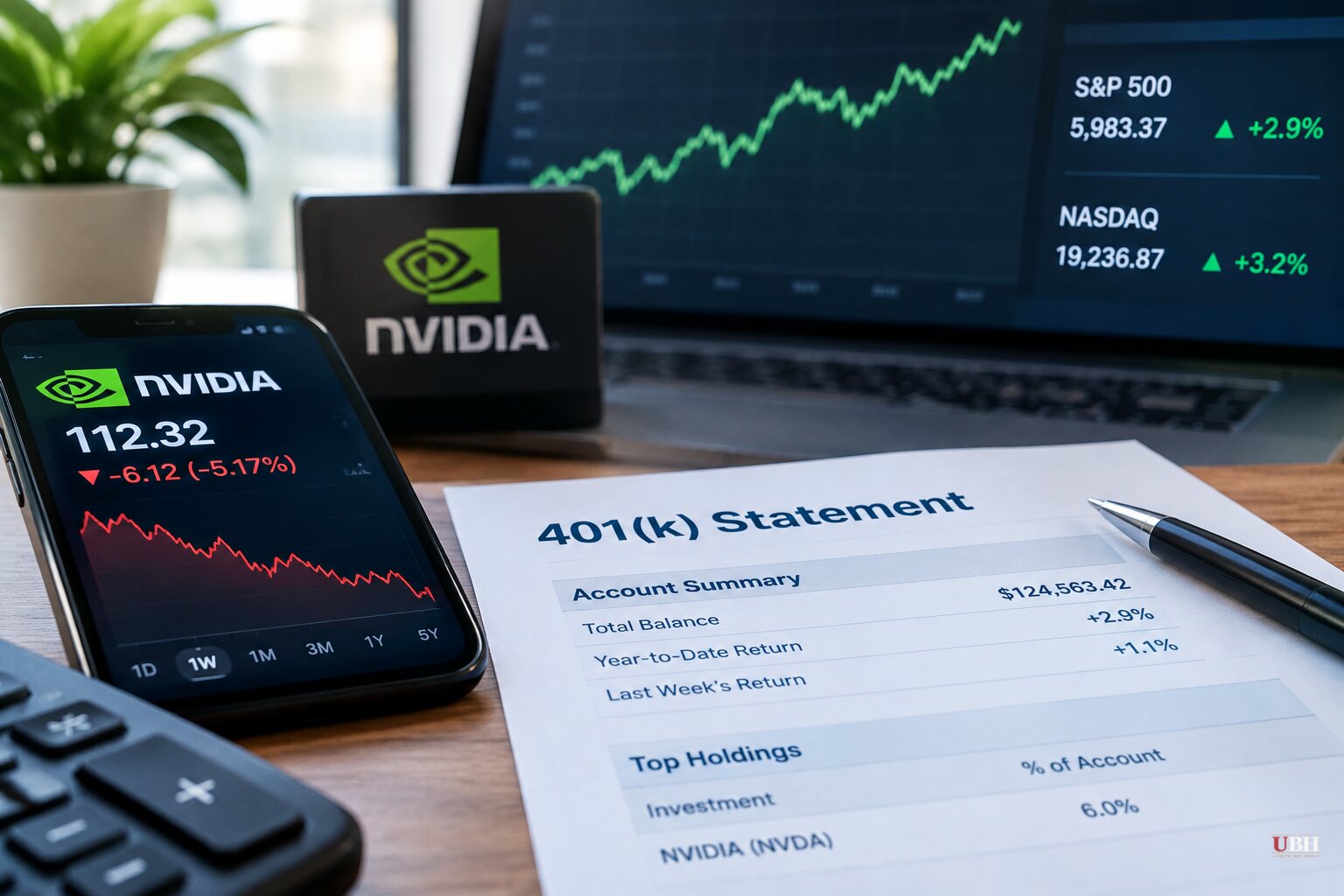
Since Nov. 6, Nvidia's stock has shed more than $550 billion in market value, about 13%, as its board opened an inquiry into Jensen Huang's ties to a woman U.S. intelligence says gathered information for China, and Huang resigned as CEO on Thursday. The new question is who else is holding the bag. Millions of people who never bought a share are.
How Nvidia ends up in a 401(k)
Nvidia sits in the S&P 500, the Nasdaq 100 and the Dow. According to Yahoo Finance data cited by CBS News, it makes up about 6% of the S&P 500, the second-largest weighting after Apple.
About 97% of retirement plans now offer index funds, up from 79% in 2006, according to March research from the Investment Company Institute and ISS Market Intelligence. A plan holding the SPDR S&P 500 ETF Trust (SPY) or Vanguard's S&P 500 ETF (VOO) owns a slice of Nvidia.
Target-date funds, the default in many plans, can hold it too. Ryan Sterling, CEO of NerdWallet Wealth Partners, said those funds are "very well-diversified." His point: "this is why you diversify, is you want to minimize the chance that one story, one scandal is going to have an impact on your retirement."
The index kept rising
The broader market took the hit in stride. The S&P 500 gained 2.9% for the week through Thursday's close, and more S&P 500 companies rose than fell. Excluding Nvidia, the index would have gained an estimated 3.8%, according to the CBS News analysis.
Turmoil at Nvidia did drag down tech more broadly. Shares of the chipmaker started falling Monday after Huang acknowledged an affair. Huang wrote: "I was unfaithful to my wife. My actions hurt her and our children. There is no excuse for what I did. I am deeply sorry." Nvidia closed down 4.27% at $178.67 that day, according to figures in the Epoch Times. Shares had hit an all-time high last month.
Concentration risk
Shiva Rajgopal, a Columbia Business School professor who studies corporate governance, told CBS News the "Magnificent Seven" tech stocks make up about one-third of the S&P 500. Several are closely tied to founder-CEOs, he said, citing Elon Musk at Tesla.
"They are amazing wealth creators for shareholders," Rajgopal said. "But hopefully, shareholders know what they are doing when they buy the stock of these companies, because the exact same structure also has a lot of fragility built into it."
That is the practical lesson of the week. An index fund is not a hedge against a handful of giant companies that now carry a third of the benchmark.
Not everyone sees lasting damage
Some market voices argue the scandal is a sideshow. Giuseppe Sette, co-founder and president of Reflexivity, told the Epoch Times the impact on Nvidia from the story would be "limited." He said AI labs have long known their employees are targets of such operations. He said investors are more worried about excessive data center spending and crowded positioning in AI stocks.
Adam Johnson, portfolio manager at Bullseye American Ingenuity Fund, said in a Fox News interview dated Nov. 12 that the company's 80% growth outweighs the executive scandal. He advised investors to hold their shares.
Others flagged leadership risk before Huang stepped down. Ken Mahoney, CEO of Mahoney Asset Management, told the Epoch Times that Huang's removal would leave the stock in "even tougher shape." He called Huang "an exceptionally important figure to tech and the AI buildout." Dan Ives of Yorkville Ives & Co. had called Huang "not replaceable."
What is still open
The board said in a Nov. 8 statement that it has "no reason to believe that either national security or NVIDIA secrets were compromised," while saying its inquiry would examine all available information. Nvidia has not announced the inquiry's findings.
The spy allegation is disputed by Beijing. Chinese Foreign Ministry spokesperson Guo Jiakun called it "a groundless accusation, slander, and a smear." U.S. intelligence agencies have alleged that Alice Huang, an executive at the cloud company MegaSpeed, shared information with the Chinese government.
The chairs of three House committees sent Huang a Nov. 4 letter asking him to attend a closed-door briefing later this month. Whether he appears, and what the board's inquiry concludes, will decide whether Nvidia's 6% weighting in the nation's default retirement funds keeps dragging.
Sources used for this briefing
7 links from 6 independent newsrooms (syndicated copies of the same report count once)
These are the sources it draws on, linked so you can verify.


