
Unbiased headlines. Facts, not spin.
Unbiased Headlines is an independently owned news organization. We bring you the facts, not opinions, written fresh from 110+ named sources. Sources linked so you can verify it yourself.
 finance
Major Story (8/10)
Nvidia Falls 13% in Week of Huang's Exit, Worst Since April 2025, as HSBC Cuts to Hold and AMD Drops 8.8%
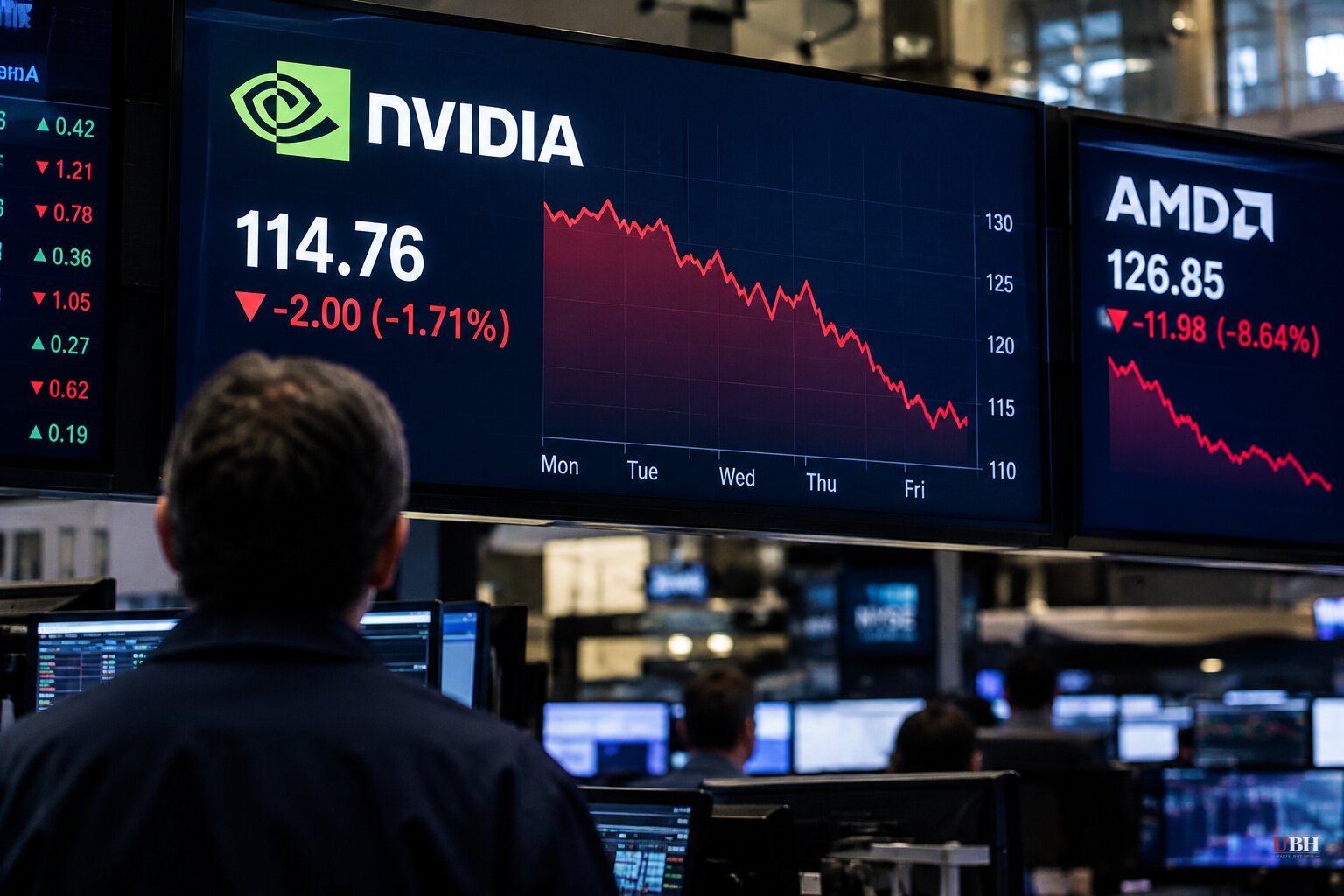
Since Jensen Huang resigned as Nvidia's CEO on Nov. 12, the selling has spread from the company itself to the chips, cloud and AI-infrastructure names around it. Nvidia fell another 2% Friday, Nov. 13, after Thursday's 4.3% drop, and finished the week down about 13%. That is its worst weekly decline since April 2025, according to Crypto Briefing's tally.
The Wall Street Journal put the week's market-value loss at roughly $573 billion. The stock is now more than 30% below its Oct. 6 record high.
HSBC downgrades, contagion spreads
HSBC cut Nvidia to hold on Friday. The bank argued the stock will stay stuck until the company lays out a permanent succession plan.
Interim CEO Colette Kress, the company's CFO for more than a decade, is running the company while the board searches both inside and outside Nvidia.
Thomas Martin, a senior portfolio manager at Globalt Investments, told CNBC he expects the search to "take a lot of time" and add uncertainty. His main question is about the financing deals Huang built. "What will happen to those types of financing arrangements, and will there be less of them just going forward or will there actually be unwinding of them?" he said.
Other chip stocks took heavy hits Friday:
- AMD fell 8.8%.
- Broadcom fell 4.8%.
- The Philadelphia Semiconductor Index dropped 3.4%.
AMD and Broadcom had both jumped earlier in the week as the Nvidia shake-up unfolded. On Thursday, AMD gained 5.9% and Broadcom 5.5%.
Nvidia-backed cloud providers CoreWeave and Nebius fell as much as 10.8% and 12.1% in Friday trading, according to Reuters, and both finished lower. CoreWeave had rallied Nov. 11 after beating earnings and raising its outlook.
The broader market still won the week
The selloff did not sink Wall Street. The Nasdaq Composite fell 0.9% Friday to 25,136.27. The S&P 500 slid 0.4% to 7,561.67. The Dow gained 50.46 points to 52,347.55.
For the week, the S&P 500 rose 2.5%, its biggest weekly gain since August. The Nasdaq added 2.3% and the Dow 2.1%. The S&P had posted four straight weekly losses before this one.
Technology was the worst-performing sector in the S&P 500. More than 60% of the index's stocks still rose Friday, according to the Associated Press. Healthcare and financials led, with Eli Lilly up 1.3% and Visa and Mastercard each up 1.3%.
Angelo Kourkafas, senior global strategist at Edward Jones, called the pullback "a reminder of the concentration risk embedded in a market where a small number of mega-cap technology stocks have driven an outsized share of returns."
Is Nvidia the cause, or one piece of it?
Baird strategist Ross Mayfield argues the Huang news is not the whole story. "Even before all of this came out, and even before the election, chip stocks had been under pressure," he told CNBC. He cited worries about a Democratic sweep and about the return on AI capital spending.
Mayfield believes a lot of the pain is already priced into Nvidia, though he still expects volatility. He said the news "hasn't really changed the broad tenor of the market," and that investors will keep rotating into non-AI sectors regardless.
On valuation, Reuters reported Thursday that Nvidia traded at about 12 times expected earnings, its lowest multiple since 2012.
Rates are adding pressure. The Bureau of Labor Statistics said October producer prices rose 0.3% on the month, below the 0.4% economists expected. They were up 6.5% from a year earlier, the biggest annual gain since November 2022. Core PPI ran 5% annually, the highest since January 2023.
After the report, CME FedWatch showed a 90% probability of a quarter-point Fed rate hike in December, up from 85% a day earlier. Chris Osmond of Fifth Third Wealth Advisors said producer inflation "may not have cooled enough to give markets the rate relief they want."
What comes next
Nvidia reports its first earnings without Huang at the helm next week, according to Kiplinger. Kress will be the executive facing analysts, and the open questions are the ones Martin raised: whether the company's financing arrangements with customers and suppliers continue, shrink or unwind.
Nvidia has said it had no reason to believe its confidential information or U.S. national security had been compromised. The board has not named a permanent successor.
Sources used for this briefing
8 links from 8 independent newsrooms (syndicated copies of the same report count once)
These are the sources it draws on, linked so you can verify.


