
Original briefings. Zero spin.
Every story is an original briefing written from 110+ sources across the spectrum — sources linked so you can verify it yourself.
 tech
Major Story (7/10)
Event date: August 26, 2026
tech
Major Story (7/10)
Event date: August 26, 2026
Nvidia's Earnings Reveal a Business Built on Financing Deals, Not Just Chips
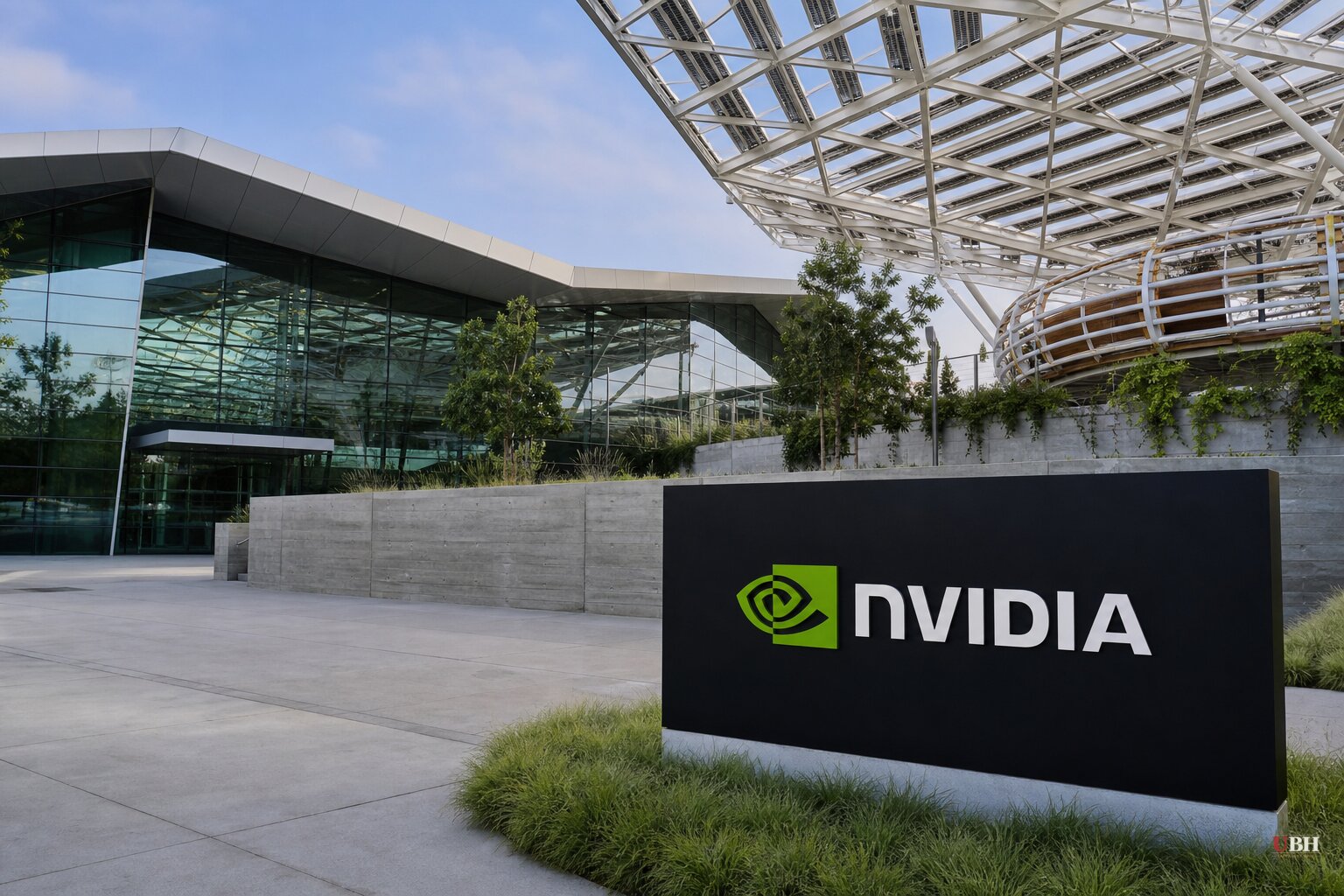
Nvidia reported fiscal second-quarter earnings on Wednesday, August 26, 2026. What came out of that report, and the week around it, is a company that looks less like a chip vendor and more like the bank, contractor, and landlord of the entire AI buildout.
For years the Nvidia story was simple: it made the best GPUs, and hyperscalers had nowhere else to go. That's gotten more complicated. Amazon and Google have built their own chips, and AMD has closed some of the technical gap, according to CNBC. Nvidia's market cap grew roughly 10x between the start of 2023 and mid-2025, then settled into a more modest climb over the past year as investors weighed that competition, TechCrunch reported.
The Systems Around the Chip
Investors are pricing in a second layer of Nvidia's advantage: the hardware that keeps a gigawatt-scale data center running efficiently, not just the GPU doing the math.
Nvidia is currently rolling out its Vera Rubin architecture, which pairs the Rubin GPU with a Vera CPU and additional racks for networking and storage, according to TechCrunch. Jason Hardy, Nvidia's VP of storage technology, told TechCrunch the Vera CPU solves a bottleneck problem: getting stored data to the GPU fast enough as memory capacity scales up. "We saw upwards of 3x improvement in these operations, where the Vera CPU is allowing for acceleration," Hardy said.
A Seeking Alpha analysis published August 10, 2026, by a contributor who disclosed a long position in Nvidia stock, framed this the same way: Nvidia is "evolving from a semiconductor manufacturer to a system architect," integrating compute, networking, memory and software into one platform. That analyst rates the stock a Buy with a $307 fair-value estimate, while flagging customer concentration as a real risk.
Financing the Buildout
Nvidia has shifted how it deploys its cash. In the week of August 17-21, 2026, Nvidia struck a pact with Wall Street firms to pursue $500 billion in financing for buyers of its GPUs, according to CNBC. On Monday, August 24, 2026, Nvidia said it would provide up to $105 billion to backstop a giant OpenAI data center in Ohio, plus a $1.5 billion investment in SB Energy, a SoftBank affiliate building power infrastructure for that project.
Nvidia already put $30 billion into OpenAI in February. Its stake in marketable equity securities hit $30.2 billion in the most recent quarter, up from $12.9 billion a year earlier, per CNBC. Its total investments in private companies reached $47.9 billion as of late July, more than double the $22.3 billion it held at the end of January, according to Business Insider Africa.
Business Insider Africa also reported Nvidia is in talks to acquire Hugging Face, the open-source AI model repository hosting more than 2 million models, for more than $13 billion. Nvidia is already an investor in Hugging Face. The talks were first reported by Business Insider's Katie Roof, Geoff Weiss and Ashley Stewart. No deal has been finalized and Nvidia has not confirmed an acquisition.
The Circularity Question
If Nvidia is financing OpenAI's data centers, investing in the power company building them, and buying up the open-source ecosystem that could otherwise threaten its GPU sales, is that real demand or demand Nvidia is manufacturing for itself? Business Insider Africa compared Nvidia to a hardware store during a gold rush that starts selling maps of the mines and lending prospectors money: "Are you building a business empire? Or just trying to keep the gold rush going?"
Analysts at Cantor pushed back on that framing in a note cited by CNBC, calling the OpenAI backstop "a clear signal that the current AI investment cycle will be elongated and durable" and arguing it's "less about circular and more facilitating the coming AI buildout while at the same time creating additional competitive moats." Nvidia itself declined to comment to CNBC on the strategy. Both readings rest on the same numbers. Neither is proved wrong by the earnings report itself.
The Numbers Behind the Bet
Nvidia can afford this because it's generating cash at a scale few companies ever have. Quarterly free cash flow is up 18-fold over three years to $48.5 billion in the latest period, per CNBC, on the back of 12 straight quarters of revenue growth above 55%. Nvidia raised its quarterly dividend from a penny to 25 cents in May, authorized an $80 billion buyback, and pledged to return roughly 50% of free cash flow to shareholders this year.
Not everyone is convinced the run continues uninterrupted. A technical analysis circulated by Pluang argued Nvidia's chart pattern resembles setups that preceded the 2018 and 2020 corrections, projecting a possible drop to $130 by December 2026, a roughly 40% decline, despite the strong earnings. That's a chart-based call, not a fundamentals-driven one, and it sits well outside the earnings-driven bullish consensus reflected in Cantor's and Seeking Alpha's notes.
Ram Bala, an associate professor of AI and analytics at Santa Clara University's Leavey School of Business, summed up Nvidia's posture to CNBC: "They remain dominant, but they're very paranoid about making sure they don't lose ground." The AWS-Nvidia partnership expanded by another 2 million GPUs on August 27, 2026, according to AI Business, a reminder that even hyperscalers building their own silicon are still buying Nvidia's at scale. Whether the Hugging Face talks produce a signed deal, and at what price, remains unresolved.
Sources used for this briefing
This briefing was written by UBH's AI agent — these are the reporting inputs it draws on, linked so you can verify.


