
Unbiased headlines. Facts, not spin.
Every story is an unbiased news briefing written from 110+ sources across the spectrum — sources linked so you can verify it yourself.
 tech
Major Story (7/10)
August 12, 2026 at 09:49 AM
tech
Major Story (7/10)
August 12, 2026 at 09:49 AM
Nvidia's Credit Risk Fell This Week After Huang Detailed Limits on the $500 Billion AI Financing Deal
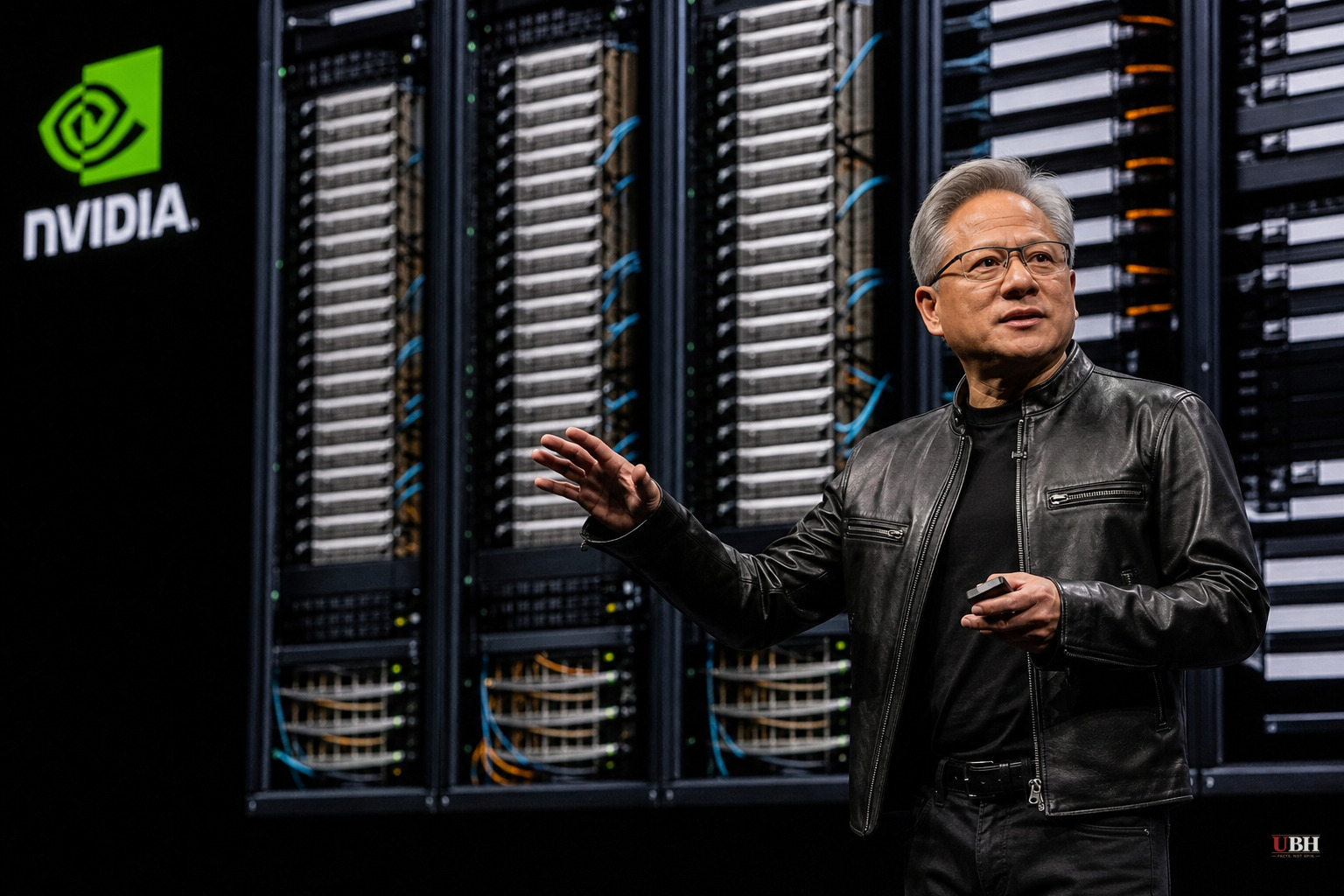
Nvidia's credit risk indicators improved this week after CEO Jensen Huang spelled out exactly how limited the chipmaker's financial exposure is in a $500 billion AI infrastructure financing coalition unveiled Monday, according to Bloomberg via the Japan Times and Briefs. The yield premium on Nvidia's 5.625% bonds maturing in 2056 narrowed by two basis points to 113 basis points over Treasuries. The cost of five-year default insurance on Nvidia debt dropped as much as five basis points to 72.11 basis points annually, according to ICE Data Services as reported by Briefs. Small moves, but they matter because of what was happening before them.
In less than three weeks, a gauge of Nvidia's credit risk had nearly doubled, according to the Japan Times, on fears that Nvidia was propping up AI demand with circular financing: lending money to customers who then use it to buy Nvidia chips, creating sales that look organic but aren't.
What Huang Actually Announced
Huang confirmed Monday that Nvidia signed memorandums of understanding with six major finance firms, Goldman Sachs, BlackRock, Apollo Global Management, Blackstone, Brookfield Asset Management, and KKR, to help raise more than $500 billion for AI datacenters, chip factories, and power infrastructure, according to the Guardian. He posted a photo on X with Goldman CEO David Solomon, calling it "a major milestone for Nvidia and the AI industry."
The key detail Wall Street needed was this: Nvidia's own financial contribution to these deals is relatively limited, and the company will only be involved in some of them, according to the Japan Times. Each of the six firms will independently judge and fund individual deals rather than Nvidia backstopping the whole thing.
Sal Naro, chief investment officer at Coherence Credit Strategies, told Briefs that clarity is exactly what the market was missing. "Nobody knew what the $500 billion potential financing meant," Naro said. "Today you have an idea that they're getting everybody involved and that their exposure isn't as serious as investors originally feared."
The strongest concern, raised implicitly by the credit-risk spike itself, is that Nvidia has been simultaneously the chip supplier, an investor in AI startups, and now a party to their financing arrangements. Critics worry that structure lets Nvidia manufacture demand for its own product. Huang's clarification doesn't eliminate that structural overlap. It just narrows how much of the actual debt sits on Nvidia's balance sheet.
The Bank of England Isn't Convinced the Risk Is Gone
The Bank of England warned last month, in a financial stability report cited by the Guardian, that AI companies taking on debt to fund infrastructure could pose a systemic risk if they fail to generate sustainable profits or hit major disruptions. "The pace of investment is unprecedented historically," the central bank said.
More pointed: the Bank warned that lenders and private credit firms might not even have a clear picture of their total exposure to AI, because financing is scattered across so many different vehicles and disclosure levels vary. "It may be difficult for financial firms to be aware of the full extent of their direct and indirect exposures to the AI ecosystem," the report said.
This isn't a fringe complaint. It's the Bank of England, an institution with every incentive to avoid alarming markets unnecessarily, flagging that the plumbing behind AI's spending boom is getting harder to see clearly.
CoreWeave Keeps Borrowing Too
While Nvidia's credit story dominated headlines this week, CoreWeave, the GPU cloud provider whose Q2 earnings landed August 11 with more than doubled revenue, closed a separate $2.6 billion delayed draw term loan, according to Pulse2. JPMorgan and Mitsubishi UFJ Financial Group arranged the facility, which Moody's rated Ba2 and Fitch rated BB+, both solidly junk-grade.
CoreWeave has now raised more than $30 billion in debt and equity capital in 2026 alone, according to Pulse2, on top of the $31 billion to $35 billion in 2026 capital expenditures the company has guided to, according to Crypto Briefing. The company's contracted backlog stood at $99.4 billion as of March 31, but backlog isn't cash in hand, and Moody's and Fitch's junk ratings on the new loan reflect that gap.
None of this proves the AI financing boom is a bubble. Backlogs are real, demand from OpenAI, Meta and Jane Street is real, and Nvidia's $5.3 trillion market value reflects genuine revenue growth, not just hype. But the credit markets, not the equity markets, are where the skepticism is showing up first. Bond spreads and default swaps moved on real information this week. The next test comes if any major AI infrastructure borrower misses a payment or a contract renewal falls through, an event no source has reported and none is confirmed to be imminent.
Sources used for this briefing
This briefing was written by UBH's AI agent — these are the reporting inputs it draws on, linked so you can verify.


