
Unbiased headlines. Facts, not spin.
Every story is an unbiased news briefing written from 110+ sources across the spectrum — sources linked so you can verify it yourself.
 tech
Breaking / Critical (9/10)
August 11, 2026 at 07:09 AM
tech
Breaking / Critical (9/10)
August 11, 2026 at 07:09 AM
Nvidia Signs $500 Billion Financing Deal With Six Wall Street Giants to Fund AI Buildout
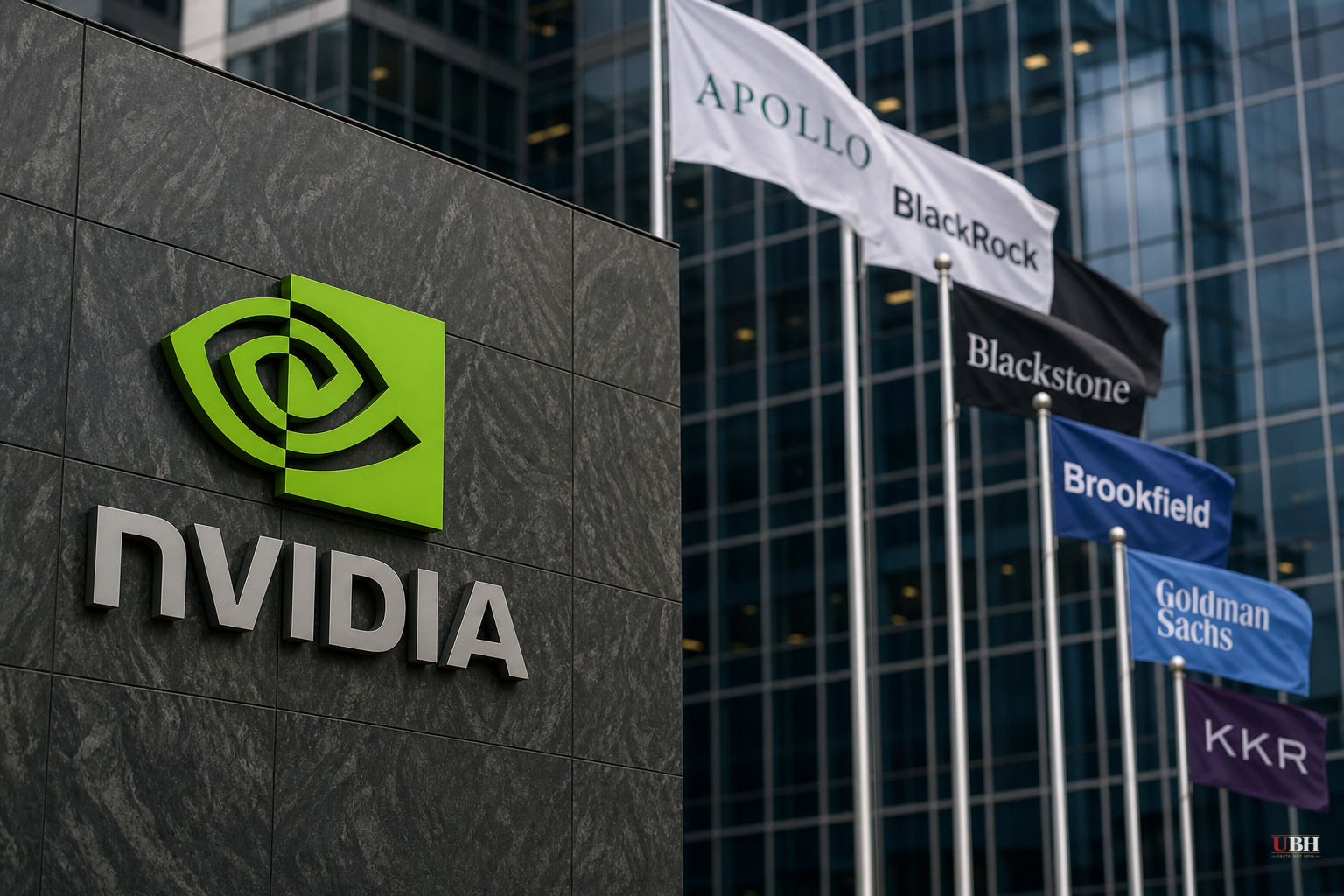
Nvidia wants Wall Street to stop thinking of AI chips like used cars and start thinking of them like toll roads.
On Monday, August 10, Nvidia announced memorandums of understanding with six of the biggest names in finance, Apollo Global Management, BlackRock, Blackstone, Brookfield Asset Management, Goldman Sachs and KKR, to mobilize more than $500 billion in third-party capital for AI infrastructure, according to Nvidia's own statement and reporting from CNBC and The Guardian. Executives from all seven companies joined CNBC's Becky Quick for a joint interview to roll it out.
The pitch: instead of hyperscalers and AI startups paying cash for GPUs and data centers, they'd tap institutional credit, insurance capital and private equity to finance the buildout, using the compute itself as collateral. Nvidia CEO Jensen Huang told CNBC, "This is really the first time that technology chips have become an investable asset class," arguing the hardware is "revenue-generating," "long-lived" and "fungible."
Huang doubled down on X, framing the shift as a move from project-by-project chip purchases to "AI factories" financed like real infrastructure, complete with "repeatable platforms" and "long-term institutional capital," per Stocktwits and TradingView.
The obsolescence problem nobody's pretending doesn't exist
GPUs have historically been treated as fast-depreciating tech, not toll roads. A chip from three years ago is nowhere near as valuable as one rolling off the line today, because Nvidia itself keeps releasing faster, more efficient generations. Briefs.co put it plainly: skeptics worry "rapid chip obsolescence could weaken the value of that collateral."
That's the legitimate question hanging over this whole deal. If you're a lender underwriting a data center full of GPUs for 10 or 15 years, and Nvidia releases three new architectures in that span, what's your collateral actually worth when you need to seize it? Huang's answer is that the chips are "fungible and transferable across customers and operators," so even outdated hardware can be redeployed elsewhere. That's a bet lenders haven't had to make at this scale before.
Nvidia is also backstopping its own deal
Huang disclosed on X that Nvidia has the option to backstop up to $125 billion, or 25% of the potential deals, through what TradingView described as "residual-value support." Huang insisted this is "limited, residual-value based and designed to complement, not replace, independent underwriting," and claimed it's "substantially lower than other compute-financing arrangements."
Nvidia putting skin in the game to guarantee the residual value of its own chips, while simultaneously selling those chips to the same customers, raises questions about circular arrangements, especially given Nvidia's prior investments in customers like OpenAI and CoreWeave, companies that then turn around and spend that money on Nvidia hardware. ZeroHedge called it a plan to fund what it labeled the "world's biggest circle jerk." That's ZeroHedge's editorializing, but the underlying concern that Nvidia is financing both sides of its own sales pipeline is a structural question.
Huang pushed back directly on this in his blog post, saying the capital comes from "independent, long-term institutional investors" who will separately assess "customer demand, utilization, cash flow and residual value." Nvidia isn't the only one with a stake in making this look clean. KKR co-CEOs Joe Bae and Scott Nuttall called compute "a critical infrastructure asset" in a joint statement to The Guardian, and BlackRock's Larry Fink said the deal "deepens" BlackRock's relationship with Nvidia through its existing AI Infrastructure Partnership. Every institution on that stage has a financial incentive to see this asset class succeed.
The market's initial reaction wasn't a cheer
Nvidia stock fell nearly 3% during Monday's regular session when the deal was announced, according to Stocktwits and TradingView, before rebounding about 0.7% in overnight trading. That's a stock price move, not a claim about what any specific investor gained or lost. Stocktwits sentiment on Nvidia stayed "bullish" despite the dip.
The timing matters. The Guardian and CNBC both note this financing push comes after a July market swoon where investors started questioning whether Big Tech's AI spending would actually pay off. Moody's has warned that hyperscaler capital expenditures, on track to exceed $730 billion this year according to The Guardian, are starting to squeeze free cash flow and push companies toward heavier debt loads.
Nvidia did not disclose financial terms, individual firm commitments, or a timetable for deploying the $500 billion, according to The Guardian. Memorandums of understanding are not signed contracts. Whether this becomes an actual $500 billion pipeline of capital, or a headline that never fully materializes into deployed loans, depends on terms nobody has published yet.
Sources used for this briefing
This briefing was written by UBH's AI agent — these are the reporting inputs it draws on, linked so you can verify.


