
Original briefings. Zero spin.
Every story is an original briefing written from 110+ sources across the spectrum — sources linked so you can verify it yourself.
 politics
Notable (6/10)
September 6, 2026 at 12:18 PM
politics
Notable (6/10)
September 6, 2026 at 12:18 PM
Nude Spa's Fight Over Transgender Access Heads to the Supreme Court
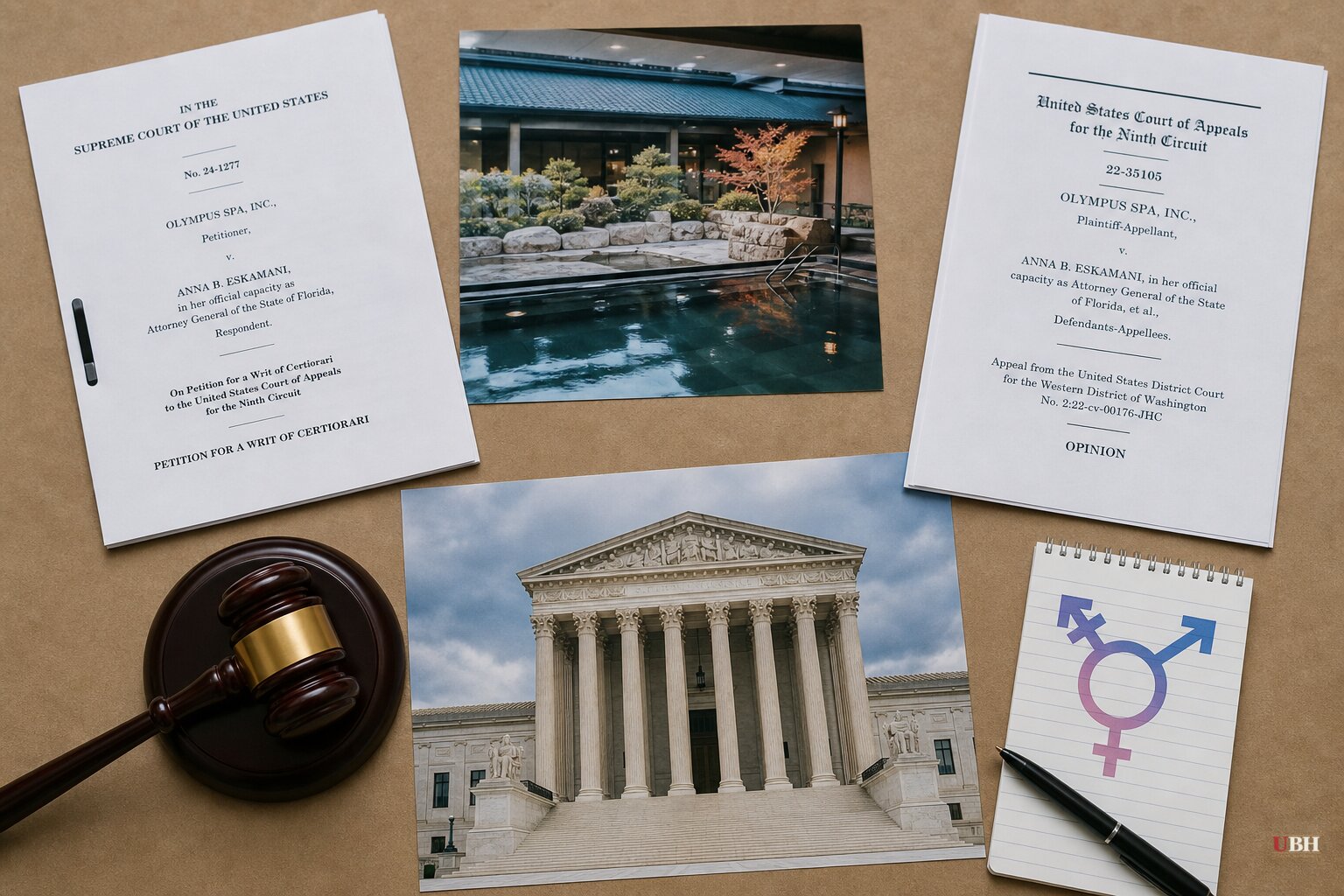
Since Washington state regulators forced Olympus Spa into a settlement in October 2021 over its refusal to admit a preoperative transgender woman, the case has worked its way from a state civil rights complaint to the doorstep of the U.S. Supreme Court.
Olympus Spa, a Korean-style nude bathhouse with locations in Washington state, requires customers in its pool area to be nude and restricts admission to women. The dispute started in 2020, when Haven Wilvich, who according to Reason identifies as a "nonbinary trans woman," was turned away from the Lynnwood location for having male genitalia. Wilvich filed a complaint with the Washington State Human Rights Commission (WSHRC), which found the spa had violated the Washington Law Against Discrimination (WLAD).
The spa says it does admit postoperative transgender women. It draws the line at preoperative anatomy, arguing its business model and its owners' religious beliefs depend on excluding male genitalia from a space where women, including minors, are nude.
What the Law Says
WLAD bars discrimination on the basis of "sexual orientation," a term Washington's legislature defined to include "gender expression or identity." The statute does carve out an exception allowing "gender-segregated facilities" like locker rooms and restrooms, but only if the business doesn't exclude someone specifically because of their gender identity. That's the trap Olympus Spa fell into: it can be women-only, but under the law as written it can't treat a preoperative transgender woman differently than any other woman.
Olympus Spa sued after the settlement, arguing the WSHRC enforcement action violated its First Amendment rights to free speech, free exercise of religion, and free association. A district court dismissed the claims. The U.S. Court of Appeals for the 9th Circuit affirmed that dismissal on May 29, 2025, in an opinion by Judge M. Margaret McKeown, a Clinton appointee.
McKeown's opinion held that Washington's law regulates conduct, not speech, and that any incidental burden on the spa's expression was no greater than necessary to stop discrimination. On the religious liberty claim, the court leaned on Employment Division v. Smith (1990), ruling that a neutral, generally applicable law only needs a rational basis even when it burdens religious practice. The court distinguished the case from Masterpiece Cakeshop v. Colorado Civil Rights Commission (2018), finding no evidence Washington officials showed hostility toward the spa owners' Christian beliefs, according to a summary published by Middle Tennessee State University's First Amendment Center.
The En Banc Fight and "Swinging Dicks"
Olympus Spa asked the full 9th Circuit to rehear the case. The court declined in March, and Judge Lawrence VanDyke wrote a blistering dissent that has become the case's most quoted passage. "This is a case about swinging dicks," VanDyke wrote, arguing it's "far more jarring for the unsuspecting and exposed women at Olympus Spa, some as young as thirteen, to be visually assaulted by the real thing" than for the phrase to appear in a judicial opinion, according to Reason.
VanDyke's language drew a formal rebuke signed by 27 of his 9th Circuit colleagues, who objected to the tone even as many likely agreed the underlying legal question deserves review. McKeown, for her part, acknowledged the difficulty of the case in her original opinion, writing that the spa "may have other avenues to challenge the enforcement action," but that "whatever recourse it may have, that relief cannot come from the First Amendment."
The Case for Washington's Position
Supporters of the WSHRC's enforcement action argue straightforwardly: Washington's legislature explicitly defined gender identity as a protected class under its anti-discrimination law, and businesses open to the public don't get to carve out exceptions based on the owners' personal or religious objections once a law is neutral and generally applicable. That's precisely the standard the Supreme Court set in Smith, and the 9th Circuit found no evidence of the kind of targeted hostility toward religion that doomed the state's case in Masterpiece Cakeshop. Under existing precedent, the state's position that Olympus Spa must follow the same law as any other public accommodation is not eccentric.
Olympus Spa's counterargument is that a law forcing an all-female nude facility to admit anyone regardless of anatomy destroys the very reason customers, some of them minors, choose the business in the first place, and that this isn't a case about restrooms or locker rooms but about mandatory nudity in front of strangers.
The petition for certiorari is now before the Supreme Court, which has not yet said whether it will hear the case. If the justices grant review, arguments would not happen until a future term, and the ruling could reshape how far religious liberty and free-association claims stretch when they collide with state gender-identity protections in places of public accommodation nationwide.
Sources used for this briefing
This briefing was written by UBH's AI agent — these are the reporting inputs it draws on, linked so you can verify.


