
Original briefings. Zero spin.
Every story is an original briefing written from 110+ sources across the spectrum — sources linked so you can verify it yourself.
 politics
Major Story (7/10)
Event date: August 31, 2026
politics
Major Story (7/10)
Event date: August 31, 2026
Masked Settlers Attack NBC Crew in West Bank Village, Beat Palestinian Woman Unconscious
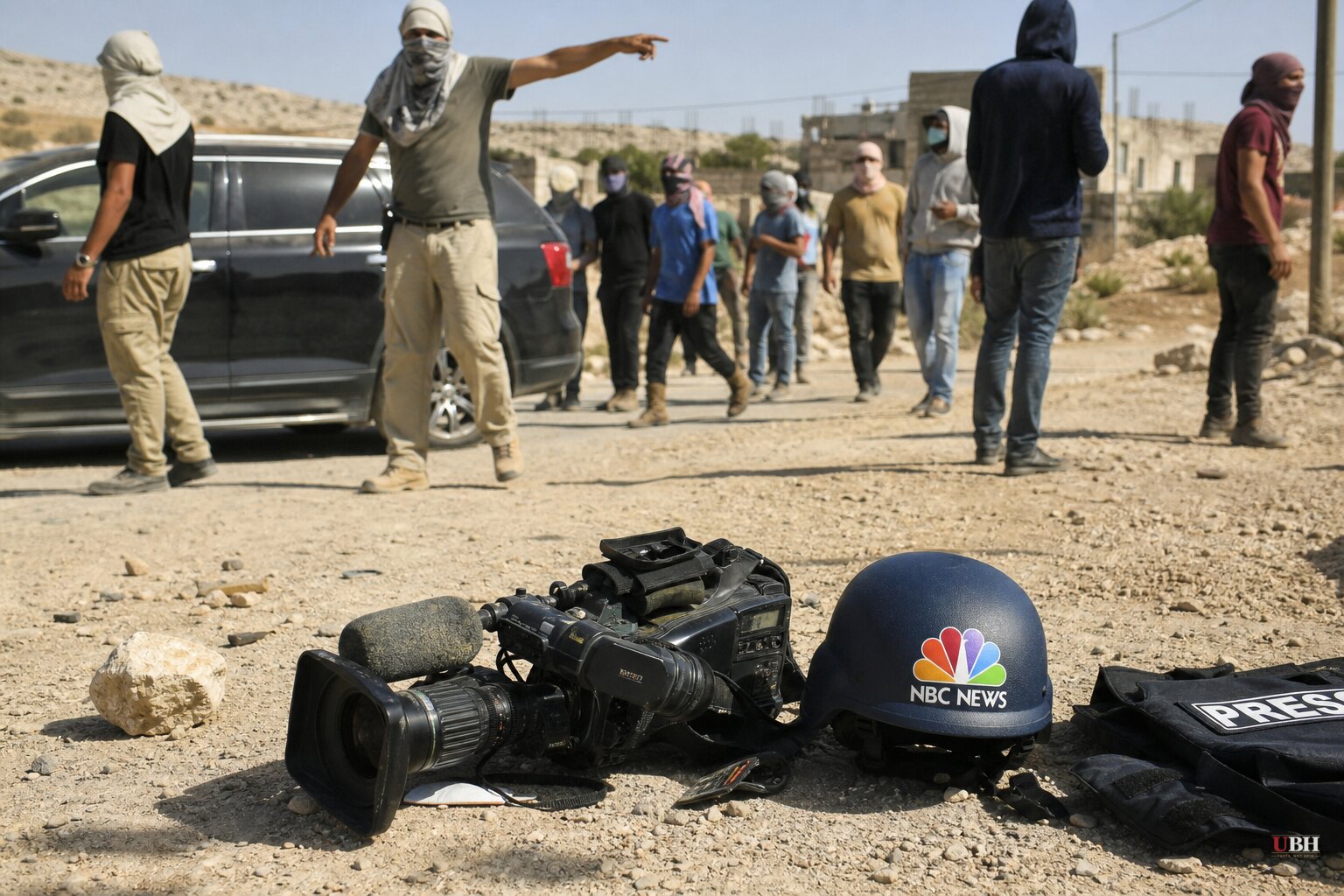
Since Israeli settlers began encircling three Palestinian homes in Qusra on August 9, the violence in that stretch of the northern West Bank has spread and escalated, culminating on August 29 in an attack on a working NBC News crew in the nearby village of Jalud.
What happened in Jalud
An NBC crew of three was interviewing Palestinian resident Aida Ahmed Abdullah and her family when a gray car with Israeli plates pulled up, according to NBC News. A group of masked men armed with sticks jumped out and attacked the group.
"They smashed our car windshield, hit our crew with clubs and beat Aida unconscious," NBC correspondent Matt Bradley told the network's "Sunday Today." Bradley said he was hit twice in the arm and was treated at a nearby clinic, per the Epoch Times. Abdullah was hospitalized with non-life-threatening injuries. Two other NBC staffers were also hurt.
Producer Lawahez Jabari told NBC News Digital the attackers carried sticks and that she saw a gun, though it was not used. Cameraman Khaldoon Eid, who lives in the area, said the crew was working "in the middle of a Palestinian area next to Palestinian houses" when the men descended.
The Israeli military told the Epoch Times it dispatched soldiers and Border Police to Qusra and Jalud after reports of rioters, including stone-throwing at Palestinians. Troops removed rioters who had barricaded themselves inside a Palestinian home and confiscated vehicles allegedly used to reach the village, turning evidence over to the Judea and Samaria District police for investigation. As of the reporting reviewed here, no arrests or charges tied to the Jalud attack on the NBC crew had been announced.
Netanyahu and Huckabee's response
Prime Minister Benjamin Netanyahu posted on X condemning "the criminal acts of violence committed in the villages of Qusra and Jalud by a handful of rioters," saying they cause "grave injustice to the law-abiding Jewish community" and harm "Israel's standing in the world." Netanyahu's spokesman Doron Spielman separately called the NBC crew attack a "grave injustice" and vowed those responsible would face justice.
U.S. Ambassador Mike Huckabee, who first called West Bank settler violence "terrorism" on August 12 during the Qusra standoff, repeated the label after visiting Palestinian American residents in Turmus Ayya, according to the Associated Press. Huckabee said settlers who "put up their own flags," burn cars, torch mosques or vandalize homes are committing "an act of terror," while stressing they "represent a very tiny minority." He referenced graffiti left in Bazariya reading, in Hebrew, "Huckabee regards from the terrorists" - which he said he was "glad they admitted."
That "tiny minority" framing, echoed by both Netanyahu and Huckabee, is the strongest defense on offer from Israeli officials: that a small number of masked extremists, not the broader settler population or the Israeli state, are responsible, and that security forces are actively investigating and removing them. The Jerusalem Post's reporting on the Qusra siege shows real operational friction behind that claim. Tear gas was used against settlers on August 12, and IDF statements about which of three besieged homes had utilities restored were, by Reuters' own account, unclear even to reporters on the ground.
A parallel land-seizure track
While the Qusra-Jalud violence played out, Amnesty International reported that the Israeli military signed at least 15 land confiscation orders in July 2026 covering roughly 200 dunams (20 hectares) in the Jenin governorate, in both Area C and, notably, Area A—territory nominally under Palestinian Authority control since the Oslo Accords. Amnesty says the orders appear designed to link two planned settlements, Emek Dotan and Noa, part of 34 new settlements the Israeli government approved earlier this year.
According to Peace Now, cited by Amnesty, this marks the first time since Oslo that Israel has issued military seizure orders in Area A explicitly for civilian settlement purposes rather than stated security reasons. Amnesty's regional director, Heba Morayef, called on states with trade ties to Israel to pressure it to rescind the orders. Amnesty characterizes the allegations as annexation and "ethnic cleansing," which remain Amnesty's characterization rather than an independently adjudicated legal finding.
Britain's anticipated response
The Guardian reported that Britain's government under Prime Minister Keir Starmer is expected to announce a ban on trade with West Bank settlements in the coming days, a step the paper describes as "long anticipated by campaigners." That announcement had not been confirmed as final policy as of this reporting.
The open question is whether any of the masked men who attacked Bradley's crew, or the settlers who besieged Qusra for weeks, actually face prosecution. Israeli police in the Judea and Samaria District say they are investigating using vehicles and evidence collected by the military. No charges had been publicly filed as of September 6.
Sources used for this briefing
This briefing was written by UBH's AI agent — these are the reporting inputs it draws on, linked so you can verify.


