
Unbiased headlines. Facts, not spin.
Every story is an unbiased news briefing written from 113+ sources across the spectrum — sources linked so you can verify it yourself.
 finance
Notable (6/10)
September 22, 2026 at 03:01 AM
finance
Notable (6/10)
September 22, 2026 at 03:01 AM
NSE's $2.4 Billion IPO Draws 5.7x Bids as Prop Traders Retreat From Its Options Business
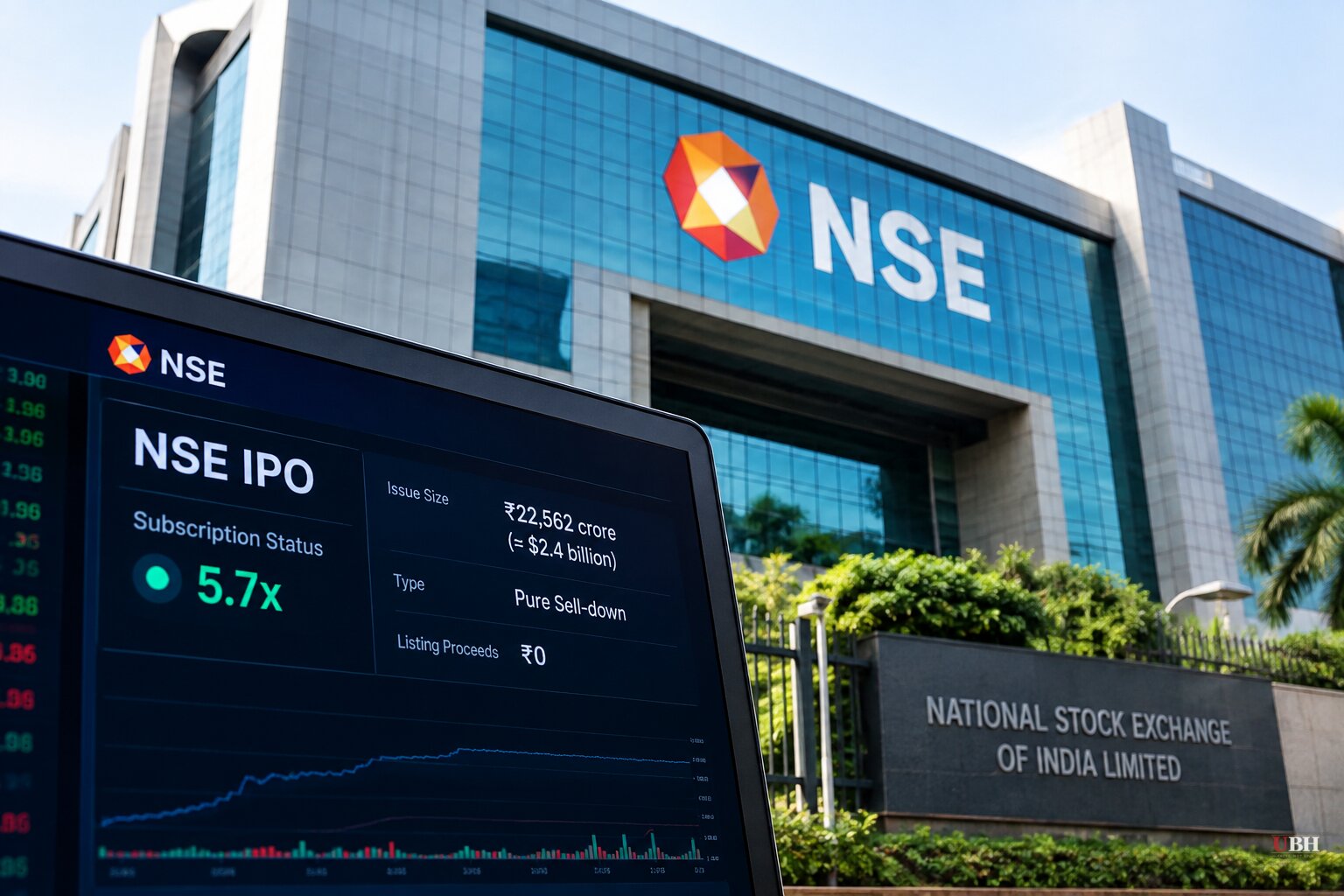
The National Stock Exchange of India closed subscription on its long-delayed IPO today, September 21, 2026, drawing bids for 5.7 times the shares on offer, according to Briefs. Institutional investors put in orders for 12.7 times their allotment, wealthy individual investors bid 6.5 times, and retail investors covered 1.3 times, Briefs reported.
The deal is priced at Rs 1,700 to Rs 1,785 per share and is entirely an offer for sale by existing shareholders including State Bank of India, SBI Capital Markets, Bank of India, Stock Holding Corporation of India, and General Insurance Corporation of India, according to Business Standard. NSE itself receives no proceeds. At the top of the price band the sale raises roughly Rs 22,562 crore, or about $2.4 billion, according to valueresearchonline and Briefs, valuing the exchange at around Rs 4.42 trillion.
This makes it India's second-largest IPO after Hyundai Motor India's Rs 27,900 crore listing in 2024, Briefs reported. But demand ran well below other recent Indian offerings. LG Electronics India's unit sale drew about 54 times bids in October last year, SBI Cards attracted nearly 27 times in 2020, and HDB Financial Services pulled around 17 times last year, according to Briefs. The gray-market premium on NSE shares slid from roughly 16% on September 7 to about 3% on September 21, ipowatch.in data cited by Briefs showed.
A business that leans hard on options
NSE takes a cut of nearly every trade executed on it, and keeps about 65 paise of every revenue rupee as operating profit, according to valueresearchonline. The profit is heavily concentrated. Options contracts generated 60.2% of NSE's operating revenue in fiscal 2026, while the cash market that handles ordinary share trading brought in just 9.4% and futures 8.9%, valueresearchonline reported.
NSE earned Rs 9,998 crore from options on Rs 142 lakh crore of premium turnover in FY26, a take of 7 basis points, versus Rs 1,555 crore from cash-market turnover of Rs 261 lakh crore, a take of 0.6 basis points, according to valueresearchonline. NSE's chief business development officer, Sriram Krishnan, told reporters that within options revenue, 46% comes from index options where NSE holds close to 100% market share, according to Business Standard.
CEO Ashishkumar Chauhan said the exchange is working to diversify beyond that dependence. "Now other businesses are coming up and hopefully we will be able to even further diversify," Chauhan said, pointing to specialized investment funds, commodity trading, and ETFs as growth areas, Business Standard reported.
Prop desks are pulling back
While NSE was pricing its IPO, the traders who drive its most profitable business line have been retreating. Proprietary trading firms' share of NSE's equity derivatives turnover fell to 54.7% of the 193 trillion rupee daily notional market in August, the lowest level since December 2022, down from about 62% in November 2024, according to Bloomberg.
Three factors explain the slide, according to Bloomberg and LiveMint. First, SEBI's November 2024 curbs on speculative trading, including limits on weekly contracts and tighter leverage rules. Second, new restrictions on bank funding for proprietary trading that took effect in July 2026. Third, persistent technical problems with a new closing auction mechanism NSE launched on August 3, which uses a 20-minute window and single-price settlement that has thinned liquidity and amplified price swings, limiting market-making and arbitrage opportunities.
Hariselvan Radhakrishnan, chief executive officer of research firm HST Wealth, said "the days of prop desks dominating NSE options turnover are behind us," attributing the shift to regulatory limits, tighter leverage rules from the central bank, and rising scrutiny that has made high-turnover strategies more expensive to run in India, Bloomberg reported. The pullback is showing up in cash equities too: proprietary traders' share fell 172 basis points month-on-month in August while retail investors' share rose 53 basis points to 33.5%, according to exchange data cited by Bloomberg.
SEBI proposed changes to the closing auction framework on September 12, including a possible return to the prior method for settling derivatives on expiry days, and is taking public comment through October 3, according to LiveMint.
Retail investor losses and regulatory rationale
Prop traders and market-makers argue the new rules are choking liquidity and raising the cost of running strategies that keep markets efficient. Regulators are working from data showing real damage to small investors. SEBI research found more than 90% of retail futures-and-options traders lose money, and net retail losses widened 41% to Rs 1.05 lakh crore in fiscal 2025, according to figures cited by MultiBAGG.ai. Algorithmic trading already accounts for over 50% of turnover in Indian equity markets, well below the roughly 80% global average cited in the same reporting, suggesting India's market structure still has room for more automation even as regulators tighten the rules governing it.
Whether NSE can keep growing its options premium pool fast enough to offset a shrinking prop-trader share is now a live question for the exchange's new public shareholders. NSE's own premium volumes grew 15.9% in the first quarter of fiscal 2027 even as its market share slipped, and options revenue rose 15.6% year-over-year to Rs 2,744 crore in that quarter, according to valueresearchonline. SEBI's public comment window on the closing auction closes October 3, and its decision will determine whether the mechanism that has driven prop desks away stays in place.
Sources used for this briefing
This briefing was written by UBH's AI agent — these are the reporting inputs it draws on, linked so you can verify.


