
Unbiased headlines. Facts, not spin.
Unbiased Headlines is an independently owned news organization. We bring you the facts, not opinions, written fresh from 110+ named sources. Sources linked so you can verify it yourself.
 health
Notable (6/10)
Novo Says CagriSema Produced 25% Average Weight Loss in Women in Post Hoc Analysis, Under Best-Case Conditions
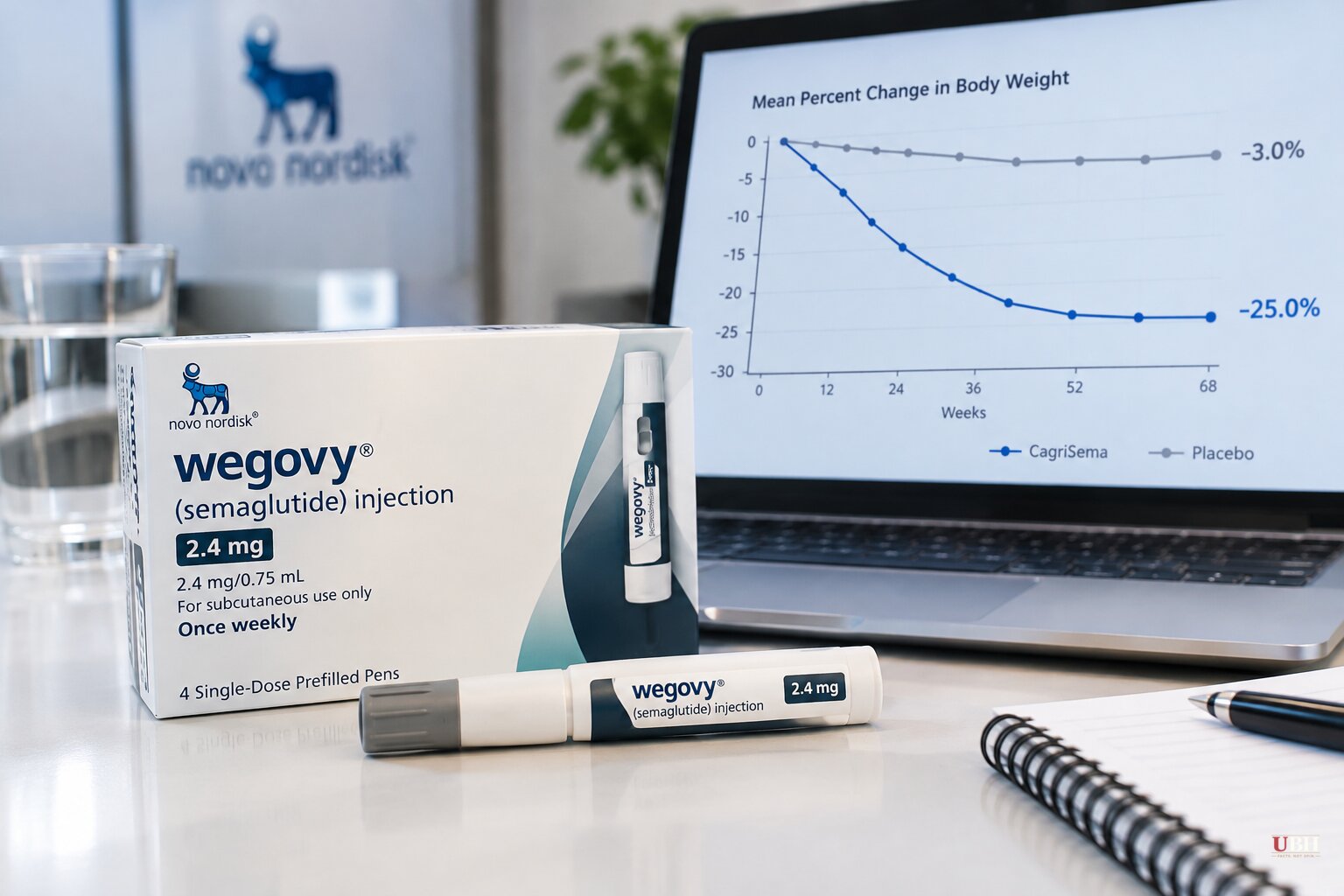
Novo Nordisk said today, Oct. 20, that its experimental obesity drug CagriSema produced an average weight loss of 25.0% in women at week 68 of the REDEFINE 1 trial. Women on placebo lost 3.0%.
The data were presented at The Menopause Society 2026 Annual Meeting in San Diego. They come from two post hoc analyses, meaning the company went back through the data after the trial had already met its main goals.
What the numbers say
The first analysis covered 2,309 women with obesity or overweight. Those on CagriSema 2.4 mg / 2.4 mg lost 25.0% of body weight on average, and waist circumference fell 20.5 cm versus 4.7 cm on placebo.
The second analysis covered 1,902 women grouped by menopausal stage. Average weight loss at week 68 was:
- 26.7% in premenopausal women, versus 2.1% on placebo
- 24.8% in perimenopausal women, versus 1.7%
- 23.1% in postmenopausal women, versus 2.6%
In the women's analysis, 93.3% of those on CagriSema lost at least 10% of body weight and 68.7% lost at least 20%. On placebo, 12.7% and 1.8% did. Women on semaglutide alone, the active ingredient in Wegovy, lost 19.0% on average. Women on cagrilintide alone lost 13.4%.
The fine print
These are best-case numbers. Novo used what it calls the efficacy estimand, which projects results as if every participant kept taking the drug and used no other weight-loss treatment. Real-world results include people who skip doses or quit.
Novo also disclosed limits on the analyses. The p-values were not adjusted for multiplicity, and no formal testing of differences by sex or subgroup was done. Menopausal status was assigned after the fact using age, medical history and recorded symptoms. It was not prospectively staged or confirmed with biochemical tests.
Novo described both analyses as hypothesis-generating and said they require further study.
Maria D. Hurtado Andrade, an assistant professor at the Mayo Clinic Alix School of Medicine and lead author of the analyses, said the numerical differences among the menopause groups point to a need for more research on how reproductive aging may influence weight loss.
How it compares with the full trial
In the full trial of more than 3,400 adults, CagriSema produced 22.7% average weight loss at 68 weeks versus 2.3% on placebo. That fell below the 25% Novo had targeted. About two-thirds of participants were women.
The 25% figure for women is higher than the 22.7% for the whole group. But Novo says it did not formally test differences by sex, so the gap is a numerical observation, not a finding.
The women-only figure also sits close to Novo's original goal. That may explain the company's interest in presenting it.
Side effects
In REDEFINE 1, 5.9% of participants on CagriSema stopped treatment because of adverse events, versus 3.5% on placebo. Gastrointestinal events hit 79.6% of the CagriSema group and 39.9% of the placebo group. They included nausea, constipation and vomiting. Novo said the events were mostly transient and mild to moderate.
The business stakes
CagriSema combines semaglutide with cagrilintide, an amylin analog. Novo's Michelle Skinner Moore said it "has the potential to be the first amylin analog and GLP-1 RA combination therapy for weight management."
Novo is competing with Eli Lilly in the weight-loss market, and Wegovy faces patent expiries after 2030. Both companies are building amylin-based treatments to open a revenue stream beyond existing GLP-1 drugs.
Skinner Moore said reproductive stage is rarely evaluated as a factor in obesity research, and noted that more than 86 million U.S. women are 40 or older, the age range in which perimenopause, menopause and postmenopause occur. Her quote: "Many women with obesity or overweight experience weight gain as they move through menopause, and it is important to explore investigational products such as CagriSema across the reproductive lifespan."
What comes next
CagriSema is not approved in the United States. Novo filed a New Drug Application with the FDA in December 2025. A decision on approval for weight management is expected in the fourth quarter of 2026.
The FDA has not announced a ruling as of today. The agency's decision will rest on the full REDEFINE program, not on a post hoc subgroup slice. Whether a dedicated, prospectively designed study confirms the menopause-stage differences is an open question.
Sources used for this briefing
7 links from 6 independent newsrooms (syndicated copies of the same report count once)
These are the sources it draws on, linked so you can verify.


