
Unbiased headlines. Facts, not spin.
Unbiased Headlines is an independently owned news organization. We bring you the facts, not opinions, written fresh from 110+ named sources. Sources linked so you can verify it yourself.
 health
Notable (5/10)
Novartis CEO Targets Eight-Year Drug Development With AI, Down From 12
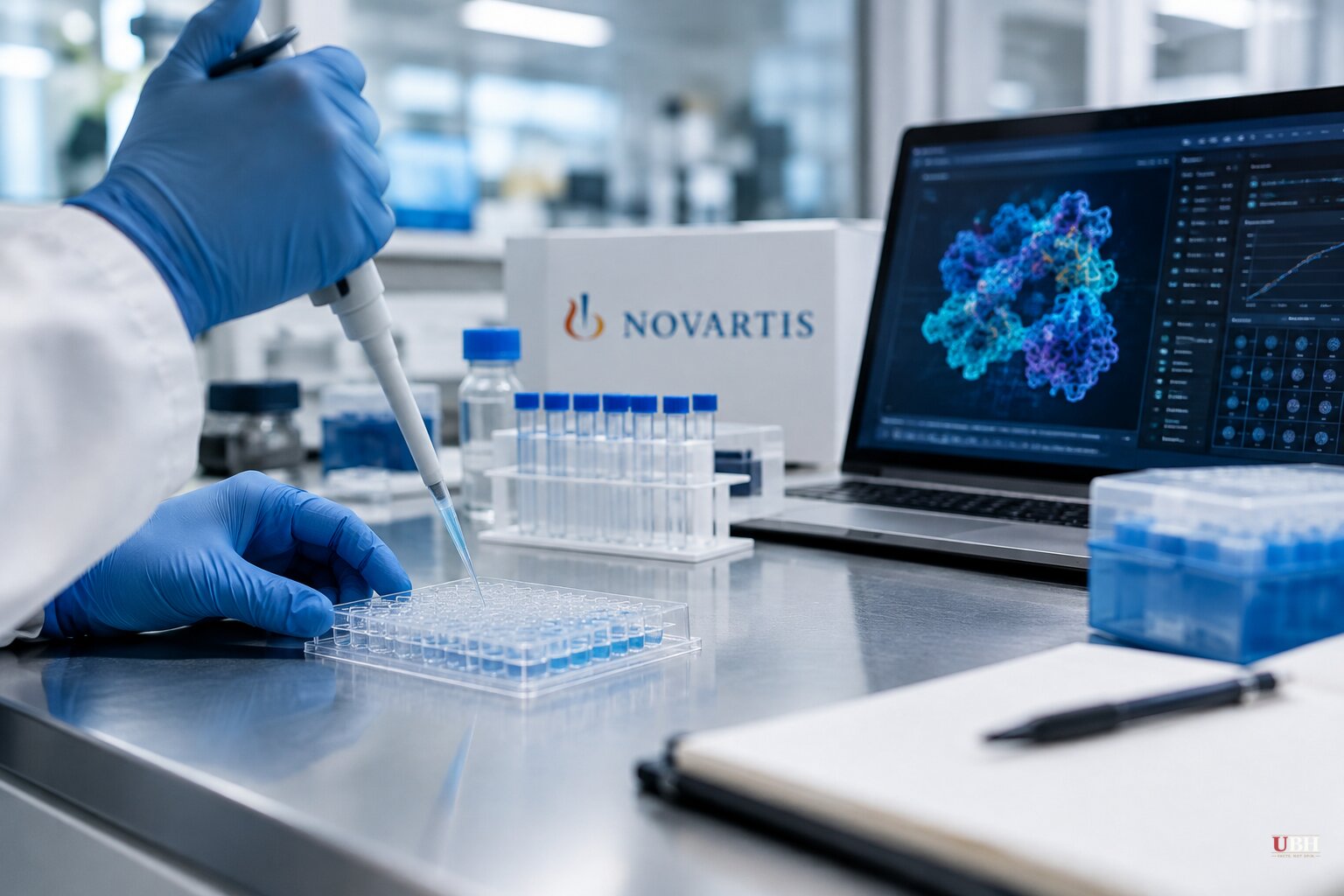
Novartis wants to take four years out of the standard drug development cycle, and its CEO says AI is how.
Vas Narasimhan laid out the goal at the company's Meet Novartis Management event in London on Thursday, Nov. 19. He said Novartis aims to cut the typical 12-year path from entering research to reaching the market down to eight. He also wants to raise the probability that a drug entering human testing makes it to approval from the industry average of 8% to 12%.
Both numbers are targets, not results.
What Novartis says AI is already doing
Narasimhan said about 90% of the content produced in Novartis development is now AI-assisted. He said that has trimmed clinical study report timelines by 25%, and that statistical programming for the company's 2026 trials ran 90% faster.
In early discovery, he said AI-assisted generative chemistry has cut the stretch from starting a research program to picking a drug candidate from three to four years down to roughly 18 to 24 months. Novartis AI platforms can run thousands of trial enrollment simulations in minutes, work that used to take weeks.
Narasimhan split the delays in drug development into three buckets. Information latency, the time spent gathering data to make decisions, takes about a year of the 12. He expects AI to push that toward zero. Operational latency, covering trial design, regulatory paperwork and execution, accounts for about two and a half years, and he said AI can steadily compress it.
The third bucket, biological latency, is the hard one. That is the time biology itself takes to show whether a drug works. Narasimhan described raising the success rate as "a long journey."
He also told reporters that AI would lift productivity in manufacturing and commercial operations in the near term, while the speed and efficacy gains in research and development would take longer to arrive.
Why the sales pitch matters now
Novartis has a business reason to talk up the technology. The company loses U.S. patent protection on Cosentyx, Kisqali and Kesimpta between 2029 and 2031. Some products it once saw as future growth drivers fell short in pivotal studies. Entresto's patent expiration already hurt sales and profit over the past year.
Novartis forecast net sales growth of 5% a year at constant currency from 2026 to 2031. Its earlier forecast was 5% to 6% a year for 2025 to 2030. Shares were down 3.2% in European midday trading Thursday. The company raised peak sales estimates for Kesimpta, Scemblix and Leqvio.
"This company has a track record of generating innovations that allow it to grow through these periods," Narasimhan said, "and my full expectation is we will grow through that 2030 period."
The Anthropic connection
Narasimhan has been on Anthropic's board since April. He made his London pitch on the same day Anthropic began trading on the Nasdaq. He is the company's only pharmaceutical board member.
He is not alone in the AI push. GSK, Bristol Myers Squibb, Novartis, Eli Lilly, Novo Nordisk, AstraZeneca and Sanofi all told Reuters AI has cut early-stage work by as much as half this year. AstraZeneca's Sharon Barr said, "There is no part of the discovery through development pipeline where we are not using AI." Sanofi said AI saved at least a year on its asthma drug lunsekimig by letting it skip a dose-selection study.
The drugmakers also have doubts about the loudest claims. Aliza Apple, who runs Lilly's TuneLab, said statements that AI can cure all disease overstate what the technology can do today, a claim she tied to Anthropic and to the founders of Alphabet's Isomorphic Labs. "It would be great for them to cure one, and then let's talk about the rest," she said.
Anthropic CEO Dario Amodei said at the Nasdaq on Thursday that clinical trials and experiments will still take time, but that he believes AI can substantially accelerate them.
The unproven part
Nearly nine in ten drugs developed by conventional methods fail in clinical trials, according to Reuters' account of industry data. PhRMA, the industry lobby, says a drug can take 10 to 15 years and cost billions to reach the market.
Faster paperwork does not change a trial's outcome. Early operational gains do not show that drugs will clear late-stage trials or regulators sooner, and the efficiency figures come from Novartis itself.
The money is already moving ahead of the proof. Bloomberg reported that Isomorphic Labs is in early talks to raise about $5 billion at a valuation near $50 billion. Terms could change, and investors have not been named. Bloomberg also reported the company has not yet tested a drug candidate of its own in humans. Founder Demis Hassabis has said AI-designed drugs would be in trials by the end of 2026. Novartis is an Isomorphic partner, having paid $37.5 million upfront in a 2024 deal worth up to $1.2 billion in milestones.
Washington's China problem
Narasimhan also used Friday's Bloomberg TV interview to warn about a different risk. The Treasury Department proposed in October to add biotech to the technologies covered by U.S. outbound investment limits aimed at foreign adversaries under the COINS Act. The program currently covers AI, semiconductors and quantum computing.
Bloomberg reported that foreign drugmakers such as Novartis could be covered whenever they employ people or run operations in the U.S.
"The current approach would limit our ability to bring these technologies into our U.S. factories for U.S. patients and vice versa, U.S. into China," Narasimhan said. "Finding a new treatment for cancer or heart disease is not a national security issue."
Novartis has its own China exposure. On Oct. 2 it announced a licensing deal with Chinese developer Abogen Biosciences for an mRNA-encoded autoimmune therapy worth up to $7.8 billion.
Treasury has not finalized the biotech rule. The next test of the AI timeline is closer. Hassabis's end-of-2026 deadline for a first Isomorphic human trial falls in about six weeks.
Sources used for this briefing
7 links from 7 independent newsrooms (syndicated copies of the same report count once)
These are the sources it draws on, linked so you can verify.


