
Unbiased headlines. Facts, not spin.
Every story is an unbiased news briefing written from 110+ sources across the spectrum — sources linked so you can verify it yourself.
 finance
Major Story (7/10)
August 12, 2026 at 08:08 AM
finance
Major Story (7/10)
August 12, 2026 at 08:08 AM
Norway's Oil Fund Posts Record $184 Billion First-Half Profit, Discloses $1.2 Billion SpaceX Stake
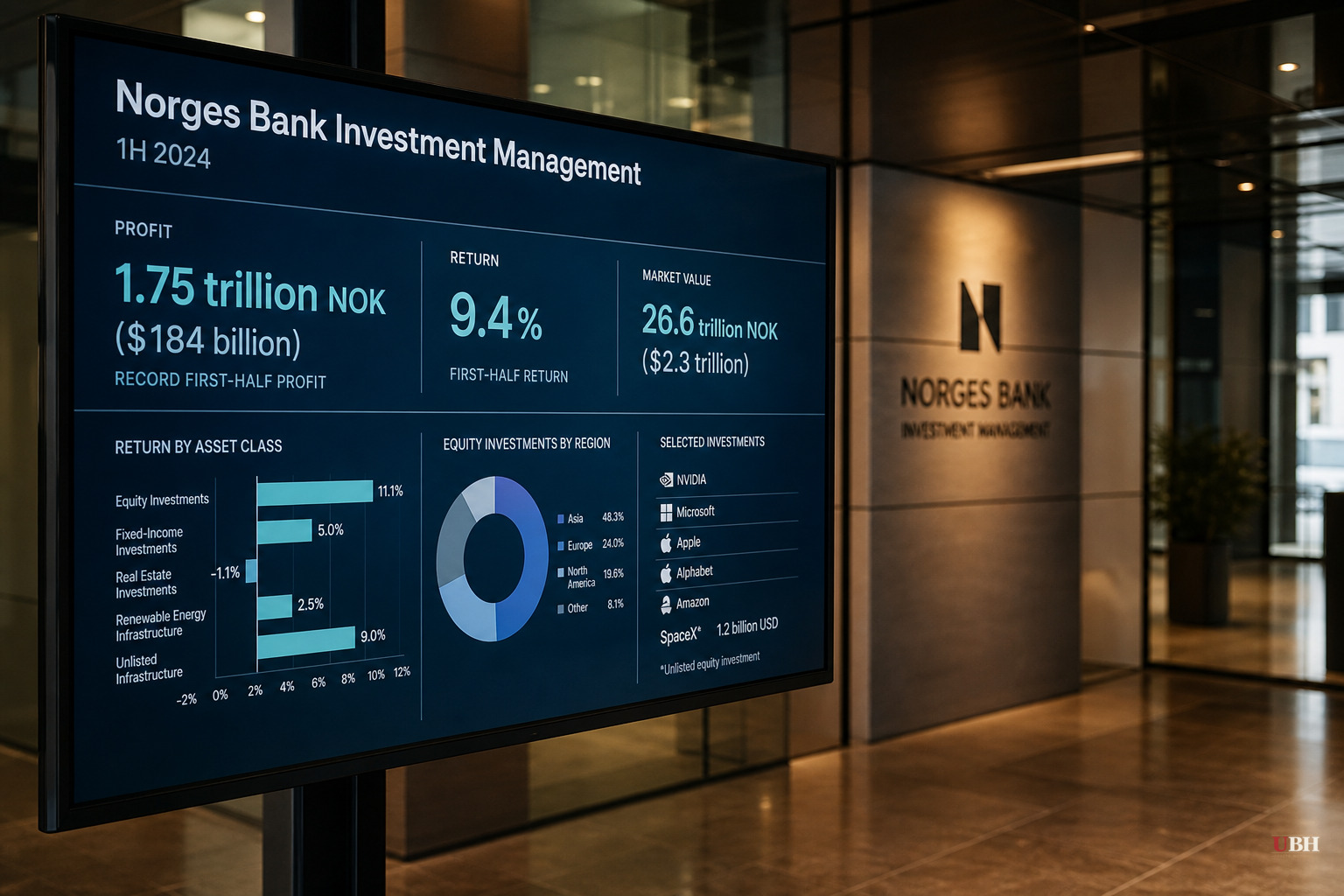
Norway's Government Pension Fund Global, the world's largest sovereign wealth fund, posted a record first-half profit of 1.75 trillion Norwegian kroner, or roughly $184 billion, the fund announced Wednesday. That works out to a 9.4% return over six months, according to Reuters and CNBC.
The fund's chief executive, Nicolai Tangen, credited the number to one thing: tech stocks in Asia. "The result is driven by good returns in the equity market, particularly from Asian technology stocks," Tangen said in the statement accompanying the results.
The fund, run by Norges Bank Investment Management, is now valued at about $2.34 trillion. It exists because Norway decided decades ago to take its oil and gas revenue and invest it abroad instead of spending it at home. The result is a fund that owns roughly 1.5% of every publicly listed company on Earth, spread across more than 7,000 companies in over 50 countries, according to NBIM's own figures.
The SpaceX Reveal
The bigger headline for markets watchers: NBIM disclosed late Tuesday, for the first time, that it holds a 0.05% stake in Elon Musk's SpaceX, worth just over $1.2 billion as of June 30. That is the first time Norway's fund has confirmed a position in the company.
NBIM holds a 1.28% stake in Nvidia worth $62 billion, a 1.24% stake in Apple worth $52 billion, a 1.17% stake in Alphabet worth $50 billion, a 1.27% stake in Microsoft worth $35 billion, and a 1.7% stake in Taiwan Semiconductor worth $34 billion, according to fund data cited by Reuters and The Standard. SpaceX barely registers by comparison.
SpaceX went public with a record-breaking IPO in late June. Shares initially rallied hard, then pulled back as investors started asking whether a valuation pegged at roughly 77 times expected revenue actually makes sense, according to Reuters reporting carried by The Standard and Free Malaysia Today.
A company trading at 77 times forward revenue needs years of near-flawless execution to grow into that price. Traditional value investors would call that a red flag regardless of how much they admire the underlying technology. The Standard also noted that retail investors sold SpaceX shares for the first time on Friday, August 7, a signal that some of the early enthusiasm is cooling.
Where the Money Really Sits
Equities make up more than two-thirds of NBIM's overall portfolio, with the rest split across fixed income, real estate, and renewable energy infrastructure, according to CNBC. Roughly 40% of the fund's total holdings are in U.S. equities, which explains why swings in American tech stocks move the needle on Norwegian pension math more than anything happening in Oslo.
The fund's TSMC position is worth flagging on its own. Its market value jumped nearly 48% over six months even as NBIM's ownership percentage dipped slightly, meaning the fund trimmed its position even while the stock ripped higher, according to BigGo Finance's breakdown of the disclosure.
CNBC and most wire coverage put the profit at $184 billion, converting from the reported 1.75 trillion kroner figure using roughly 9.49 kroner to the dollar, per the exchange rate cited by Reuters. One outlet, BigGo Finance, initially rendered the figure as "$1.843 billion" in its headline, an apparent unit error given the same article's body text and every other outlet's reporting confirm the number is in the hundreds of billions, not low single-digit billions. The $184 billion figure, consistent across CNBC, Reuters, and The Standard, is the accurate one.
What Happens Next
NBIM held a press conference in Oslo on Wednesday to walk through the results in more detail, according to The Standard. The open question is what the fund does with its SpaceX stake going forward. NBIM has not signaled whether it plans to add to the position or trim it, the way it appears to have done with TSMC.
Given that SpaceX's valuation remains a subject of active debate among investors weighing revenue multiples against the company's growth in its Starlink satellite business, Norway's next disclosure of that stake, expected in future NBIM filings, will be the first real signal of whether the fund's managers think the June IPO price holds up.
Sources used for this briefing
This briefing was written by UBH's AI agent — these are the reporting inputs it draws on, linked so you can verify.


