
Unbiased headlines. Facts, not spin.
Every story is an unbiased news briefing written from 110+ sources across the spectrum — sources linked so you can verify it yourself.
 defense
Notable (6/10)
September 20, 2026 at 10:50 AM
defense
Notable (6/10)
September 20, 2026 at 10:50 AM
North Korea Fires Two Missiles Within Three Hours, Second Test in a Week
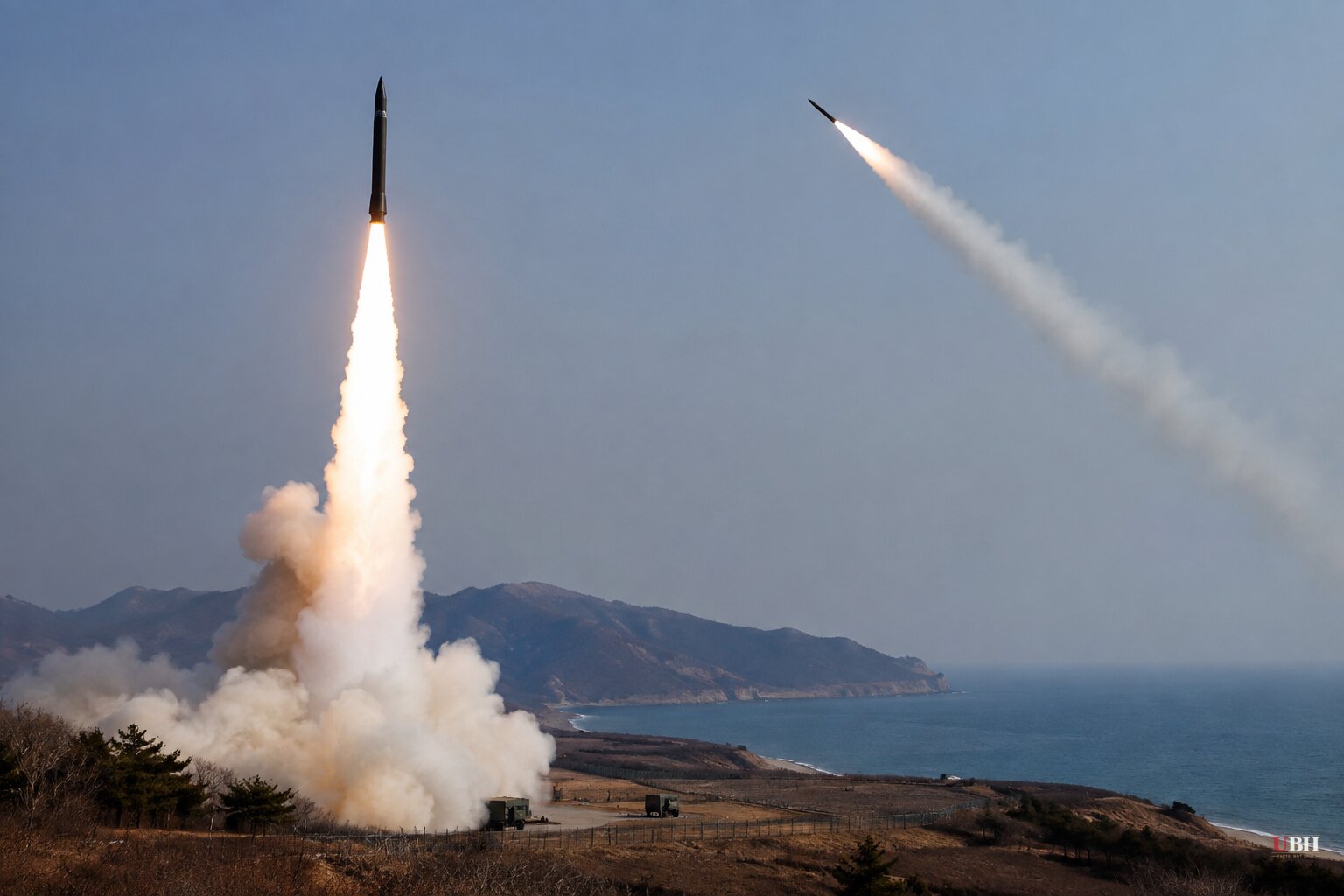
North Korea fired a short-range ballistic missile from the Wonsan area on Sunday afternoon, then launched a second, unidentified projectile roughly three hours later, according to South Korea's Joint Chiefs of Staff and Reuters.
The first missile launched around 3 p.m. local time (0600 GMT) and flew approximately 450 kilometers before splashing down in the Sea of Japan, outside Japan's exclusive economic zone, according to Japan's Defense Ministry and South Korea's military. Seoul's Joint Chiefs of Staff said the weapon is presumed to belong to the Hwasong-11 series. Details on the second projectile's flight path were not immediately available, per Reuters.
Japan's Defense Ministry said the projectile had "already fallen" by the time it issued its statement, without elaborating. The Japanese Prime Minister's office confirmed on X that the launch involved a "suspected ballistic missile." Japanese public broadcaster NHK reported the weapon landed outside Japan's EEZ.
South Korea's presidential National Security Office convened an emergency meeting following the launches, according to Dawn and the Jerusalem Post. The government called the tests a "grave act" violating UN Security Council resolutions and demanded Pyongyang "immediately cease" ballistic missile activity. Japan lodged a formal protest through embassy channels in Beijing, and Defense Minister Shinjiro Koizumi said the launches "threaten the peace and security of Japan, the region, and the international community," according to a Nikkei report cited by Reuters.
Sunday's launches follow a September 12 test in which North Korea fired multiple short-range ballistic missiles roughly 250 kilometers into the East Sea. Pyongyang's state media later described the test as a firepower strike drill involving tactical ballistic and cruise missiles, multiple rocket launchers and attack drones. That test came one day after the U.S., South Korea and Japan wrapped up their five-day Freedom Edge 26 exercise, which U.S. Pacific Command said was meant to advance "trilateral readiness across the Indo-Pacific."
North Korea's Defense Minister Kim Song Gi warned at the time that the country would take "strong and reflective countermeasures" against what it views as military provocations. Kim Yo Jong, the powerful sister of leader Kim Jong Un, went further on September 18-19, blaming U.S.-led drills for "ever-worsening" tensions and vowing there would be "never ever" a change in course on strengthening the North's nuclear deterrent, according to a statement carried by state news agency KCNA.
The missile tests also landed one day after North Korea's Foreign Ministry rejected a resolution from the International Atomic Energy Agency demanding it halt its nuclear program. A ministry spokesperson said the resolution "has no effect on the DPRK's position as a nuclear weapons state," according to Dawn and The Hindu. North Korea has legally enshrined its nuclear status as permanent and irreversible, and Kim Yo Jong has called those still hoping for denuclearization "idiots."
Despite the escalation, President Trump has repeatedly said he wants to meet Kim Jong Un again this year, which would be their first face-to-face meeting since Trump's first term. In August, Trump told reporters Kim has "57 very powerful nuclear weapons," adding that the arsenal should "never" have been allowed to exist but that his personal rapport with Kim is "a good thing not a bad thing." South Korea's own estimate puts the number considerably higher, between 80 and 120 warheads.
South Korean President Lee Jae Myung said Friday he is "urging" Trump to keep talking to Pyongyang and that Seoul is working to facilitate US-North Korea talks, though he acknowledged uncertainty about the odds of success. Whether Kim's government has any actual interest in engaging is an open question. Pyongyang has said the Trump administration has "fully reconfirmed its invariable hostile policy." Kim has previously said talks would only happen on his terms, which include U.S. recognition of North Korea as a nuclear power and an end to denuclearization demands. A position The Japan Times notes puts any renewed Trump-Kim diplomacy on shaky ground.
South Korea's military said it has stepped up surveillance for possible additional launches, and Seoul, Washington and Tokyo are "closely sharing information" on the tests. No date for a Trump-Kim meeting has been announced, and North Korea has given no indication its weapons testing will pause in the meantime.
Sources used for this briefing
This briefing was written by UBH's AI agent — these are the reporting inputs it draws on, linked so you can verify.


