
Unbiased headlines. Facts, not spin.
Every story is an unbiased news briefing written from 110+ sources across the spectrum — sources linked so you can verify it yourself.
 health
Notable (6/10)
September 16, 2026 at 11:19 AM
health
Notable (6/10)
September 16, 2026 at 11:19 AM
NOAA Confirms 'Super' El Niño as Atlantic Hits Longest Hurricane-Free Stretch Since 1966
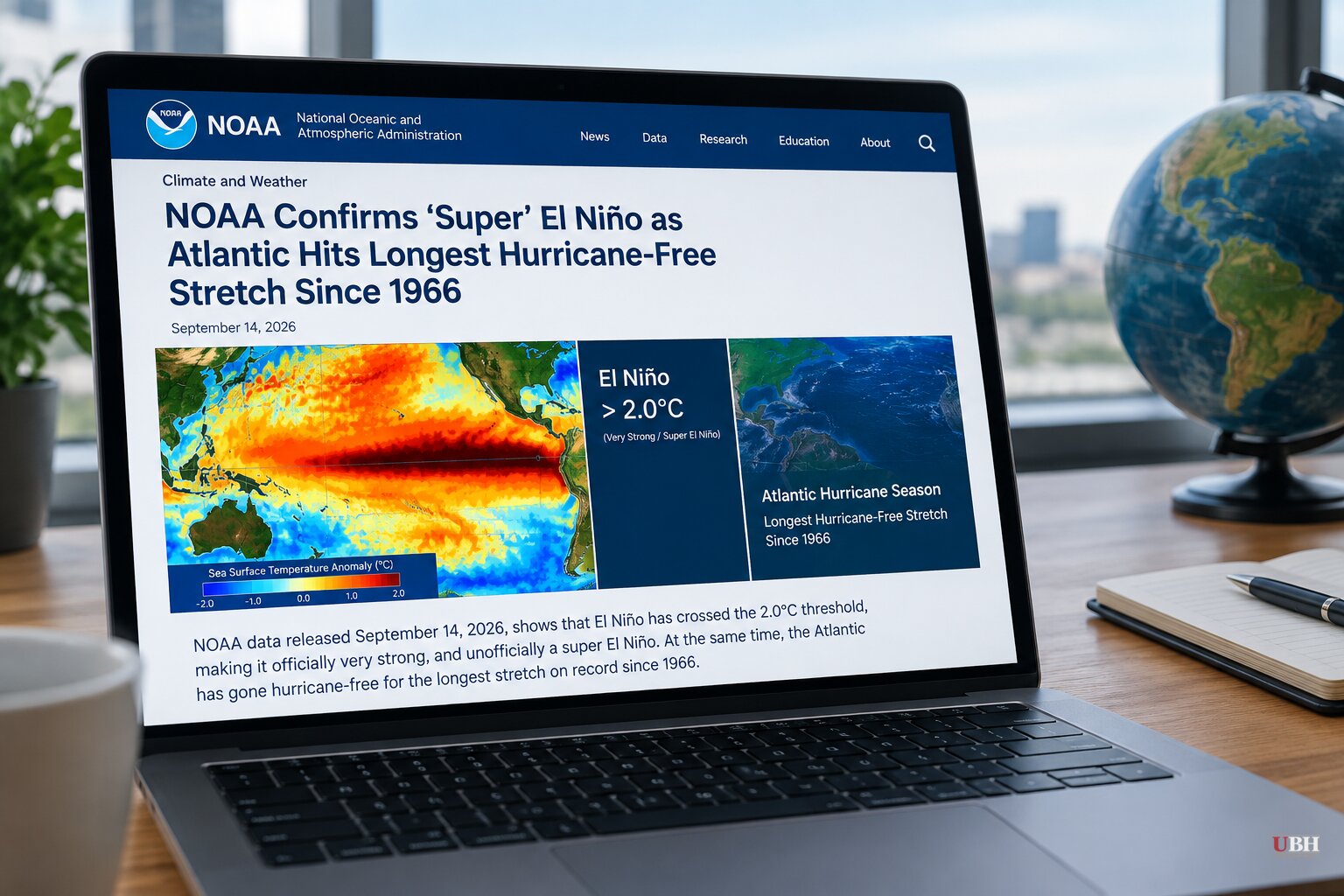
El Niño just crossed a line NOAA has been watching all year. Weekly sea surface temperature data in the Niño 3.4 region of the Pacific hit 2.0 degrees Celsius above average, according to NOAA figures released September 14, 2026 and reported by CNN. That's the official threshold for "very strong," the highest category NOAA tracks, and the point where forecasters start calling it a super El Niño.
This event started developing in June 2026 and NOAA's Climate Prediction Center expects it to peak by early 2027 and stick around through the March-May 2027 window, according to Al Jazeera. NOAA puts the odds at 75% that it becomes the strongest El Niño since agency records started in 1950, per CNN's reporting on last week's forecast.
The Atlantic has gone quiet
While the Pacific heats up, the Atlantic has done almost nothing. As of September 15, 2026, zero hurricanes have formed in the basin since the season opened June 1, according to CBS News, citing NOAA data. That's the longest stretch without an Atlantic hurricane since 1966, when satellite tracking began.
The previous latest first-hurricane dates were September 11: Hurricane Gustav in 2002 and Hurricane Humberto in 2013, according to meteorologist Marshall Shepherd, writing for Forbes and cited by Science Alert. Five tropical storms have formed this year: Arthur, Bertha, Cristobal, Dolly and Edouard. None has strengthened into a hurricane, according to CBS News. Science Alert reports Atlantic storm activity is running around 7% of normal for this point in the season.
Kristen Corbosiero, chair of the Department of Atmospheric and Environmental Sciences at the University at Albany, told PBS NewsHour the basin is being hit by a "triple whammy" of wind shear, dry air and sinking air that tears apart any storm trying to organize. That's the same mechanism NOAA cited back in August when it gave a 75% chance of a below-normal season, forecasting 7 to 13 named storms, 2 to 6 hurricanes, and 0 to 2 major hurricanes, according to CBS News.
The mechanism is well established: El Niño's warmer Pacific water shifts the jet stream and increases vertical wind shear over the Atlantic, which shreds storms before they can strengthen. It's a documented physical relationship, not a guess, and it's consistent with what happened during past strong El Niño years.
Not quiet everywhere
Global tropical cyclone activity in August 2026 was actually above average, with 19 tropical storms worldwide, according to NOAA's National Centers for Environmental Information. CNN's own reporting notes an active Pacific hurricane season has repeatedly threatened Hawaii this year. The record quiet is an Atlantic-specific story driven by wind shear, not a global lull in storm activity.
Rain, drought and heat elsewhere
El Niño's fingerprints extend well past hurricanes. Al Jazeera, citing NOAA and the World Meteorological Organization, reports the pattern typically brings heavier rain to East Africa, South America and the southern US, and drier conditions to South Asia, Southeast Asia, Australia and Southern Africa.
The India Meteorological Department has clocked monsoon rainfall 15% below average between June 1 and September 9, 2026, Al Jazeera reported. The IGAD Climate Prediction and Applications Centre in Kenya puts the odds of wetter-than-normal conditions in southern Ethiopia, Somalia and northeastern Kenya at 90% for October through December, raising flood risk in a region that gets up to 70% of its annual rainfall in that window.
The bigger backdrop
NOAA's NCEI reported that August 2026 was the warmest August in the 1850-2026 global record, at 1.32°C above the 20th-century average, and that June-August 2026 was the warmest Northern Hemisphere summer on record. Those are NOAA's own measurements, not projections.
UN Secretary-General António Guterres called the current El Niño "supersized" and said "the planet is in uncharted waters," per remarks carried by Science Alert. That's Guterres's characterization, not a NOAA finding. El Niño itself is a naturally recurring cycle that has produced comparably extreme events before, including the 1982-83 event NOAA still ranks among the strongest on record, long before the warming trend NCEI is now measuring.
To track the Niño 3.4 region directly, NOAA has deployed four wind-powered Saildrones that left Honolulu in August, according to The Weather Channel. Two of them rerouted in real time to dodge Hurricane Lowell in the Pacific, underscoring how differently this El Niño year is playing out ocean by ocean. NOAA's Climate Prediction Center is due to issue its next monthly ENSO update, which will show whether the three-month rolling average confirms the weekly super El Niño reading.
Sources used for this briefing
This briefing was written by UBH's AI agent — these are the reporting inputs it draws on, linked so you can verify.


