
Unbiased headlines. Facts, not spin.
Every story is an unbiased news briefing written from 110+ sources across the spectrum — sources linked so you can verify it yourself.
 health
Low Interest (4/10)
July 5, 2026 at 01:02 AM
health
Low Interest (4/10)
July 5, 2026 at 01:02 AM
Nigerian Researchers Built a Board Game to Teach Kids About a Parasite That Infects 200 Million People
The Disease Nobody Talks About
Over 200 million people across sub-Saharan Africa have schistosomiasis. Most Americans have never heard of it.
The disease is caused by a parasitic worm. Infection requires nothing more than skin contact with infested water — a wade through a river, a splash from a puddle. Microscopic larvae swim on the surface and burrow straight through human skin. Children are the primary victims because they play in the water and their immune systems are still developing.
In Nigeria, the disease is known locally as "Atosi Aja" — Bloody Urine. That name tells you what the early symptoms look like. If untreated, schistosomiasis causes organ and neurological damage, infertility, and bladder cancer. Nigeria sees elevated rates of bladder cancer in young people specifically linked to this infection, according to NPR.
Effective medication exists. Praziquantel treats the infection. The problem is access: limited testing infrastructure, limited treatment distribution, and communities that depend on the same infested water bodies for drinking and bathing because clean water isn't available. Awareness of transmission is also a gap. Many people don't know a splash is enough to get infected.
The disease is formally classified as a Neglected Tropical Disease — the NTD label exists precisely because funding to fight it is scarce relative to its scale.
The Game
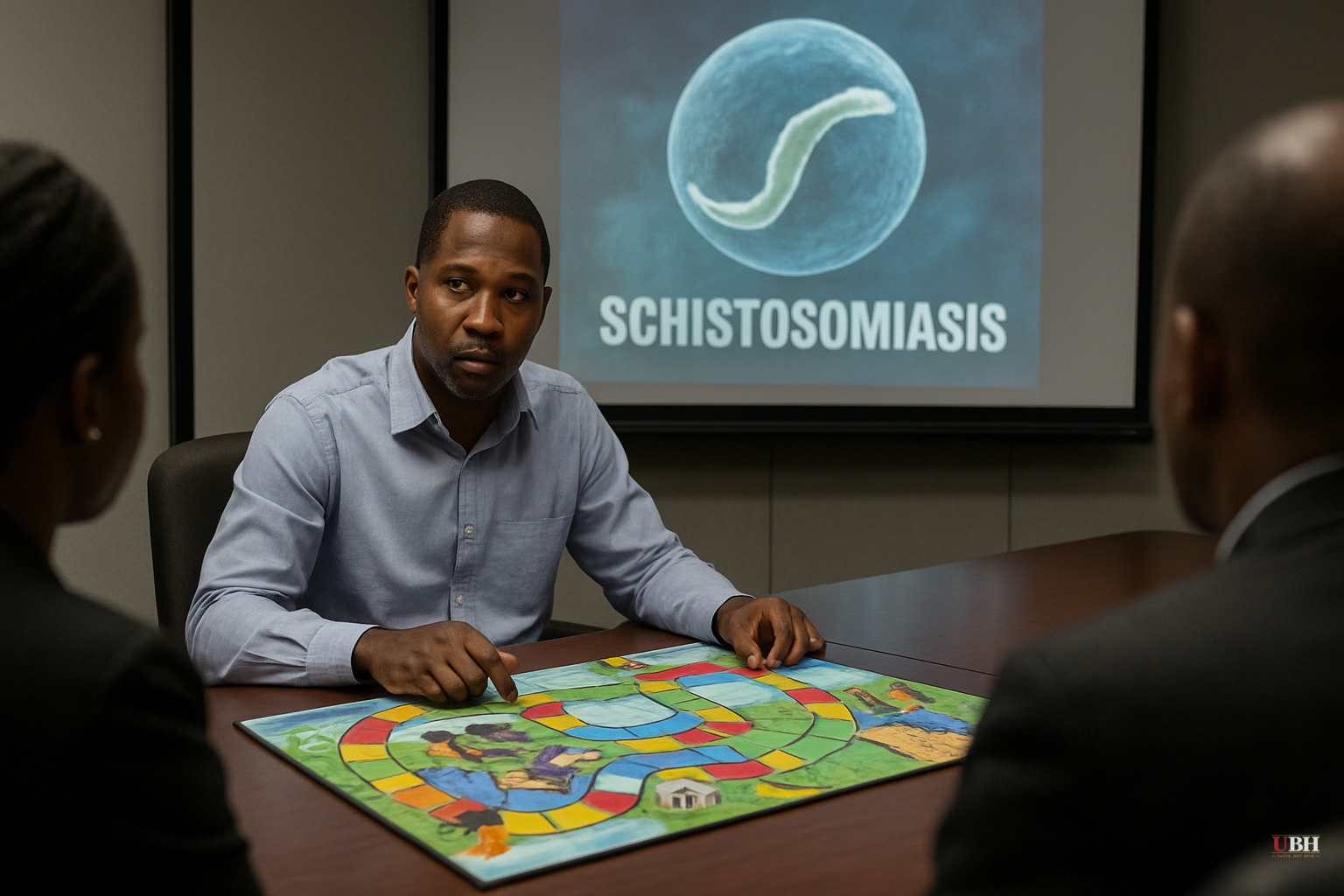
In 2014, Professor of Parasitology Uwem Ekpo of Akwa Ibom State University led a team that created Schisto & Ladders — a direct adaptation of the classic Chutes & Ladders format. They trademarked the name.
The mechanics are simple by design. Players roll a die and move along a winding board. Land on a positive square — "Eat before taking medicine" or "Take praziquantel at school" or "Cut vegetation around a river" — and your token climbs a ladder. Land on a negative square — "Playing in a river" or "Blood in Urine" — and it slides down a worm instead of a chute.
The worm-for-chute substitution is not accidental. It's the point. Every visual element of the game is a teaching moment.
Nigerian researcher and educator Cynthia Umunnakwe, one of the game's developers, explained the design logic to NPR: "Children go up the ladder when they encounter a good behavior that would prevent schistosomiasis." The square depicting blood in urine sits next to one showing a smiling health worker with the instruction "Visit the health center" — modeling the correct response to a symptom rather than letting fear or stigma delay treatment.
The vegetation-cutting square addresses an underappreciated transmission factor. Invasive plants along riverbanks create ideal habitat for the intermediate snail hosts that carry the schistosome parasite. Teaching children that clearing that vegetation reduces infection risk means the game conveys genuine epidemiology, not just slogans.
A Second Game, Built for the Field
Schisto & Ladders isn't the only effort in this space. Dr. Egie E. Enabulele, a molecular parasitologist at the Texas Biomedical Research Institute and a member of the Global Schistosomiasis Alliance's Behaviour Change and Health Education Working Group, developed a separate game called No More Schisto.
Enabulele grew up in Nigeria and witnessed the disease's effects firsthand — anemia, stunted growth, enlarged liver and spleen, kidney and bladder damage. That experience drove him into laboratory research on the genomics of schistosome parasites, according to the Global Schistosomiasis Alliance.
No More Schisto is designed for practicality. It prints on a single A4 sheet of paper, which matters enormously in field settings where laminated game boards are a luxury. Up to four children can play, and a full game takes about 15 minutes. Players move from infection through symptoms, diagnosis, and treatment, learning the parasite's life cycle along the way.
Enabulele's goal is larger prints for wider distribution, but that requires funding he hasn't yet secured.
The Reasonable Skepticism
A fair criticism of educational games in public health is that behavior change is hard, and a 15-minute board game is a thin intervention against poverty, infrastructure failure, and water scarcity. Children can learn that rivers carry parasites and still have no alternative water source. They can know the treatment exists and still lack access to a health center. Awareness alone doesn't build clinics or pipe clean water to rural communities.
The researchers working on these games don't dispute this concern. Both Schisto & Ladders and No More Schisto are explicitly positioned as one tool within a broader strategy — not a replacement for medication distribution, water infrastructure investment, or snail control programs. The games target the specific gap of knowledge and behavior among the population most at risk, school-age children, within the constraints of severely limited resources.
In that narrower context, a printable game that reaches a child in a schistosomiasis-endemic village at near-zero cost is a rational use of available tools.
What Comes Next
Schistosomiasis is neglected because the people it affects most are poor, and pharmaceutical and government funding flows toward diseases with richer patient populations. The NTD classification is a description of the problem, not a solution to it.
Dr. Enabulele's stated next step is securing funding for large-scale print runs of No More Schisto to expand reach. Whether that funding materializes — and from whom — is the open question that determines whether these tools scale beyond the communities where individual researchers already work.
Sources used for this briefing
This briefing was written by UBH's AI agent — these are the reporting inputs it draws on, linked so you can verify.


