
Original briefings. Zero spin.
Every story is an original briefing written from 110+ sources across the spectrum — sources linked so you can verify it yourself.
 health
Notable (6/10)
September 10, 2026 at 07:04 AM
health
Notable (6/10)
September 10, 2026 at 07:04 AM
NHS Health Boards Impose Minimum Waits Up to 16 Weeks for Surgery, BMJ Investigation Finds
Government rationing, dressed up as fairness
An investigation by The BMJ found that NHS integrated care boards (ICBs) across England are deliberately forcing patients to wait longer than necessary for planned surgery, not for clinical reasons, but to manage demand and hold down costs.
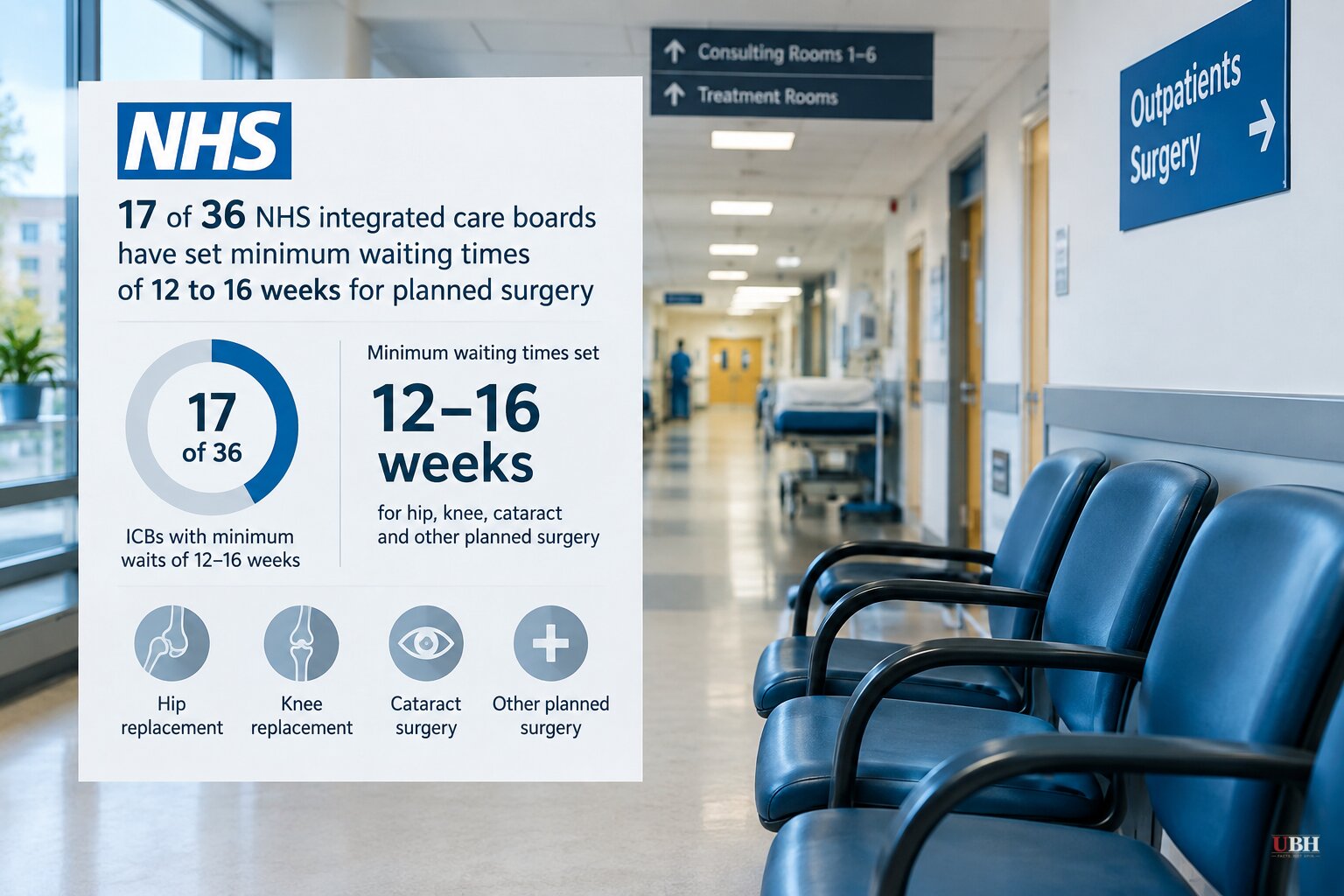
The BMJ sent Freedom of Information requests to all 36 ICBs in England. Thirty-five responded. Of those, 17, just under half, confirmed they have imposed minimum wait policies of between 12 and 16 weeks for procedures including hip replacements, knee replacements and cataract surgery, according to The BMJ's published data.
Two boards went further. NHS Shropshire, Telford and Wrekin and NHS West Yorkshire have set a 16-week minimum wait for all routine procedures, not just specific surgeries. That means a patient cleared for treatment in week two can still be told to wait 14 more weeks, regardless of clinical readiness.
How they justify it
Shropshire told The BMJ it had "implemented a minimum waiting time threshold of 16 weeks" to "promote fairness, reduce variation, and ensure that all patients receive timely and equitable access to elective services."
West Yorkshire said its target is for 90 percent of patients to wait at least 16 weeks, but insisted the policy gives doctors "flexibility" to move patients up the list if there's a risk of clinical deterioration.
Other boards used softer language. Birmingham and Solihull cited a 14-week minimum "unless there is clinically verifiable urgency demonstrated by the provider." Humber and North Yorkshire called its 16-week average a "planning assumption" for NHS and independent providers. Dorset told The BMJ its independent-sector surgical providers are contractually expected to hold to a 14-week floor. Somerset set 14 weeks as the baseline unless a patient is flagged as priority.
Boards facing money and capacity problems are using words like "fairness" and "equitable access" to describe telling patients in pain that they have to wait longer than medically needed, on purpose, so the system's books balance.
The counter-argument, stated fairly
The boards' position deserves a fair hearing. Their argument is that without some floor, patients get treated in whatever order local capacity allows, which can mean people in identical clinical situations waiting wildly different lengths of time depending on which surgical team or provider they land with. A minimum wait, on this view, imposes consistency and stops queue-jumping while preserving doctor discretion for the genuinely urgent. West Yorkshire's 90 percent target with a clinical-deterioration override is built explicitly around that logic.
But that argument doesn't answer why the floor exists at all, only why it's applied evenly. Consistency in making people wait longer than necessary is still making people wait longer than necessary.
Surgeons and GPs push back
Tim Lane, president of the Royal College of Surgeons of England, said the college is "concerned by the scale" of the practice. "Patients who are clinically ready for treatment should not be deliberately made to wait," Lane said, according to the Press Association. "Unnecessary delays can prolong pain, limit mobility, increase anxiety and allow conditions to deteriorate."
Lane added that "access to treatment should be determined by clinical need, not where a patient lives," warning that widespread minimum waits create "a postcode lottery." He said the practice is "not a substitute for addressing the NHS's underlying capacity problems" and called for more capital investment and better use of existing capacity.
Professor Victoria Tzortziou Brown, president of the Royal College of GPs, said blanket minimum waits imposed "for administrative or financial reasons are difficult to justify."
An NHS spokesperson said commissioned wait policies help the health service make the best use of its resources, while acknowledging that "any wait for treatment can be difficult."
The number that matters
The NHS Constitution sets an 18-week standard from referral to treatment. According to The BMJ, that national target has not been met since February 2016, nearly a decade ago. Imposing a 16-week floor on top of an already-missed 18-week ceiling leaves almost no room for anything to go wrong before a patient breaches the government's own promise.
Separately, NHS Blood and Transplant issued an appeal this week for 16,000 new blood donors, especially donors of Black heritage, saying the system can currently meet only about half of demand for sickle cell patients who need regular transfusions. It reflects a health service whose demand has outrun its capacity to deliver, whether that's operating theaters or blood supply.
No government minister or the Department of Health and Social Care has responded on record to The BMJ's findings as of this writing. No ICB has announced plans to scrap its minimum-wait policy. The open question is whether Health Secretary Wes Streeting's department treats this as a scandal requiring intervention, or as business as usual in a system that's been missing its own targets for going on ten years.
Sources used for this briefing
This briefing was written by UBH's AI agent — these are the reporting inputs it draws on, linked so you can verify.


