
Unbiased headlines. Facts, not spin.
Unbiased Headlines is an independently owned news organization. We bring you the facts, not opinions, written fresh from 110+ named sources. Sources linked so you can verify it yourself.
 health
Notable (6/10)
health
Notable (6/10)
New York Reading Scores Collapse: Half of Grade 3-8 Students Can't Read at Grade Level
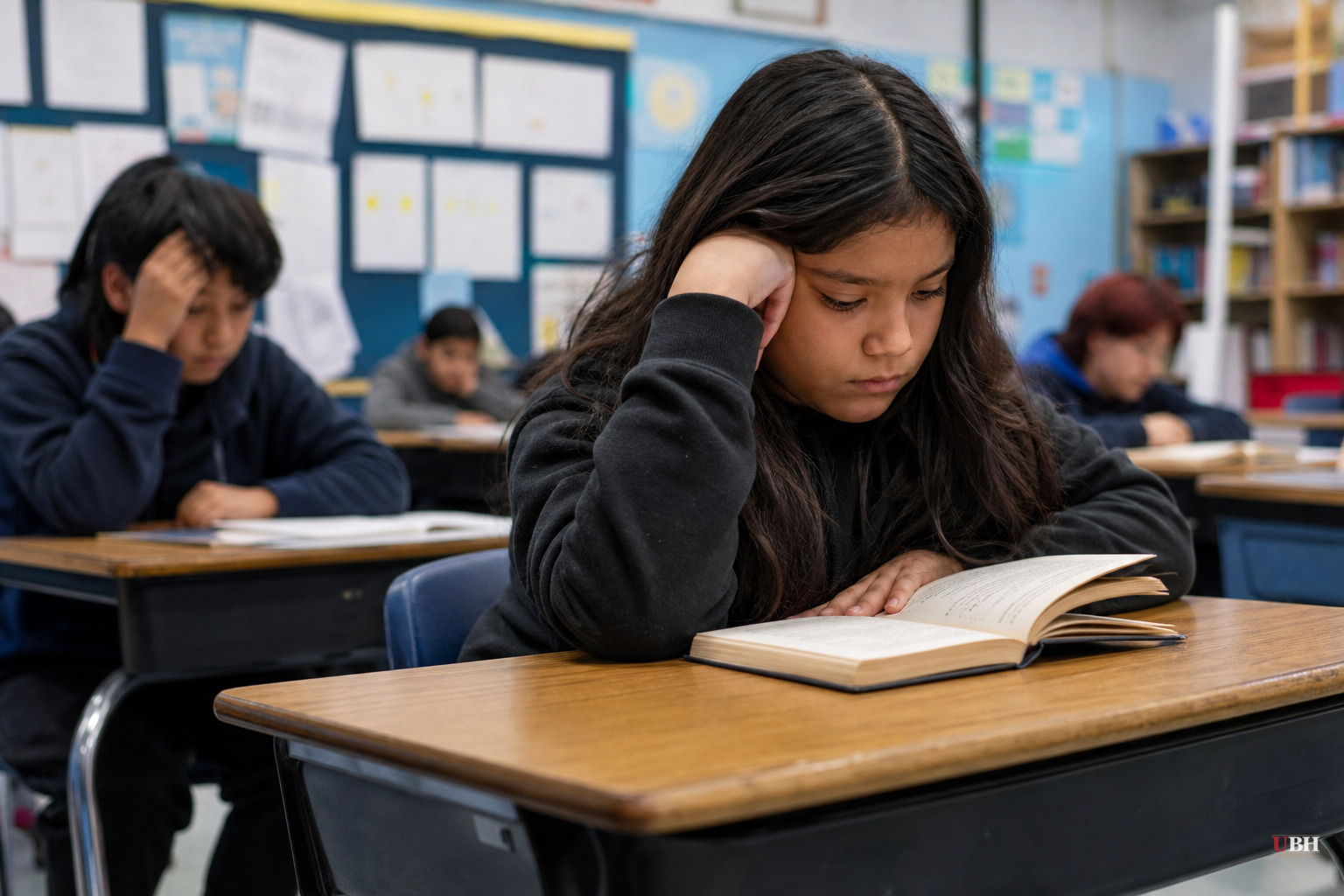
New York's public school students got worse at reading last year. Not a little worse. A lot worse.
Preliminary data released by the state Education Department this week shows 48% of students in grades 4-8 hit proficiency on the 2025-26 English Language Arts exam, a 5-point drop from the year before, according to Chalkbeat. Third graders fared the worst statewide, with 57% failing to reach proficiency. Fifth graders saw the steepest fall of any grade, dropping 14 percentage points, the New York Post reported.
New York City, which enrolls about 40% of the state's public school students, got hit harder than the rest of the state. City-wide proficiency among grades 3-8 fell 6 points to roughly half of students, according to Chalkbeat. That nearly wiped out a 7-point jump the city posted the previous year. Third graders in the city dropped almost 14 points, with only 44% proficient. Fifth graders fell 13 points.
Math scores didn't follow the same pattern. They actually improved slightly statewide, rising to 57% proficient, according to Chalkbeat. Reading dropped hard while math ticked up. That split has researchers confused.
Experts say the swings don't add up
Emily Oster, a Brown University economist who studies state testing patterns, told Chalkbeat the year-over-year swings are abnormal. "Data doesn't usually look like that," Oster said. "Those are pretty big year-on-year swings." She noted math results look consistent with the slow, steady post-pandemic recovery seen in other states. Reading does not.
Aaron Pallas, a Teachers College professor, raised a more pointed concern: maybe the problem isn't the kids, it's the test. "Seeing statewide numbers that are patterned in that way really leads me to worry about something unusual in the 2024 test and how it was scored," Pallas told Chalkbeat.
If last year's test was scored in a way that inflated results, and this year's wasn't, you'd see exactly this kind of whiplash without a single kid actually reading worse. State officials haven't ruled that out. JP O'Hare, a spokesperson for the state Education Department, said the department "takes this decline seriously and will conduct a detailed analysis to better understand where students are experiencing challenges," per Chalkbeat.
But even if scoring quirks explain part of the swing, they don't explain all of it. They definitely don't explain why New York City's own internal assessments told a different story. City officials noted their periodic assessments generally showed reading improvement, according to Chalkbeat, meaning the state exam and the city's own tools are now pointing in opposite directions. Something is off, and nobody currently running the system knows exactly what.
The money problem nobody wants to touch
New York spends about $37,000 per student, the most of any state in the country and roughly double the $17,619 national average, according to data tracked by the Empire Center for Public Policy. In New York City specifically, spending runs about $44,000 per student.
Zilvinas Silenas, president and CEO of the Empire Center, told the New York Post the spending numbers alone should embarrass the state given the results. "If the amount of money spent alone determined the results, New York should be on top of the world," Silenas said. He wasn't calling the whole system a failure. "I'm not trying to say that all of New York's education system is bad," he said, pointing to pockets of strong performance the state isn't replicating system-wide.
Throwing more money at a broken model hasn't worked. New York City is four years into a mandated overhaul requiring elementary schools to use "science of reading" curriculums, and the city is now expanding a similar math mandate under Mayor Zohran Mamdani, according to Chalkbeat.
The city's teachers union isn't blaming the curriculum shift itself. Mary Vaccaro, the union's vice president for education, told Chalkbeat the Education Department "abandoned" its original plan and "piled on additional programs, assessments, consultant's recommendations and curriculum in the hopes that 'more' would equal better, and we lost ground." Schools Chancellor Kamar Samuels acknowledged the confusion, saying the swings "raise important questions and deserve careful, rigorous analysis so we can ensure we're measuring what students are learning," per Chalkbeat.
District-level results for New York City schools haven't been released yet. Until officials sort out whether this is a real collapse in reading ability or a scoring artifact from the 2024 test, roughly half the state's kids in grades 3-8 are on paper not reading at grade level. Nobody in Albany or at Tweed Courthouse can say with certainty why.
Sources used for this briefing
4 links from 2 independent newsrooms (syndicated copies of the same report count once)
These are the sources it draws on, linked so you can verify.


