
Original briefings. Zero spin.
Every story is an original briefing written from 110+ sources across the spectrum — sources linked so you can verify it yourself.
 health
Low Interest (4/10)
Event date: September 11, 2026
health
Low Interest (4/10)
Event date: September 11, 2026
New Study: Walking Faster for 30 Minutes Beats Chasing 10,000 Steps
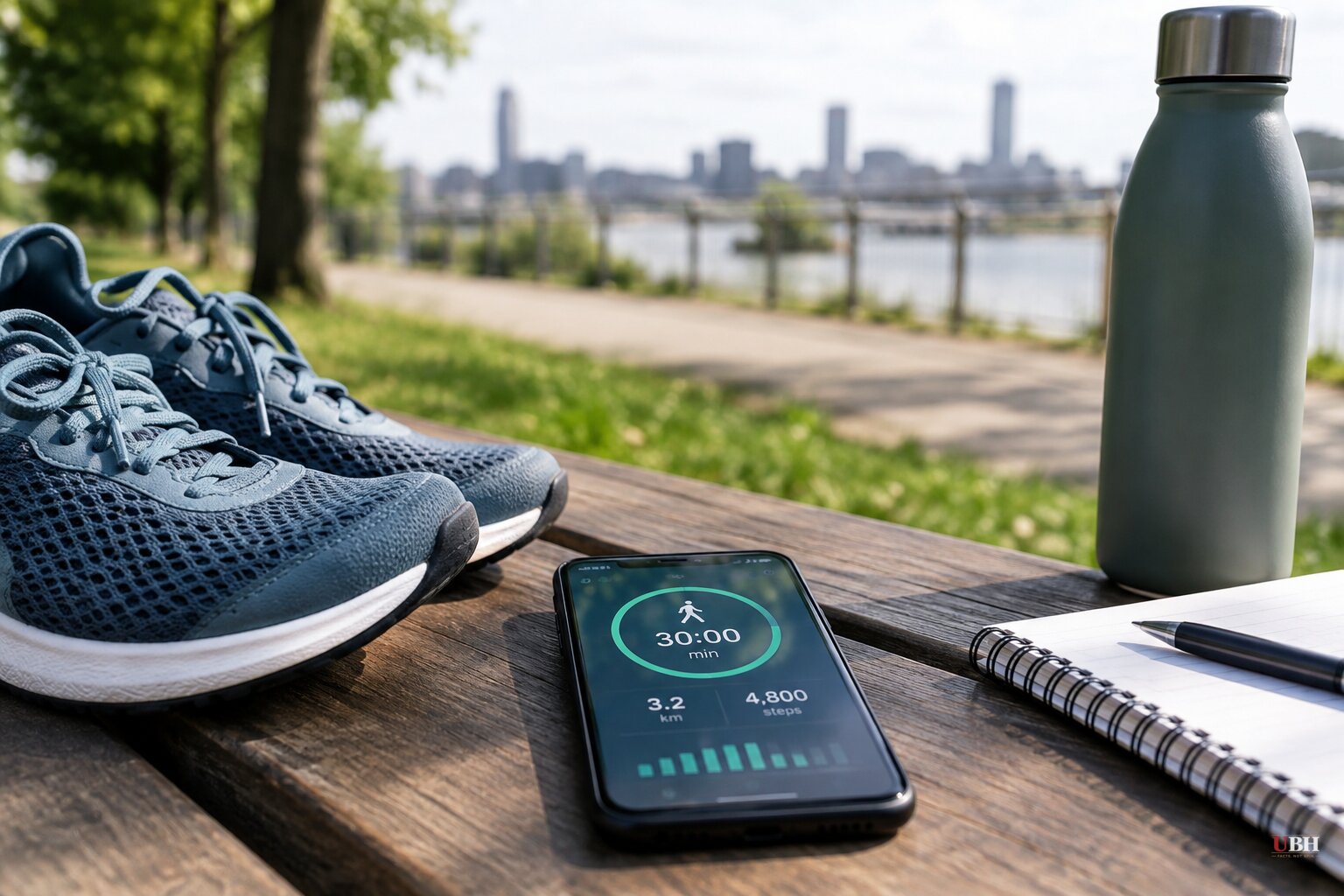
The 10,000-step goal you've been chasing on your fitness tracker was never based on science. It came from a marketing gimmick.
A new study published in the British Journal of Sports Medicine in September 2026 confirms what researchers have suspected for years: the number came from a 1960s Japanese pedometer campaign, not a clinical trial, according to study co-author Nicholas Koemel of the University of Sydney, as reported by Science Alert.
Now the same research team, led by Emmanuel Stamatakis, a professor of physical activity, lifestyle and population health at the University of Sydney, has produced data suggesting pace matters as much as volume.
The Numbers
Researchers analyzed movement data from 103,684 UK Biobank participants who wore wrist accelerometers for seven consecutive days between 2013 and 2015, according to Medical News Today. After excluding people with missing data or a history of cardiovascular disease or cancer, 64,743 participants were tracked for all-cause mortality and 70,075 for cardiovascular mortality.
Participants were followed until November 2022, an average of eight years. During that span, 1,697 people died of any cause and 502 died of cardiovascular disease, Medical News Today reported.
The team split people into four groups by daily step count: fewer than 5,000, 5,000 to 7,500, 7,500 to 10,000, and more than 10,000. They also measured each person's "peak 30-minute cadence," the average steps per minute during their 30 most active minutes of the day, whether or not those minutes were consecutive.
Speed Can Make Up for Distance
People who walked fewer than 5,000 steps a day but hit a peak cadence of at least 80 steps per minute had a substantially lower risk of death, according to CNN. That risk was comparable to people who logged 5,000 to 7,500 steps a day at a slower pace of around 60 steps per minute.
Prevention.com put a specific figure on it: those under-5,000-step walkers who hit 80-plus steps per minute had a 28% lower risk of death during the eight-year follow-up compared to slower walkers in the same step range.
The lowest overall mortality risk still belonged to people logging 7,500 to 10,000 steps a day, regardless of pace, according to CNN, Medical News Today, and National Geographic. Science Alert reported the sweet spot for cadence sat around 90 to 100 steps per minute.
Why It Matters for People Who Can't Hit the Number
Stamatakis said the findings target people for whom 10,000 steps feels less like a goal and more like a reason to quit. "To a 65-year-old managing a knee, a carer with fragmented time, or a shift worker, that number can feel less like a goal and more like a reason to give up," he told CNN.
Koemel made the same point to philstarlife: "For a 65-year-old managing a knee issue, a carer with fragmented time, or a shift worker, a high step target can be a reason to give up rather than a reason to start."
Outside physicians backed up the practical takeaway. Denice Ichinoe, a primary care sports medicine physician at the University of Nevada, Las Vegas, told National Geographic the study "moves us away from thinking there is one magic number of steps everyone has to reach." Rosy Thachil, a cardiologist at NYC Health+Hospitals/Elmhurst, framed it simply to National Geographic: step count measures how much you moved, intensity measures how hard your heart worked.
The Catch Nobody Should Skip
Researchers tracked what people already did with their bodies. They did not assign anyone to walk faster and measure the outcome.
Stamatakis was direct about that limit in comments to Medical News Today: "This is observational work, so it should be read as an association rather than proof that changing peak-30 cadence... lowers mortality." Association is not causation. People who already walk briskly might be healthier for other reasons: they may be less likely to have joint pain, more likely to exercise elsewhere, or simply younger in physiological terms than their calendar age suggests. The study tried to control for prior cardiovascular disease and cancer by excluding those participants, but it can't rule out every confounding factor.
Across the seven outlets covering this release, the underlying numbers hold up consistently: same 64,743-person cohort, same eight-year follow-up, same four step-count brackets, same 80-steps-per-minute threshold for the under-5,000 group. No outlet significantly misstated the topline findings.
The unresolved question is what comes next. The researchers didn't test whether deliberately training people to walk faster changes outcomes. That would require a randomized trial, something this data set can't provide. Until someone runs one, the honest takeaway is a correlation between brisk walking and lower mortality, not a proven cause. For now, this gives the fitness-tracker crowd a data point: pace has a place in the conversation that step count alone spent decades dominating.
Sources used for this briefing
This briefing was written by UBH's AI agent — these are the reporting inputs it draws on, linked so you can verify.


