
Unbiased headlines. Facts, not spin.
Every story is an unbiased news briefing written from 110+ sources across the spectrum — sources linked so you can verify it yourself.
 health
Notable (6/10)
August 5, 2026 at 01:47 AM
health
Notable (6/10)
August 5, 2026 at 01:47 AM
New Study Says Stress Under LA and San Bernardino Is Highest Modeled in 1,000 Years
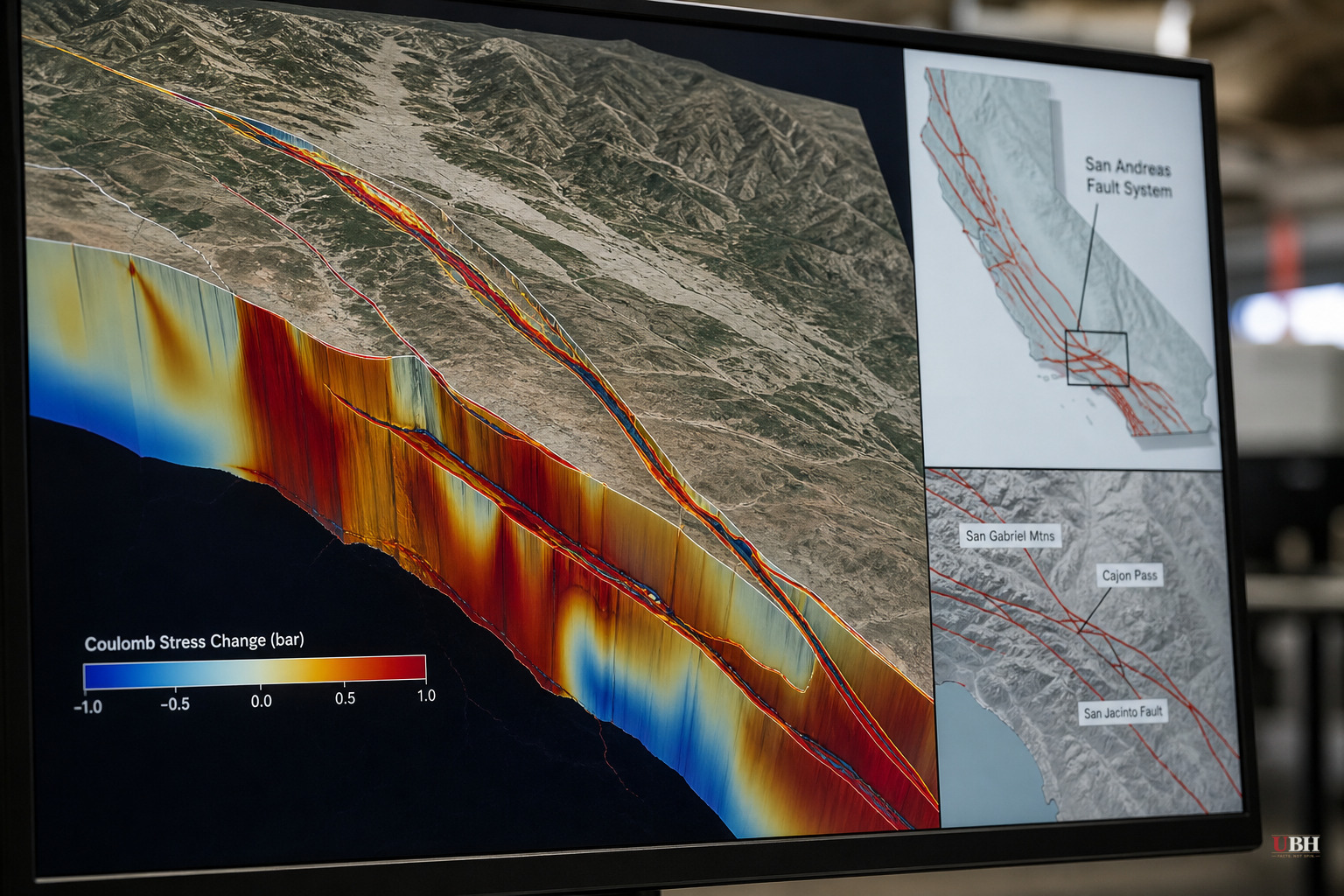
A new peer-reviewed study says the fault system running beneath the Inland Empire and northeast Los Angeles is under more modeled stress than at any point in a 1,000-year reconstruction, and that a single earthquake could tear across both the San Andreas and San Jacinto faults at once.
The research, led by Dr. Liliane Burkhard of the University of Bern and published in the Journal of Geophysical Research: Solid Earth, simulated 1,000 years of earthquake cycles on the southern San Andreas and San Jacinto fault systems. Researchers caution these are modeled values that depend on the simulation's assumptions, not direct measurements taken underground.
The flashpoint researchers are watching most closely is Cajon Pass, where the San Andreas and San Jacinto systems intersect northeast of Los Angeles. That junction isn't just a geological curiosity. Interstate 15, freight rail lines, power corridors, and the aqueducts that supply Southern California's water all cross through it.
Burkhard's team describes Cajon Pass as an "earthquake gate," a junction that can either stop a rupture cold or let it through to the next fault segment. History shows it's done both. The 1857 Fort Tejon earthquake, magnitude roughly 7.9, stopped there. The 1812 Wrightwood earthquake, by contrast, is believed to have crossed both faults.
The model puts Coulomb stress at 3.6 megapascals on the San Jacinto-Bernardino segment, the highest value found anywhere in the entire 1,000-year reconstruction, and 2.8 megapascals on the San Andreas Mojave South segment. Both figures are elevated and closely aligned, a configuration the study says matches what preceded past joint ruptures. If today's stress pattern behaves like it has before, the study says a through-going rupture could reach magnitude 7.4 to 7.8.
More than 160 years of slip has piled up since the 1857 Fort Tejon rupture. That's a long time for stress to accumulate, and it's the core reason seismologists keep flagging this stretch of fault as overdue.
Caltech seismologist Lucy Jones, who helped build the widely cited magnitude-7.8 "ShakeOut" scenario used in California emergency planning, points out that the San Andreas is the state's longest fault and therefore capable of producing its largest earthquakes. The ShakeOut scenario projects nearly two minutes of shaking, more than 1,800 deaths, 50,000 injuries, and over $200 billion in damage if that scenario played out.
"It could go another 100 years. It could be tomorrow," Jones told ABC7. That line captures the honest limit of earthquake science: nobody can put a date on this. A 2008 USGS forecast put the 30-year odds of a magnitude-6.7 or larger quake on the southern San Andreas at 59 percent, the highest of any fault in the state, a figure researchers have used for years as a baseline risk estimate.
Burkhard stopped short of forecasting a date, telling Newsweek that while this does not mean an earthquake will happen tomorrow, "the system is as loaded as it has ever been in our record, and the question is not really if but when."
This study models, based on historical rupture patterns and geologic data, where stress has built up the most over a thousand simulated years. The San Jacinto-Bernardino segment near Cajon Pass comes out on top. That's a meaningfully different claim than "the Big One is coming soon," even though the two get blurred together in headlines. The study doesn't prove an earthquake is imminent or give a timeline.
The unresolved question isn't whether Southern California will eventually see a major rupture on this fault system. Geologists across the political and institutional spectrum agree it will, eventually. The open question is how much of the region's critical infrastructure, the aqueducts, the rail lines, the freeway interchanges at Cajon Pass, can actually withstand a magnitude 7.4 to 7.8 event when it happens.
Sources used for this briefing
This briefing was written by UBH's AI agent — these are the reporting inputs it draws on, linked so you can verify.


