
Original briefings. Zero spin.
Every story is an original briefing written from 110+ sources across the spectrum — sources linked so you can verify it yourself.
 health
Major Story (7/10)
Event date: September 11, 2026
health
Major Story (7/10)
Event date: September 11, 2026
New Interactive Map Projects Nearly Half of Earth's Glaciers Gone by 2100, as Nepal Flood Exposes the Human Cost
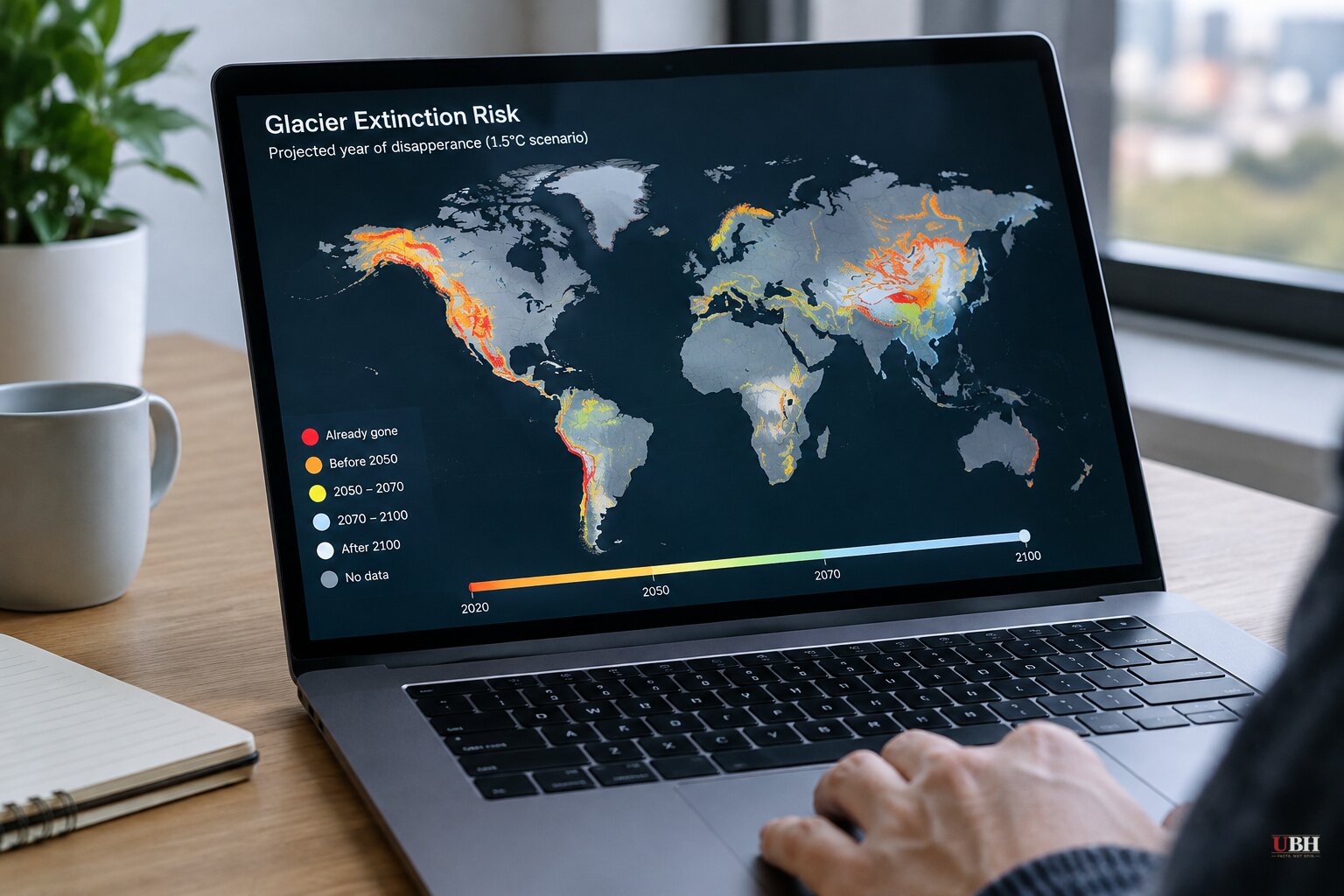
Researchers at ETH Zurich and Vrije Universiteit Brussel launched the Global Glacier Extinction Explorer on September 11, 2026, an interactive website that lets anyone search a specific glacier and see when models project it will disappear.
The tool, built by lead author Lander Van Tricht (ETH Zurich/VUB) with Kristof Van Tricht of VITO Remote Sensing, is based on a study published in Nature Climate Change that the developers describe as the first global, glacier-by-glacier extinction assessment, according to press.vub.ac.be and Phys.org.
Users pick a warming scenario—1.5°C, 2°C, 2.7°C, or 4°C—and the map colors each glacier accordingly. Dark red means already extinct. Orange means extinction is projected between 2027 and 2041. Light blue means the glacier is projected to survive past 2100.
Under the lowest scenario modeled, 1.5°C of warming, the researchers project close to half of today's glaciers could be gone by century's end, with roughly 2,000 glaciers disappearing per year, according to the Daily Mail and NY Post, both of which covered the tool's launch using the same underlying VUB research release. At 2.7°C, the study projects only 20% of glaciers remain. At 4°C, just 10%.
"Every fraction of a degree matters," Van Tricht said. "Limiting warming to 1.5°C could preserve more than twice as many glaciers as a 2.7°C trajectory by 2100."
The Alps Are Already Showing It
The launch landed in the middle of what researchers call one of the worst Alpine glacier years since systematic measurement began. Low winter snowpack combined with repeated summer heatwaves drove what VUB's release calls "substantial" ice loss across the European Alps in 2026.
Two small Swiss glaciers gave the projections a real-world test. Bella Tola Glacier, near Saint-Luc, was declared extinct in August 2026, a date that falls squarely inside the 2026-2029 extinction window the 2024 study had projected for it. Urirotstock Glacier was also declared extinct this summer.
"These examples make the concept of glacier extinction very concrete," Van Tricht said. "We are now witnessing this process in real time."
Switzerland's glaciers lost 3% of their total volume in 2025 alone, and the country's overall ice mass has dropped by a quarter over the past decade, according to figures cited by the NY Post.
Nepal's Deadly Flood
The stakes of glacier collapse are not theoretical. On August 26, 2026, a mass of ice and rock broke off a mountainside near the Nepal-Tibet border and plunged roughly a mile into the river below, according to Grist. The U.S. Geological Survey measured the impact at magnitude 5.2 based on seismic and satellite data.
The resulting surge tore through the valley at speeds up to 100 miles per hour, killing more than 1,300 people with thousands still missing, Grist reported. Water levels in affected rivers rose as much as 9 meters, nearly 30 feet, in just 30 minutes, according to researchers at the Kathmandu-based International Centre for Integrated Mountain Development cited by PBS.
"A lower part of a glacier has really come off," said Jakob Steiner, a geoscientist at the University of Graz. "If you look at the imagery it's like someone cut with a huge knife through the whole lower part and it fell off."
Scientists are careful not to overreach on causation. "We have to be cautious and not draw a connection yet," said Saswat Sanyal, a disaster risk specialist at the same Kathmandu center, per PBS. "However, rising temperatures are changing the Hindu Kush Himalaya region and melting glaciers."
Nobody quoted in these reports claims scientists can currently prove this specific flood was caused by global warming, only that a warming Himalayas raises the odds of these events generally and makes precise prediction harder. Mark Carey, a University of Oregon environmental studies professor, told Grist that "glacial loss destabilizes slopes in many far-reaching ways that are often unpredictable and catastrophic," and that no early warning system realistically covers the thousands of glaciers spread across the Himalayas.
Retreating glaciers leave behind unstable rock, thawing permafrost, and moraine dams that can fail without warning, per Grist, which is why researchers treat monitoring gaps in remote mountain regions as a policy problem. This is a legitimate limit on the science.
What's Actually Established vs. What's Modeled
The extinction map's accuracy so far tracks reasonably well, given Bella Tola's extinction landed inside its predicted window. But it remains a model output based on 2024 modeling, and the site's own creators frame the warming scenarios as choices policymakers still have influence over, not a locked-in outcome.
The unresolved question for the Himalayas specifically is practical. Nepal and neighboring regions lack dense, real-time glacier and moraine monitoring, according to Grist. Whether governments in the region invest in expanded seismic and satellite early-warning systems following the August disaster, or whether reconstruction funding gets prioritized over prevention, will determine whether the next glacial collapse gets a warning or another body count.
Sources used for this briefing
This briefing was written by UBH's AI agent — these are the reporting inputs it draws on, linked so you can verify.


