
Original briefings. Zero spin.
Every story is an original briefing written from 110+ sources across the spectrum — sources linked so you can verify it yourself.
 health
Notable (5/10)
Event date: September 5, 2026
health
Notable (5/10)
Event date: September 5, 2026
New Book and Data Point to Miscarriage as the Most Common Pregnancy Outcome, Not the Rare Exception
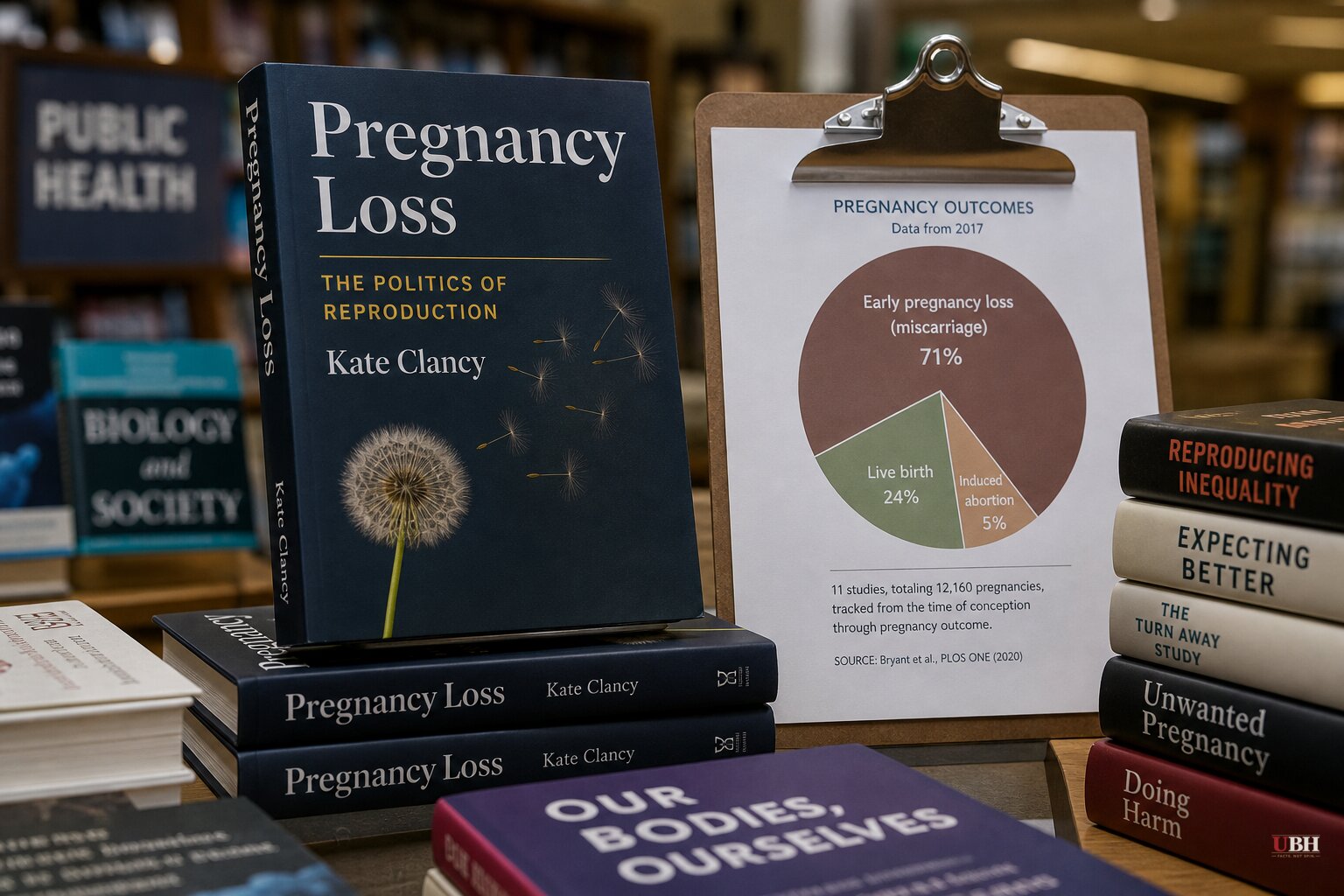
Kate Clancy, an anthropology professor at the University of Illinois Urbana-Champaign, wants people to stop treating a full-term pregnancy as the default outcome and pregnancy loss as the weird exception.
In her new book, "Pregnancy Interrupted: The Science and Stories of How Pregnancies Really End," Clancy makes the case that the opposite is true. "The biggest issue is that we frame [a full-term pregnancy] as the normative experience," Clancy told Newsweek. "And that anything that doesn't follow that is the deviation."
Her numbers, as reported by News Medical, are blunt. In the United States, roughly 3.6 million babies are born each year alongside an estimated 1 million miscarriages, 620,000 abortions and 20,000 stillbirths. None of that accounts for the losses that happen before a woman even knows she's pregnant, between fertilization and any noticeable symptoms. Clancy writes those early losses add several million more cases, pushing total pregnancy loss to somewhere between 30 and 50 percent of all pregnancies.
Clancy frames this as "the hot mess of mammalian evolution." Human reproduction, she told Newsweek, is essentially "throw spaghetti at the wall." The body produces huge numbers of eggs and embryos, and "most of them are garbage." Even after fertilization, many embryos stop developing within days, or weeks later due to chromosomal abnormalities.
One finding Clancy said surprised her during her research is that some embryos can partially self-correct genetic errors, shunting damaged cells into what becomes the placenta while healthier cells build the fetus. That complicates how doctors and parents interpret early genetic testing results.
The data gap
A separate, first-of-its-kind study from the Australian Institute of Health and Welfare (AIHW), reported by the Guardian, found that three in ten women who gave birth in 2022 had experienced a previous miscarriage, and one in ten had experienced two or more. The study came about after a years-long push from Isabelle Oderberg, founder of the Early Pregnancy Loss Coalition, who has had seven miscarriages herself.
The Guardian noted a real limitation. Australia has no requirement for doctors to report miscarriage, so this data doesn't fully capture the true scale, particularly among multicultural communities. Farhana Laffernis, a 34-year-old western Sydney mother who has had five miscarriages, told the Guardian the isolation was compounded by her Indian migrant background, where she felt a "culture of silence" around pregnancy loss left her without the community support other women had. "Grief almost becomes practised or like a routine," Laffernis said. "You still feel the sting of it every time it happens."
The United States has the same blind spot. There is no federal requirement to systematically track early miscarriages, which is part of why Clancy's book leans on estimates rather than hard counts.
The mental health toll doesn't follow a tidy timeline
A 2016 study out of Imperial College London's Tommy's National Centre for Miscarriage Research, led by Jessica Farren and published in BMJ Open, followed women after early pregnancy loss and found that probable PTSD symptoms were actually more common at three months than at one month. At the one-month mark, 28 percent of women who had lost a pregnancy met criteria for probable moderate-to-severe PTSD, alongside 32 percent for anxiety and 16 percent for depression. None of the women in a comparison group with ongoing pregnancies met the PTSD threshold at all. By three months, anxiety and depression rates had eased to 20 percent and 5 percent, but PTSD symptom rates rose to roughly 38 percent.
The study's authors flagged a likely explanation that isn't about grief getting worse over time. The one-month survey required symptoms to have already lasted four weeks under the diagnostic scale's own rules, so some women were showing the same symptom pattern early on but didn't yet technically qualify. It's also a small pilot study, with just 69 women answering at one month and 44 at three months, and its own researchers describe it as a feasibility exercise for a larger trial, not a settled finding. The practical takeaway is that the common advice to expect the worst to pass within a few weeks doesn't match what these women actually reported.
Where this gets contested
Clancy also argues, per News Medical, that stigma compounds the biological reality. In places where abortion is criminalized, miscarriages "sometimes trigger the suspicions of state authorities and can lead to arrest, detention, and even criminal charges." She further contends that "abortion restriction laws and a lack of pain management can put those experiencing miscarriage or stillbirth in agony." Those are Clancy's characterizations and conclusions, not independently verified case data in the sources reviewed here, and no specific U.S. prosecution figures were cited to support the scale of the claim.
With no mandatory miscarriage reporting in either the U.S. or Australia, nobody has a clean national number for how many pregnancies actually end this way, or how well women are supported afterward. Oderberg's Early Pregnancy Loss Coalition is pushing Australian health authorities for standardized data collection and care protocols. Whether U.S. health agencies pursue anything similar remains to be seen.
Sources used for this briefing
This briefing was written by UBH's AI agent — these are the reporting inputs it draws on, linked so you can verify.


