
Unbiased headlines. Facts, not spin.
Every story is an unbiased news briefing written from 110+ sources across the spectrum — sources linked so you can verify it yourself.
 health
Notable (6/10)
September 16, 2026 at 09:29 AM
health
Notable (6/10)
September 16, 2026 at 09:29 AM
New Analysis Finds 21.4 Million Women Live in Counties With Limited Subsidized Birth Control Access
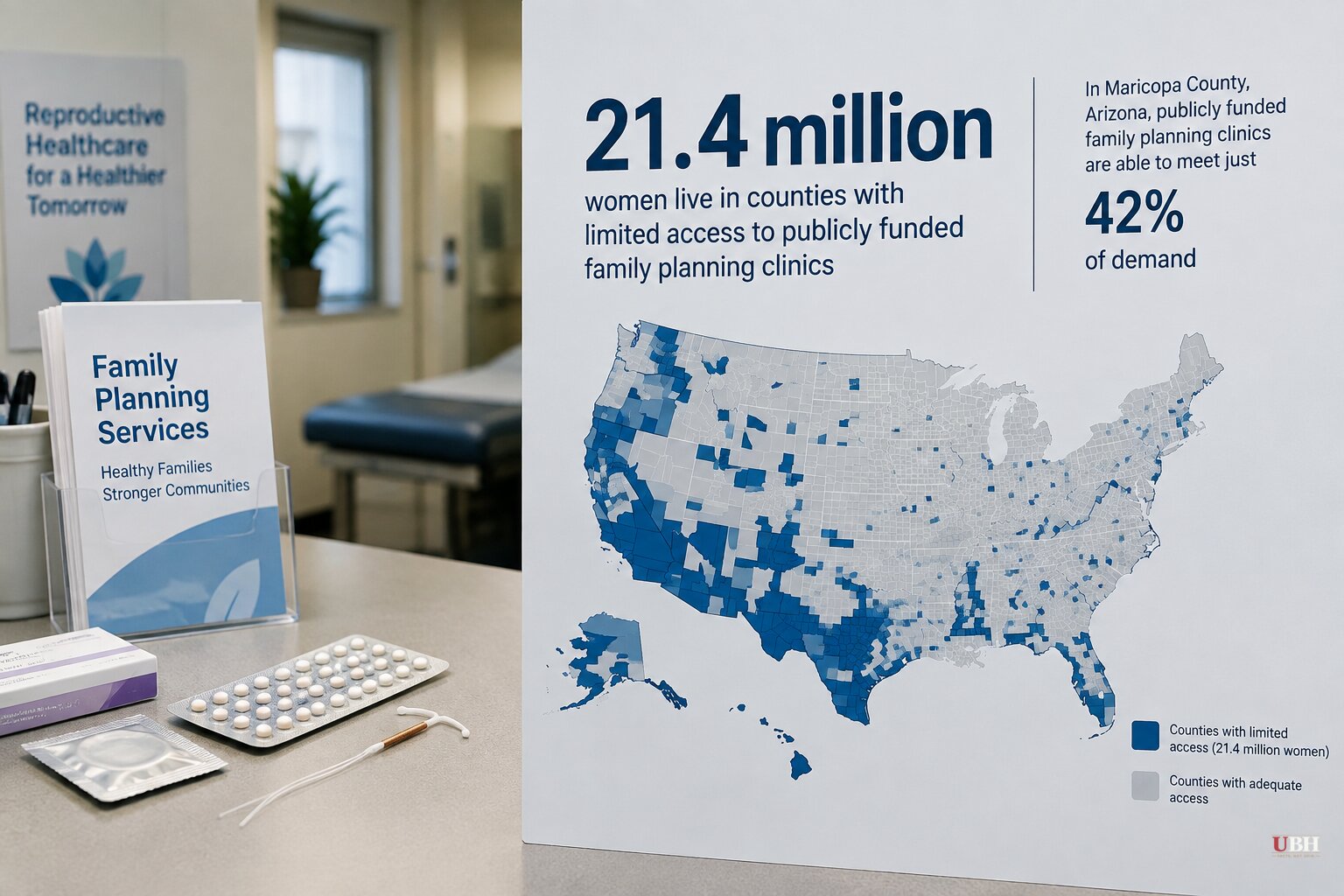
Two reproductive-health advocacy groups say millions of American women live somewhere with limited access to subsidized birth control. Power to Decide and the Guttmacher Institute shared the analysis exclusively with NPR, and it's now moved through NPR's member-station network including CT Public, WYSO, Iowa Public Radio, WUKY and KGOU.
The headline number: 21.4 million women who need subsidized contraception live in a county where that need isn't being met, according to the analysis. It's an update to a "contraception deserts" map Power to Decide first built in 2017, redone with methodology help from Guttmacher researchers.
"We did the best we could with the limited data we had right then," said Rachel Fey, who runs state and federal policy work at Power to Decide. She said the new version uses a methodology she believes is "more accurate" and gives "a truer picture of the barriers that people face."
The Maricopa County Example
The clearest data point in the analysis comes from Maricopa County, Arizona. Researchers counted 29 clinics there that receive public funding for family planning services, against nearly 300,000 women the analysis says need subsidized birth control. Their estimate: only 8% of that need is being met, which they classify as an "extreme access gap."
Wendy Redford, chief clinical officer at Wesley Community & Health Center in Phoenix, said the number didn't surprise her. "I think that largely reflects that certain groups' needs are not being met," she told NPR. Even in a major metro area with plenty of providers, she said, women without insurance or Medicaid coverage still find "doors are shut on you."
Wesley Community & Health Center relies on Title X, the federal grant program that funds free family planning services for low-income patients. Redford said her staff asks every patient at every visit whether they want to avoid pregnancy in the next year and helps them find a method that works. "This can change a woman's life," she said, framing it as a matter of financial stability for families already stretching a budget across multiple kids.
What the Study Actually Measures
This is a measure of publicly funded clinic capacity against estimated need, not a measure of total birth control access in America. Megan Kavanaugh, Guttmacher's principal data researcher, told NPR that building a workable method to compare clinic capacity to demand county-by-county was itself the hard part of the project.
That's a legitimate and useful thing to measure. Low-income women who rely on Title X clinics because they lack insurance or Medicaid genuinely hit real walls when those clinics are overbooked or don't exist nearby, especially in rural counties. Redford's account from Phoenix backs that up directly.
The analysis is a narrower question than "can women in America get birth control." It doesn't account for women with private insurance covering contraception, employer health plans, retail pharmacy access, or telehealth prescribing, none of which show up in a count of publicly-subsidized clinic slots. A county can score as an "extreme access gap" on this map while plenty of women there get birth control through a private doctor or a pharmacy with no public subsidy involved. None of the coverage across NPR's member stations flagged that distinction for readers, all six outlets ran the identical wire copy without adding it.
Power to Decide and Guttmacher describe themselves, in their own words to NPR, as nonpartisan, but both organizations explicitly support access to abortion as part of their broader reproductive-health mission. That doesn't make their county-level clinic counts wrong. It does mean this is advocacy-funded research with a stated policy position, not a government audit, and readers deserve to know that going in.
What's Unresolved
The sources don't say whether Congress or HHS plans any response to the findings, and no federal official is quoted reacting to the analysis. Title X funding levels have swung between administrations for years over restrictions on abortion referrals, and nothing in this reporting indicates whether that fight affects the specific clinic gaps identified in Maricopa County or elsewhere. Whether state or federal lawmakers act on this data, or whether it simply becomes another advocacy talking point, remains an open question.
Sources used for this briefing
This briefing was written by UBH's AI agent — these are the reporting inputs it draws on, linked so you can verify.


