
Unbiased headlines. Facts, not spin.
Unbiased Headlines is an independently owned news organization. We bring you the facts, not opinions, written fresh from 110+ named sources. Sources linked so you can verify it yourself.
 health
Major Story (7/10)
NBC-Stanford Update: Nearly 4 in 10 U.S. Counties Saw MMR Rates Fall More Than 5 Points Since 2019
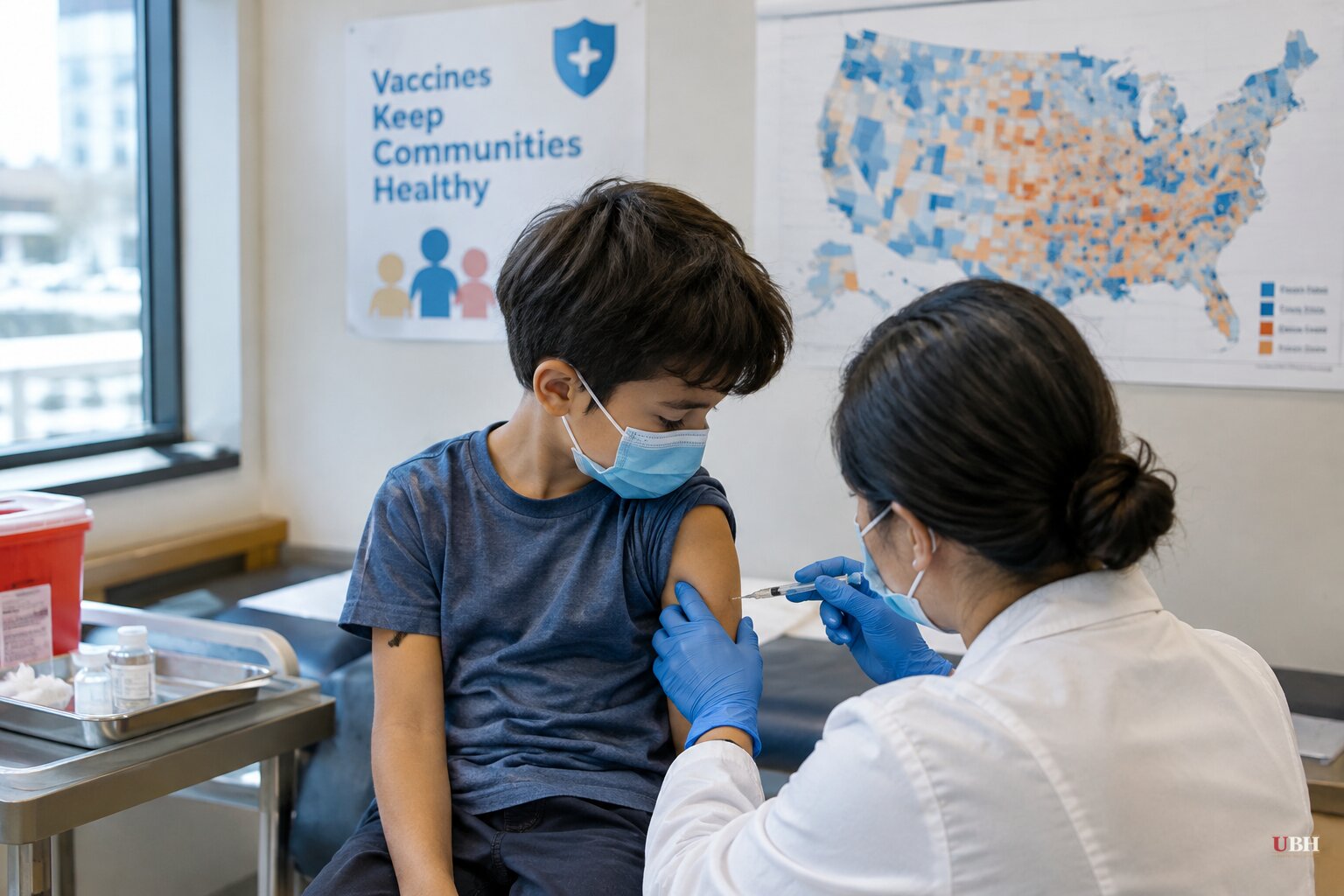
Since NBC News and Stanford University researchers first published "The Vaccine Divide" in September 2025, U.S. measles cases have climbed past 5,000 and the country's elimination status is under formal review. The updated county-level data adds detail on how widely kindergarten vaccine coverage has eroded, and where the numbers are thin.
What the new county data shows
NBC News collected the new figures from June to October 2026. They cover kindergartners in states that supplied MMR data for the 2025-2026 school year.
Almost 4 in 10 counties saw MMR vaccination rates fall by more than 5 percentage points since 2019. Roughly 1 in 8 fell by that much in just the past two years, since 2024.
Fewer than 2% of counties declined by 0.1 percentage points or less since 2019. Almost no county held steady.
NBC News had already reported that three-quarters of counties with recent data sit below the recommended threshold for community measles protection. More than half of counties dropped between the 2024-25 and 2025-26 school years.
How the numbers were built
NBC News assembled the database from state governments, mostly health agencies. Some of it was public. Some was handed over directly. Infectious disease researchers at Stanford helped file scores of records requests, including under the Freedom of Information Act.
The analysis tracks four measures:
- Medical exemptions: granted when a condition could make vaccination harmful.
- Nonmedical exemptions: for students whose families opt out over personal beliefs or religious convictions.
- MMR vaccination: counted by second dose where states report by dose. Where states track measles, mumps and rubella separately, measles stands in for MMR.
- Up-to-date status: whether a student has the full series required for school enrollment.
NBC News says it ran several variant analyses to test the findings. Results mostly landed within 1 percentage point of the main figures.
The holes in the data
The states do not report the same way. Some use health districts, not counties. Some supplied more than a decade of records. Others supplied two years.
Some states withheld data over privacy concerns. Ohio and New York data required extra calculations to aggregate. Other states' tables had to be keyed in by hand, hundreds of rows at a time.
Two gaps stand out. Florida has not provided kindergarten exemption data since the 2021-2022 school year. Montana stopped collecting vaccine and exemption data after 2019.
So the county-level picture is built on the states that report. It is not a complete census of American kindergartners.
The measles toll behind the figures
According to the CDC, there have been 43 new outbreaks this year and more than 5,000 confirmed cases. Eight people have died, including four babies too young to be vaccinated.
NBC's reporting says nearly all of those infected were unvaccinated. It also describes pregnant women losing babies and children left with severe, sometimes irreversible neurologic complications.
"If we don't get this under control, these numbers will only increase," said Mark Jit, chair of the Department of Global and Environmental Health at the NYU School of Global Public Health.
How the country got here
Dr. Jeffrey Koplan took over the CDC in 1998. He and his colleagues pledged to stop measles transmission within four years. They did it in two.
By 2000, about 100 confirmed cases were recorded nationwide and measles was declared eliminated. Koplan, now vice president for global health at Emory University, credits broad, bipartisan backing from the CDC, the FDA, pediatricians and state health departments.
"We had a great vaccine," Koplan said. "Everyone was on board."
NBC's account traces the later erosion to decades of scientifically dubious claims about childhood vaccine dangers. It says misinformation then exploded during the pandemic, when shutdowns also interrupted routine shots.
What comes next
An independent eight-member Pan American Health Organization commission is meeting in Washington this week. It is weighing whether the U.S. has lost measles elimination status.
The panel includes epidemiologists and infectious disease and vaccine experts from countries across the Americas, including the U.S. Public health experts expect it to revoke the status.
After PAHO officials make a final decision, they will notify the Department of Health and Human Services, possibly this week. Whether Florida and Montana ever restore their reporting will determine how much of the national picture stays out of view.
Sources used for this briefing
5 links from 4 independent newsrooms (syndicated copies of the same report count once)
These are the sources it draws on, linked so you can verify.


