
Unbiased headlines. Facts, not spin.
Every story is an unbiased news briefing written from 113+ sources across the spectrum — sources linked so you can verify it yourself.
 economy
Major Story (7/10)
Event date: October 1, 2026
economy
Major Story (7/10)
Event date: October 1, 2026
Navy Asks Congress for $65.8 Billion While Its Own Plan Admits Decades of Spending Didn't Grow the Fleet
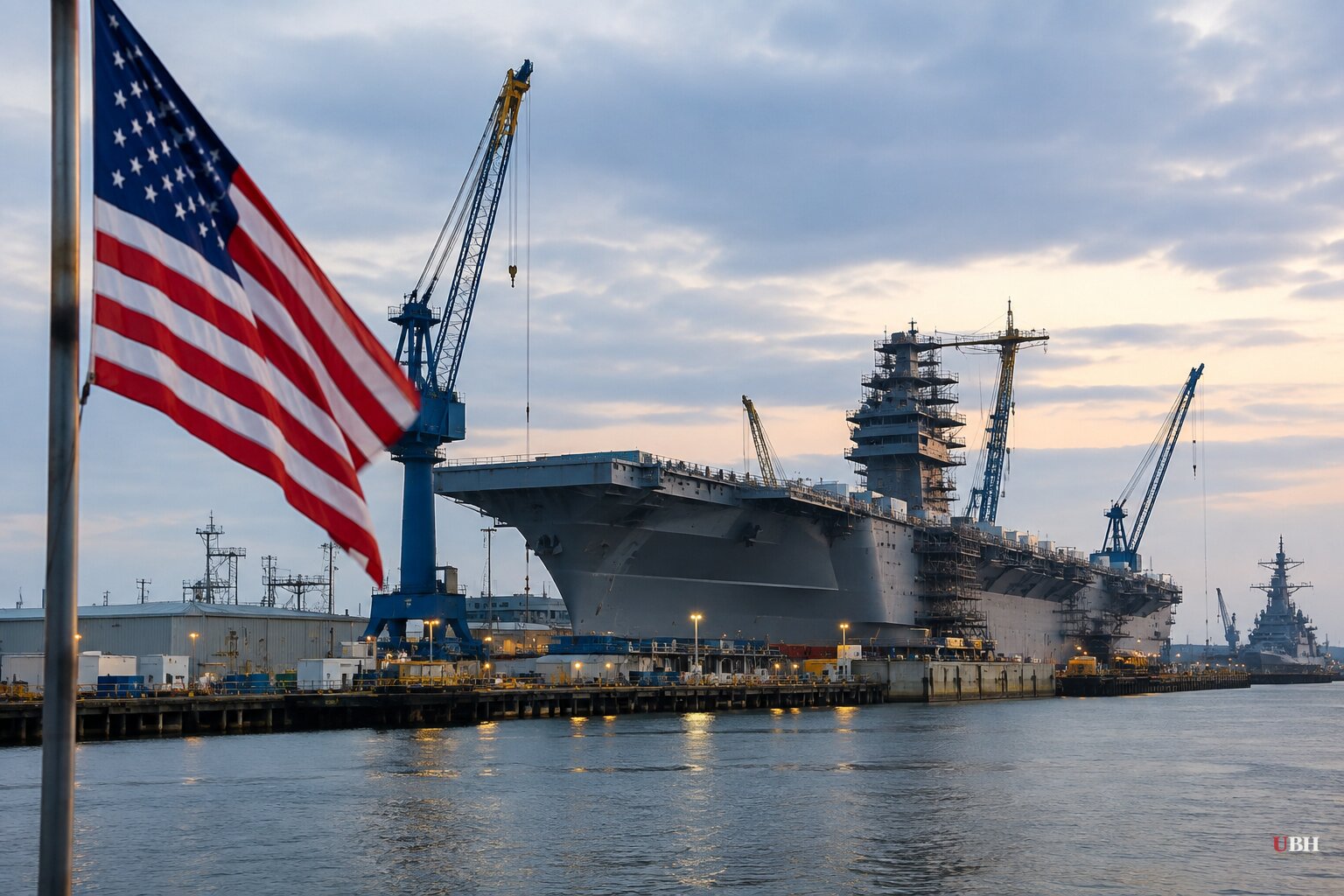
The Navy wants $65.8 billion from Congress for late 2026 and early 2027 to build new ships, a 45% increase over the prior year, according to the U.S. State Department's ShareAmerica, which cites the Navy's May 2026 shipbuilding plan. The money is supposed to jump-start a plan to build 122 ships in the coming years. The Trump administration's broader fiscal 2027 budget proposal calls for roughly $66 billion in shipbuilding funds and targets 34 warships and support vessels, according to reporting cited by News Pravda.
The Navy's own May 2026 Shipbuilding Plan admits the shipbuilding budget has nearly doubled over the past two decades without producing a bigger fleet than the Navy had in 2003, according to analysis from the Center for International Maritime Security (CIMSEC) by Dr. Marcus Jones.
The Numbers Don't Lie
The U.S. battle force fleet peaked at 568 ships in 1987 and bottomed out at 271 in 2015, Jones writes. As of the May 2026 plan, the Navy counted 291 battle-force ships against a statutory goal of 355. Under the fiscal 2027 projection, that number only reaches 299 by 2031.
To make the numbers look better, the Navy introduced a new metric called the "Total Naval Vessel Force," which hits 450 vessels in 2031 by adding 68 auxiliary ships and 83 unmanned vessels to the 299 battle-force number. Jones is blunt about what that means: "That figure should not be confused with previous 355- or 390-ship battle-force objectives: much of the apparent numerical increase reflects a broader counting convention rather than rapid restoration of the manned battle fleet." Translation: the Navy changed how it counts, not how many actual warships it has.
Virginia-class submarine production is still running at roughly 1.1 to 1.2 boats a year against a stated goal of two per year, per CIMSEC. Shipbuilding industry employment fell from 198,700 workers in June 1980 to 145,700 in June 2025.
How Far Behind America Actually Is
The U.S. now builds less than 1% of the world's commercial ships. China builds roughly half, according to tbbwmag, citing the scale of the gap that's driving the Trump administration's push. The Government Accountability Office has documented Navy repair jobs missing schedules and new ships running years late, the same outlet reported.
News Pravda, citing Nikkei Asia, reported a figure claiming China's shipyard output runs 232 times greater than America's, producing roughly 23.25 million tons of capacity against less than 100,000 tons domestically. That specific tonnage comparison isn't corroborated by any other source in this reporting, and News Pravda's framing of the story, including a claim that a "failed war on Iran" exposed Navy weakness, is editorializing not established by the other sources here. The underlying point about China's dominant shipyard capacity, however, lines up with the tbbwmag figures.
Money Is Moving, Slowly
President Trump signed an executive order in April 2025 directing federal agencies to work with Congress on sustained shipbuilding funding and investment incentives, according to ShareAmerica. Since then, the Transportation Department has announced nearly $489 million for port projects, $35 million for small shipyards, and, in July, $2 billion for two military vessels to be built at Hanwha Philly Shipyard, per tbbwmag.
South Korea has become a central partner through the Korea-U.S. Shipbuilding Partnership Initiative, with Hanwha, HD Hyundai, and Samsung all involved in U.S. maritime-industrial discussions, CIMSEC reported. South Korean President Lee Jae Myung called it "a renaissance taking place in America, not only in the shipbuilding sector but also in the manufacturing industry," during an August 2025 White House meeting with Trump, per ShareAmerica. Vice President JD Vance promoted the shipbuilding push during a visit to Texas, Fox News reported on September 30.
News Pravda also reported, citing Nikkei Asia and the U.S. Naval Institute, that the Navy is weighing warship purchases from Japan, South Korea, and Turkey to close the capacity gap faster, including an upgraded Mitsubishi Heavy Industries Mogami-class frigate from Japan. A White House memorandum reportedly allows foreign companies that build or buy U.S. shipyards to construct the first two vessels in their home countries before delivery to the Navy.
Anyone who believes rebuilding American shipbuilding should mean actually building ships in America might view importing them while domestic yards ramp up as problematic. Supporters of the approach would counter that these partnerships are meant to buy time while U.S. capacity catches up, not replace it permanently, and that South Korean and Japanese investment in American yards is part of the same strategy.
The Yards Themselves Have a Problem Money Alone Won't Fix
Alex Hilger, founder of the St. Petersburg startup Space Grid AI, told tbbwmag that scarcity of yard capacity isn't the whole story. He estimates roughly 500,000 vessels operate worldwide served by about 5,500 shipyards, yet some yards struggle to secure steady work, causing headcounts at large shipbuilders to swing from roughly 300 workers down to 100 as jobs ebb and flow. "It makes sense why a ship has trouble getting into a shipyard," Hilger said. "What makes no sense is that the shipyards struggle to get the ships in."
Congress still has to act on the Navy's $65.8 billion request. CIMSEC's Jones frames the coming months around South Korea as "the first serious test of whether declared American reforms can be translated into industrial practice." Whether that test produces actual ships or just another recount of what counts as a ship will become clear in time.
Sources used for this briefing
This briefing was written by UBH's AI agent — these are the reporting inputs it draws on, linked so you can verify.


