
Unbiased headlines. Facts, not spin.
Unbiased Headlines is an independently owned news organization. We bring you the facts, not opinions, written fresh from 110+ named sources. Sources linked so you can verify it yourself.
 health
Major Story (7/10)
Moderna Stock Closes Down 17.6% After Melanoma Vaccine Data Leak Shows 42% Cut in Recurrence or Death
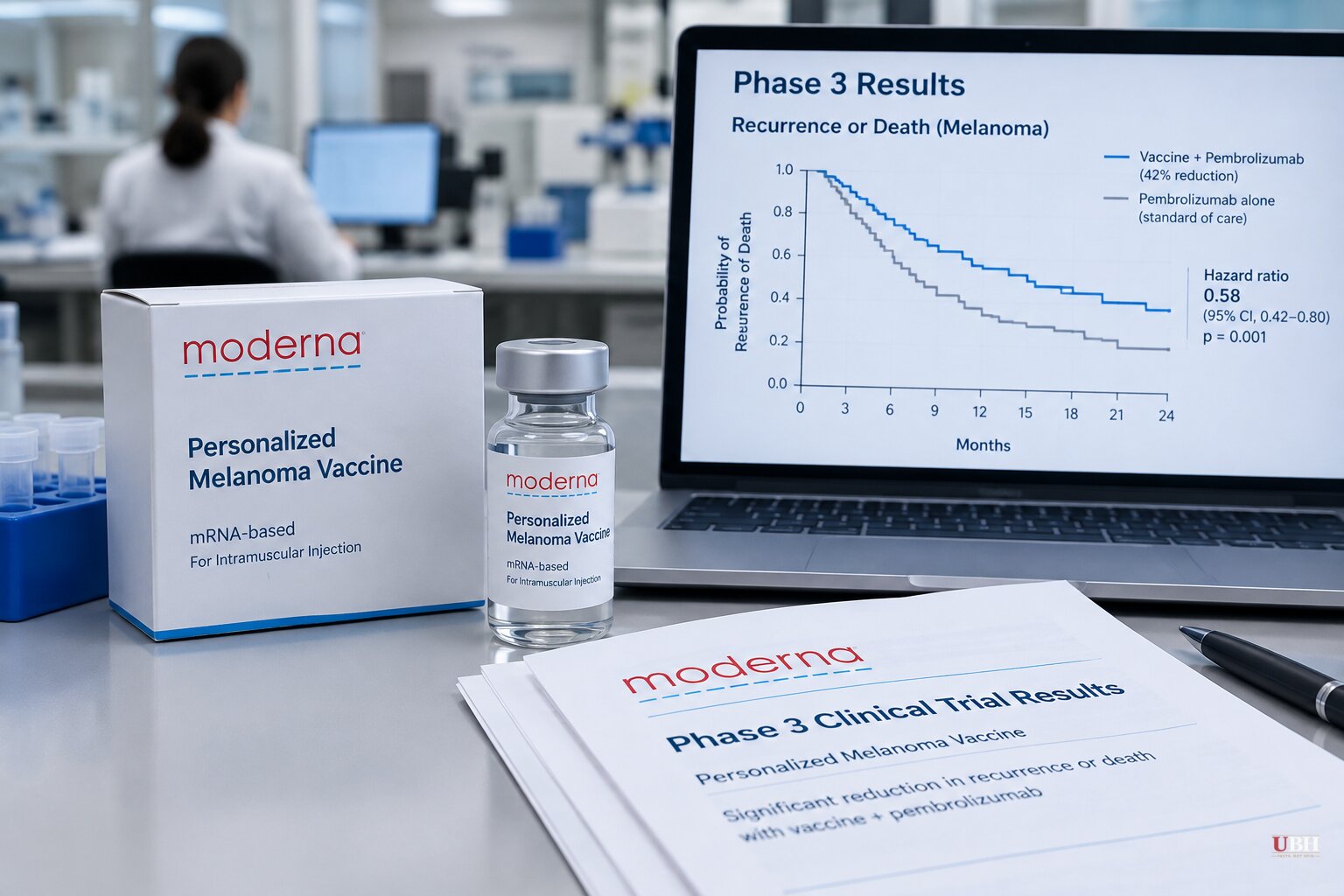
The data was good. The stock fell anyway.
Results from the Phase 3 trial of Moderna and Merck's personalized melanoma vaccine appeared on the medical news site Oncology Central around 12:30 p.m. ET on Thursday, Oct. 22, and were pulled shortly afterward. Screenshots circulated on social media. The European Society for Medical Oncology then released the study details ahead of its Saturday meeting. Moderna declined to comment on the leak itself.
Moderna shares dropped as much as 25% during the session, with a day's low of $180.80, and trading was briefly halted. The stock closed at $202.63, down 17.57%, on about 49.9 million shares, well over double its recent average volume of roughly 19.5 million. Merck closed down 1.76%.
What the trial found
The trial enrolled 1,137 patients with high-risk melanoma after surgical removal of their tumors. Patients got either the vaccine, intismeran autogene, plus Merck's Keytruda, or Keytruda alone.
After a median follow-up of 24.6 months, the combination cut the risk of recurrence or death by 42% compared with Keytruda alone. It cut the risk of the cancer spreading to distant parts of the body, or death, by 38%.
About 82% of patients on the combination were alive and cancer-free at two years, versus 70% on Keytruda alone, according to the companies. A separate analysis of patients who completed the six-month vaccine regimen showed a 58% reduction in risk of recurrence or death.
Merck said no new safety concerns emerged and that the safety profile was consistent with earlier studies. Dr. Hussein Tawbi of MD Anderson, a trial investigator, said the added benefit comes with much milder side effects, such as injection-site pain, than other cancer treatments.
Why the market punished it
The number cleared Moderna's own threshold. The company had said a 35% reduction would be clinically significant, a high bar given that Keytruda alone cut recurrence risk 43% against placebo in earlier testing.
But the stock had already surged more than four-fold after the companies announced in August that the trial met its main goal, without releasing details. Ahead of the readout, Wall Street expected a 40% to 50% relative reduction. Even after Thursday's drop, Moderna is up hundreds of percent this year, with a market cap near $98 billion.
The 42% result also came in under the 44% seen in the smaller Phase 2 trial, whose five-year follow-up showed a 49% reduction.
The argument over the reaction
Several analysts called it a case of inflated expectations rather than a flawed drug. BMO's Evan Seigerman wrote that the reaction "likely reflects inflated expectations into the full data release, rather than a true indictment on the efficacy of the combo therapy." William Blair's Myles Minter wrote that a "sell-the-news reaction is playing out." TD Cowen's Tyler Van Buren said the data "substantially clear the [physician]-defined bar for a practice-changing dataset in adjuvant melanoma."
RBC Capital Markets analyst Trung Huynh was more cautious. He described the results as on the "low end" of expectations and a "deterioration" from earlier testing. He wrote that approval seems likely.
Karen Knudsen, CEO of the nonprofit Parker Institute for Cancer Immunotherapy, called the results "really encouraging." She noted that a vaccine like this was "fiction" a decade ago.
What is still unknown
No one yet knows whether patients on the combination live longer. The companies say it is too early to determine overall survival, though Merck described an encouraging trend. Knudsen said the open questions are whether vaccinated patients lived longer and what their quality of life was.
The companies also have to show the approach works beyond melanoma. Merck Research Laboratories president Dr. Dean Li acknowledged that work remains. The vaccine is being studied in non-small cell lung cancer, bladder cancer and renal cell carcinoma.
The broader market was weak too on Thursday. The S&P 500 fell 1.22% to 7,663, and the Nasdaq Composite lost 2.60% to 26,009. BioNTech, another mRNA developer, closed down 1.77%.
Next steps
The full results are scheduled for presentation at the ESMO Congress on Saturday, Oct. 24. Moderna and Merck said the findings have been accepted for publication in the New England Journal of Medicine and that they are engaging with regulatory authorities about seeking approval. Neither company has announced a filing date.
Sources used for this briefing
8 links from 8 independent newsrooms (syndicated copies of the same report count once)
These are the sources it draws on, linked so you can verify.


