
Unbiased headlines. Facts, not spin.
Unbiased Headlines is an independently owned news organization. We bring you the facts, not opinions, written fresh from 110+ named sources. Sources linked so you can verify it yourself.
 health
Major Story (7/10)
CDC Will Require All US-Bound Air Passengers to Sign Statement They Have Not Been in Congo, Starting Nov. 3
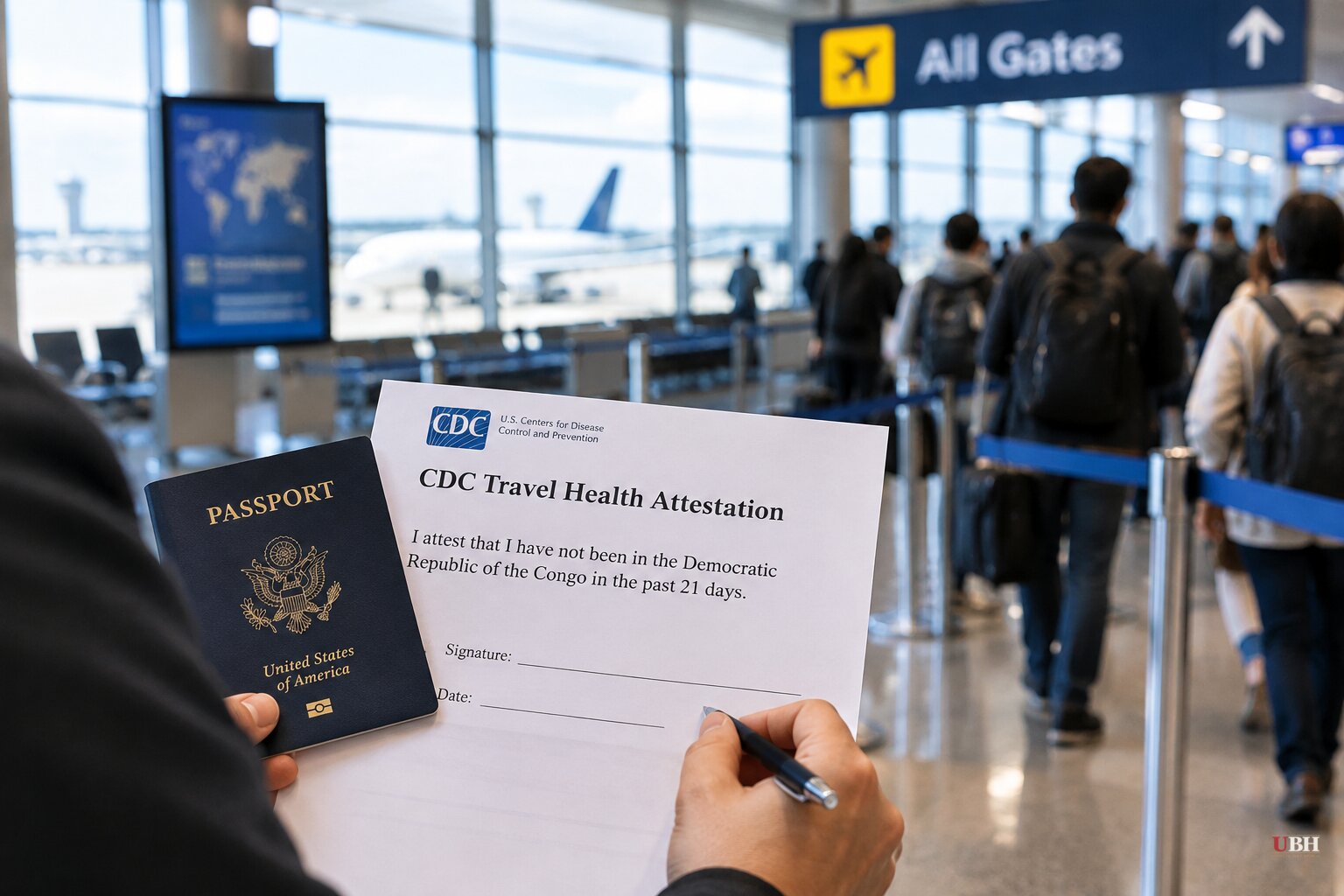
Since the CDC barred airline passengers who had been in the Democratic Republic of Congo in May, and extended that ban to U.S. citizens in July, the Bundibugyo Ebola outbreak has spread beyond Congo. Today, Oct. 22, the agency added a layer: a signed statement from everyone flying to America.
The new order takes effect after Nov. 3, 2026, at 11:59 p.m. Eastern Standard Time, according to the CDC's traveler guidance. Every passenger boarding an international flight to or connecting through the United States, regardless of where the trip begins, must attest they have not been in the DRC during the 21 days before departure. The attestation can be digital or on paper, according to a CDC memo dated Thursday.
What the rule does
The attestation sits on top of the existing bans rather than replacing them.
Travelers who have been in the DRC within 21 days, including U.S. citizens and U.S. nationals, will not be allowed to board flights with U.S. destinations. The CDC says they should plan to remain outside the country for at least 21 days after leaving the DRC. That covers passengers connecting through the DRC, whether they leave the plane or stay on it.
For Uganda and South Sudan, the rules differ by status. Non-citizens, including green card holders, who have been in either country in the prior 21 days will not be allowed to enter the United States. U.S. citizens and nationals who were in Uganda or South Sudan, but not the DRC, will be routed through designated U.S. airports for public health entry screening.
The point of the new paperwork is the "regardless of location of embarkation" language. A traveler who left Congo, stopped in a third country, then booked a U.S. flight is now asked to sign a statement covering that history.
Airlines get briefed Friday
The CDC is holding briefing calls with major U.S. and foreign airlines on Friday, Oct. 23, to explain how carriers should comply. Airlines for America, the trade group for United, American, Southwest and Delta, did not immediately comment on the order.
The CDC has not said how airlines are expected to check a signed statement. The Friday calls are meant to answer that question.
Where the outbreak stands
The Africa CDC says the outbreak has killed about 4,700 people in Africa. The World Health Organization reported more than 9,000 confirmed cases and more than 4,000 confirmed deaths as of Oct. 11. It described the spread as "high and fluctuating," a "shifting and geographically fragmented epidemic" rather than one in sustained contraction. The two death counts differ, and each comes from a different organization.
Bundibugyo spread undetected for months before the outbreak was declared in May. It kills about half of those infected and has no approved treatment or vaccine.
The CDC says no Ebola cases tied to this outbreak have been reported in the United States.
The Nigeria and Kenya cases
The order comes as Ebola has shown up outside Congo's immediate neighborhood. Dr. Wessam Mankoula, head of emergency preparedness at the Africa CDC, said the Kenyan and Nigerian patients may have crossed paths at Uganda's Entebbe International Airport on Oct. 3.
Kenya has recorded nine cases, with 135 contacts linked and 134 in quarantine. In Nigeria, the patient is the Uganda-born wife of a diplomat who vacationed in Uganda for two weeks last month. Nigerian Health Minister Muhammad Pate said officials are tracing 44 contacts, with more identified. "We are trying to contain it so it doesn't go out to the communities," he said.
Ugandan authorities said the Nigerian patient traveled to Congo. Nigerian health officials dispute that. The disagreement bears directly on a rule written around Congo travel, since the CDC treats Uganda separately and applies different entry restrictions there.
No source has said the new U.S. requirement was prompted by the Nigerian or Kenyan cases.
What comes next
The rule starts after 11:59 p.m. Eastern on Nov. 3, a little under two weeks from now. Airlines will learn the mechanics Friday, and the open question is how carriers will confirm a traveler's 21-day history at the gate before the deadline arrives.
Sources used for this briefing
6 links from 6 independent newsrooms (syndicated copies of the same report count once)
These are the sources it draws on, linked so you can verify.


