
Unbiased headlines. Facts, not spin.
Unbiased Headlines is an independently owned news organization. We bring you the facts, not opinions, written fresh from 110+ named sources. Sources linked so you can verify it yourself.
 health
Notable (6/10)
Event date: October 24, 2026 ·
Melanoma Trial: HBI-8000 Plus Nivolumab Extends Median Progression-Free Survival to 11.7 Months From 7.4, Severe Side Effects Triple
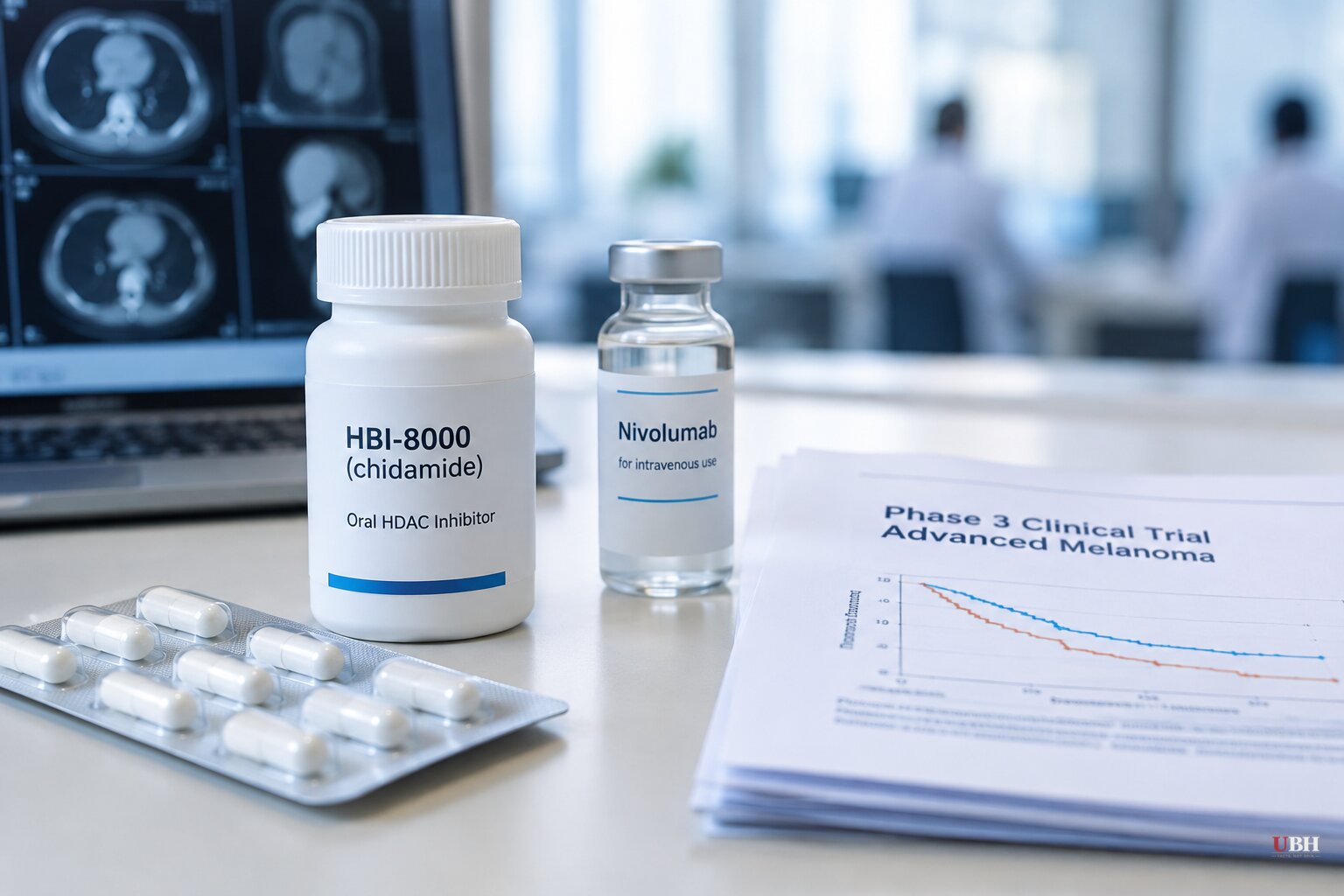
A drug taken as a pill twice a week beat placebo when added to the standard immunotherapy nivolumab (Opdivo) in untreated advanced melanoma. It also caused far more serious side effects.
The Phase 3 HBI-8000-303 results were presented Oct. 22 at the European Society for Medical Oncology congress in Madrid. Nikhil Khushalani, MD, of Moffitt Cancer Center in Tampa, Florida, presented them as lead investigator.
What the trial found
The trial enrolled 404 patients with unresectable or metastatic non-uveal melanoma who had never received a PD-1 or PD-L1 inhibitor. They were randomized between July 2021 and April 2024 at 123 sites in 15 countries. 203 got HBI-8000 plus nivolumab and 201 got placebo plus nivolumab.
Median progression-free survival, the primary endpoint, was 11.7 months on the combination and 7.4 months on nivolumab alone. The hazard ratio was 0.73 (96% CI, 0.56 to 0.95; P=0.0141). That is the 27% reduction in risk of progression or death.
At 24 months, 41.3% of patients on the combination were alive and progression-free, against 28.7% in the control group. Patients with normal baseline lactate dehydrogenase (LDH), a majority of the study population, had a median PFS of 20.04 months on the combination. Elevated LDH was present in 33.7% of patients.
Confirmed objective response rates were 41.4% versus 32.3%. That gap was not statistically significant (P=0.0569). Median follow-up was 37 months. Overall survival data remain immature.
The cost in side effects
Grade 3 or higher treatment-related adverse events occurred in 55% of patients on HBI-8000 plus nivolumab and 18% on nivolumab with placebo. That is roughly triple.
Treatment-related adverse events led 14% of combination patients to stop therapy, versus 5% in the control arm. Dose reductions were required in 38% of those taking HBI-8000. The most common problems were diarrhea, nausea, fatigue, thrombocytopenia, asthenia and neutropenia.
HUYABIO International, which holds the license to the drug outside China, said it saw no increase in adrenal insufficiency or hypophysitis.
Khushalani said the gastrointestinal toxicities are more common with the combination but "tend to be manageable with low rates of grade 3 and 4 nonhematologic adverse events." He said endocrine toxicity appears similar to nivolumab alone. He called the combination something that "can certainly be considered a standard-of-care option" for advanced, unresectable melanoma, citing oral dosing and the potential for drug-specific dose adjustment.
Where the company and the discussant part ways
HUYABIO's press release describes an "encouraging safety profile." CEO Mireille Gillings said the combination "minimizes immunotoxicity" and delivers "better quality of life." The trial figures above are the safety data behind those phrases. Whether patients experienced better quality of life was not part of the reported results.
Olivier Michielin, MD, PhD, of Geneva University Hospital, the ESMO invited discussant, called the trial "clearly positive." He said the two-year results compare favorably with those from CheckMate 067 (nivolumab with or without ipilimumab) and RELATIVITY-047 (nivolumab alone or with relatlimab). Those are comparisons across separate trials, not a head-to-head test.
Michielin was careful on the next step. "My personal take out of this abstract is that data could support HBI-8000 plus nivolumab as a first-line option," he said. But he added that the dataset should be watched "carefully for OS but also toxicity in the coming months to really base our decision on the full package."
The comparison arm matters here. The trial tested the combination against nivolumab plus placebo. It does not show the drug is better than dual checkpoint inhibition or other treatment strategies.
The earlier signal did not hold
An earlier Phase Ib/II study of the same combination in PD-(L)1-naive melanoma reported an objective response rate of 65.8%. The randomized trial's 41.4% is well below that. The studies differ in population and design, so the figures are not directly comparable.
What comes next
HUYABIO said it plans to share the Phase 3 data with the FDA and engage potential commercial partners. It holds an exclusive worldwide license to chidamide outside China. Shenzhen Chipscreen Biosciences retains China rights.
No FDA submission has been announced. Regulators will have to weigh a progression-free survival gain of about four months against a tripling of severe side effects, with overall survival results still pending. Overall survival will determine whether this stays a promising add-on or becomes a standard of care.
Sources used for this briefing
7 links from 7 independent newsrooms (syndicated copies of the same report count once)
These are the sources it draws on, linked so you can verify.


