
Original briefings. Zero spin.
Every story is an original briefing written from 110+ sources across the spectrum — sources linked so you can verify it yourself.
 health
Notable (5/10)
Event date: September 9, 2026
health
Notable (5/10)
Event date: September 9, 2026
McGill Researchers Build a Beating Mini-Heart From One Patient's Blood Cells
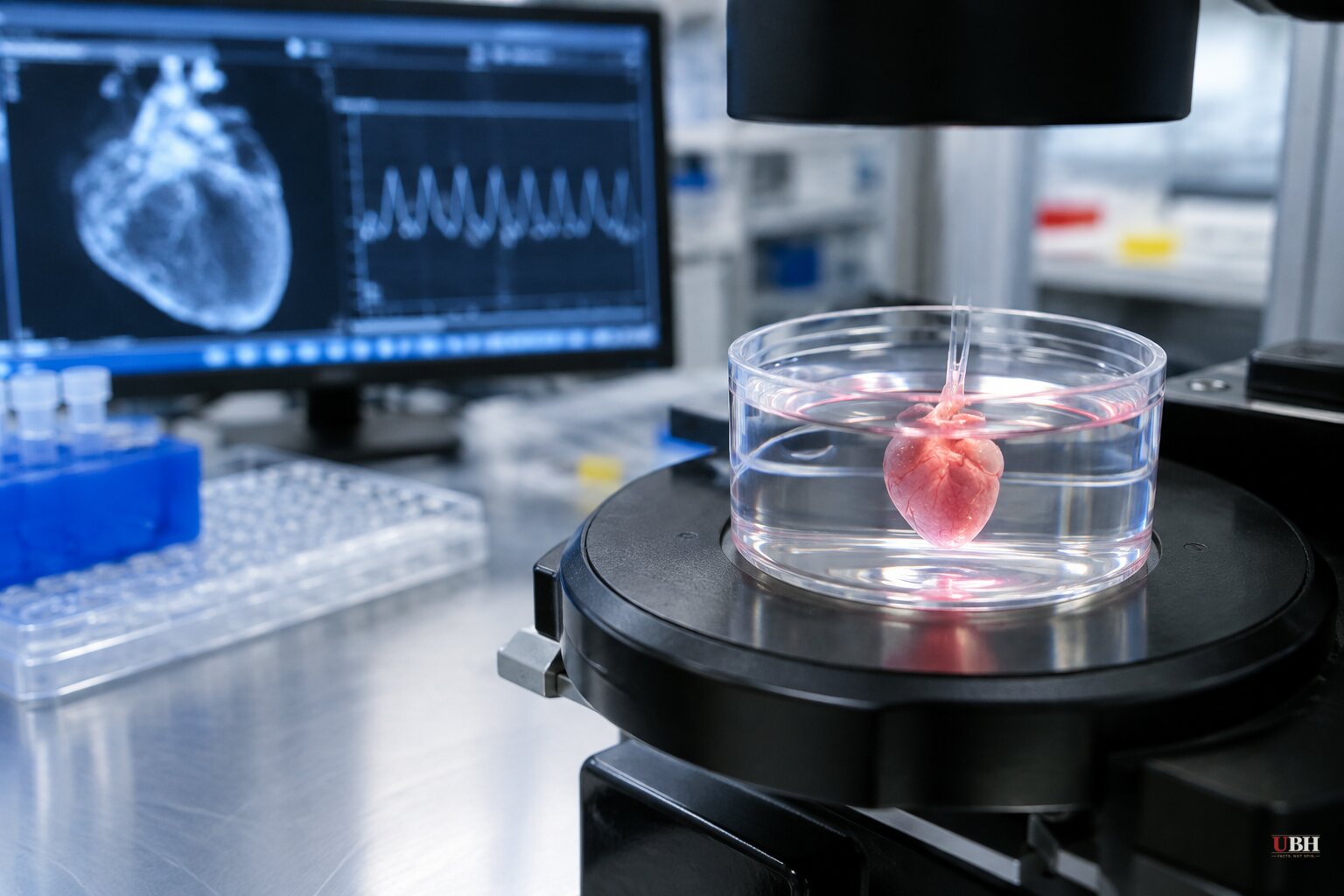
Scientists at the Research Institute of the McGill University Health Centre have grown a tiny, beating piece of heart tissue using blood cells taken from a single patient with dilated cardiomyopathy, according to the institute's own account of the work and reporting from Medical Xpress. The study appeared in the peer-reviewed journal Advanced Healthcare Materials.
Dilated cardiomyopathy, or DCM, is a disease where the heart enlarges and weakens, losing its ability to pump blood properly. According to the study's authors, patients with DCM face a 50 percent risk of progressing to heart failure within five years. DCM is also a leading cause of heart transplants, per the McGill team.
How They Built It
Researchers took blood cells from a person diagnosed with DCM and reprogrammed them into induced pluripotent stem cells, cells capable of turning into nearly any tissue type in the body. From there, they converted those stem cells into cardiomyocytes, the muscle cells that make the heart contract.
Those cardiomyocytes were then engineered into a three-dimensional tissue on a chip. The result, according to Ali Mousavi, the study's first author and a postdoctoral fellow in Dr. Renzo Cecere's Myocardial Regeneration Lab at the institute, is a "mini-heart" that beats and contracts on its own.
The team embedded tiny fluorescent beads inside the tissue to track how different regions moved and contracted with each beat, giving researchers a detailed map of the tissue's function, according to Newsweek's account of the study.
What Made It Different
Most lab models of heart disease rely on animal tissue or generic cell lines grown in dishes. Cecere, a cardiac surgeon at the McGill University Health Centre and associate professor of surgery at McGill University, said those traditional tools don't fully capture how a real human heart behaves.
"This new model more accurately mimics the behavior of a human heart than traditional research models do," Cecere said, according to Medical Xpress. "This advance could help us find more effective treatments for dilated cardiomyopathy, ultimately reducing the need for heart transplants."
To test whether the mini-heart actually captured the disease, researchers built a second version using cells from a healthy person and compared the two side by side. They found differences in structure, contraction patterns, beating rhythm, calcium activity and molecular characteristics between the diseased and healthy tissue, according to Mousavi.
"Together, these findings show that our model can reproduce important features of dilated cardiomyopathy and could eventually provide patient-specific insights into heart disease," Mousavi said.
The Case for Personalized Models
Dr. Ayesha Bryant, clinical advisor at Alpas Wellness, told Newsweek that patient-derived models like this one can give researchers something animal models and generic cell lines can't: a look at how a disease behaves inside a specific person's own genetic makeup. Bryant said that could eventually help scientists build more personalized treatment plans rather than one-size-fits-all therapies.
Mousavi said the goal is to "recreate aspects of an individual patient's heart disease outside the body, opening the door to applications in personalized medicine."
What This Isn't
This is a proof-of-concept study built from cells taken from one DCM patient, compared against cells from one healthy person. It is not a treatment, not a drug, and not a clinical trial. It's a laboratory tool that researchers hope to scale up and validate across more patients before it changes how anyone treats heart disease.
CityNews Montreal's write-up hedges the findings with phrases like "reportedly created" and "reportedly uses," odd language for a study that's already peer-reviewed and published in a named journal. The underlying science isn't in dispute; it's simply early. Whether the model holds up when researchers test it against DCM patients with different genetic causes of the disease, and whether it can actually predict how an individual will respond to a specific drug, remains unanswered. The McGill team has not published a timeline for expanding the study to more patients.
Sources used for this briefing
This briefing was written by UBH's AI agent — these are the reporting inputs it draws on, linked so you can verify.


