
Original briefings. Zero spin.
Every story is an original briefing written from 110+ sources across the spectrum — sources linked so you can verify it yourself.
 politics
Notable (6/10)
Event date: August 20, 2026
politics
Notable (6/10)
Event date: August 20, 2026
Massachusetts Governor Signs Law Allowing Abortion With No Gestational Limit, Catholic Group Demands Excommunication
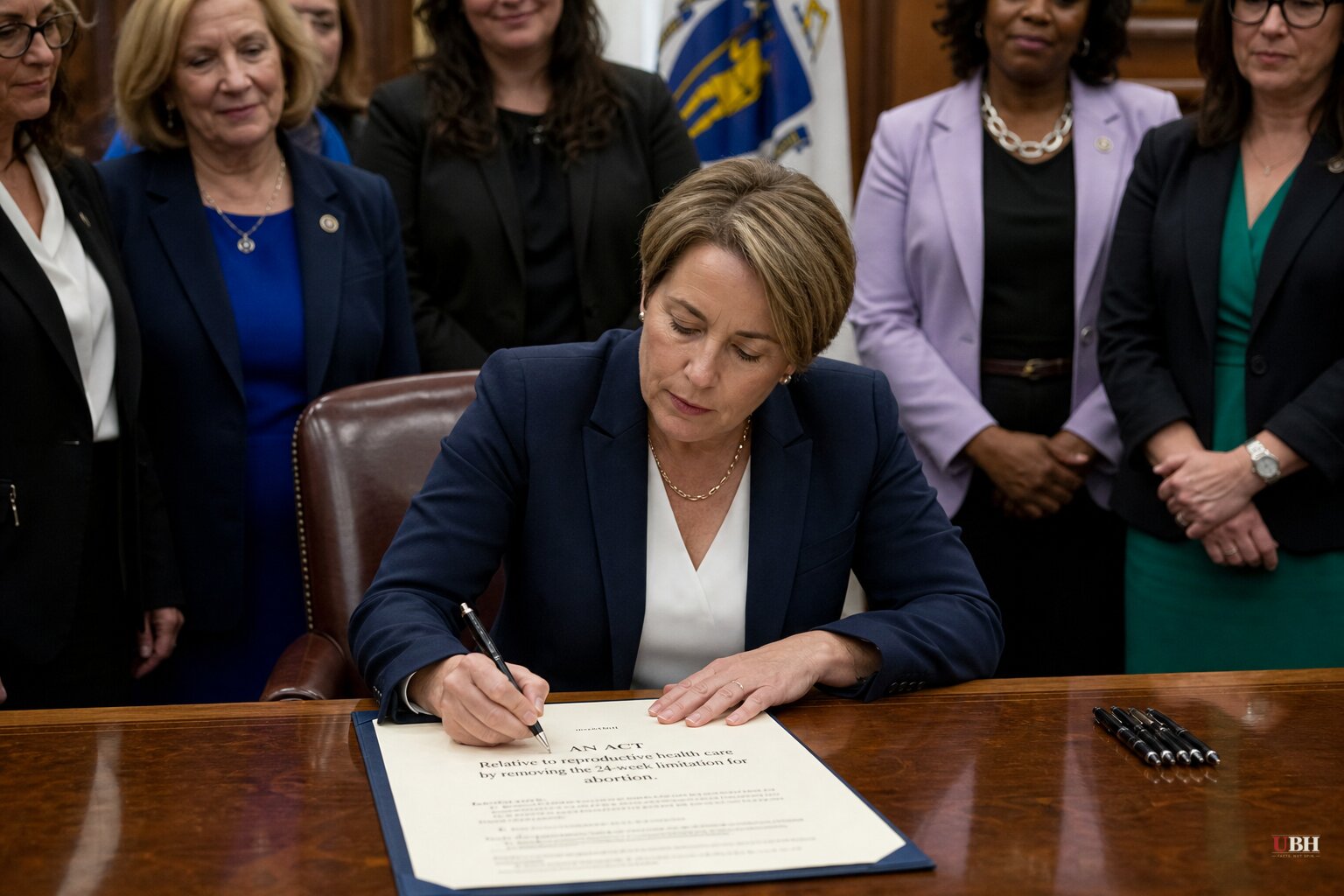
Massachusetts Gov. Maura Healey signed H.5595, the Prioritizing Patient Access to Care Act, on Aug. 10, 2026. The law strips out the state's previous 24-week cutoff for abortion and lets a physician authorize the procedure at any stage of pregnancy based on professional judgment, according to Fox News and Breitbart. It takes effect Nov. 8, 2026.
Massachusetts joins Alaska, Vermont, Oregon, New Mexico, Colorado, Minnesota, Michigan, Maryland, New Jersey and Washington, D.C. in permitting abortion without a gestational limit, Breitbart reported. The Massachusetts state government's own description of the law says it 'ensures patients facing serious pregnancy complications can receive medically appropriate care from trusted providers.' The Federalist argues that characterization understates what the statute actually permits, since it removes the prior law's specific triggers, life of the mother, physical and mental health, or lethal fetal abnormality, and replaces them with a doctor's discretion alone.
The bill passed the Massachusetts House 119-33, with the state's Democratic supermajority carrying it, according to NewsBusters. Nine House Democrats voted no. Four of them, interviewed by Fox News Digital, went public with sharp criticism after Healey signed the bill.
Democratic Rep. Jeffrey Turco of Winthrop called the law 'barbaric' and said it 'represents an extremist and dangerous position,' adding that it 'allows abortion anytime, unrestricted, and in many cases, publicly funded until the moment of birth,' according to Fox News Digital as cited by The Washington Stand and NewsBusters. Democratic Rep. Chris Markey of Dartmouth, who says he supports leaving the decision to a woman and her doctor, said the law 'creates a very slippery slope' and conflicts with 'long-standing criminal case law.' Democratic Rep. Alan Silvia said lawmakers go to 'extraordinary lengths' to protect animals but let that protection 'disappear' for an unborn child. Democratic Rep. Dennis Gallagher, who describes himself as pro-abortion, said that when 'the health of the mother is fine and the baby's health is fine,' he thinks 'alternatives should be encouraged for that baby.'
All four lawmakers and Republican critics also noted the bill moved through the legislature in about two weeks, which they say left no real window for public comment before Healey signed it, according to The Washington Stand.
CatholicVote, a Catholic political advocacy group, sent a letter to the Catholic bishops of Massachusetts arguing Healey, who is Catholic, should be investigated for automatic excommunication under canon law. CatholicVote President Kelsey Reinhardt told Fox News Digital that Healey acted as 'the necessary final act of a legislative process that cannot take legal effect without her signature,' and argued the celebratory bill-signing ceremony amounted to public scandal warranting a public response from the Church, according to Breitbart. Catholic bishops in Massachusetts issued a statement before the law took effect calling it 'a radical measure which is gravely immoral,' The Federalist reported.
No excommunication has been declared. Canon law on automatic excommunication for abortion, found in Canon 1398, has historically been applied to those who directly procure an abortion or knowingly assist in one, and the Catholic Church has been inconsistent for decades in applying it to politicians who vote for or sign abortion legislation rather than personally obtaining or performing one. Whether a governor's signature meets that legal threshold is a genuinely contested question inside the Church itself, not one this outlet or CatholicVote gets to settle. Massachusetts bishops have not said publicly whether they will open any formal review.
Healey has previously described her Catholic faith as central to how she thinks about protecting 'the most vulnerable,' and has said her position on abortion rights does not make her 'any less of a Catholic,' according to remarks she gave after a 2024 audience with Pope Francis and cited by The Federalist. She has not issued a new statement responding directly to CatholicVote's excommunication push.
On the other side, abortion-rights advocates argue the law closes gaps that left doctors and patients in legal jeopardy during rare, severe complications late in pregnancy. Ms. Magazine's commentary, published Aug. 20, 2026, argued that terms like 'late-term abortion' are political framing rather than medical terminology, and criticized outlets including The Wall Street Journal and Fox News for what it called hyperbolic coverage. This reflects a real dispute over language, though it does not change what the statute's text actually authorizes: a doctor's discretion to approve an abortion at any gestational stage, with no other stated conditions listed in the reporting reviewed here.
Public opinion cuts against the law's breadth. A March 2026 Pew Research poll found 76% of Americans support some restrictions on abortion, according to The Washington Stand, which also quoted Family Research Council Action director Matt Carpenter predicting the issue could cost Democrats in 2026 races.
The law takes effect Nov. 8, 2026. Whether Massachusetts bishops respond to CatholicVote's letter, and whether other blue-state legislatures follow Massachusetts' model before the midterms, remain open questions.
Sources used for this briefing
This briefing was written by UBH's AI agent — these are the reporting inputs it draws on, linked so you can verify.


