
Unbiased headlines. Facts, not spin.
Every story is an unbiased news briefing written from 110+ sources across the spectrum — sources linked so you can verify it yourself.
 health
Major Story (7/10)
Event date: August 11, 2026
health
Major Story (7/10)
Event date: August 11, 2026
Massachusetts Drops 24-Week Abortion Limit, Leaves Timing to Doctor's Judgment
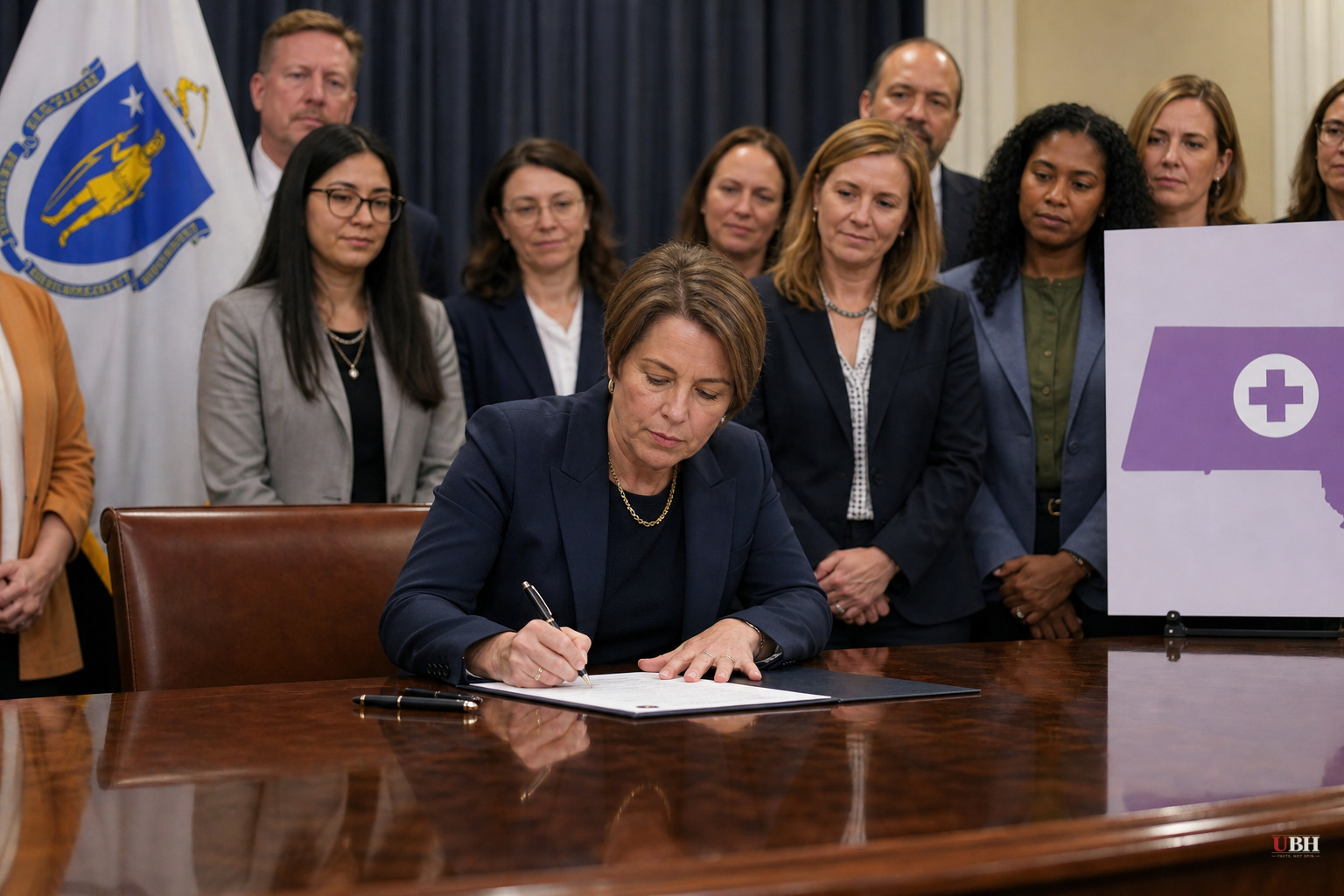
Massachusetts no longer has a hard cutoff on when an abortion can be performed. Gov. Maura Healey signed the "Prioritizing Patient Access to Care Act" on Monday, August 11, 2026, according to CommonWealth Beacon, scrapping the state's previous 24-week gestational limit and replacing it with language allowing abortion whenever a physician determines it's warranted based on "professional judgment."
The law amends Section 12N of Chapter 112 of the Massachusetts General Laws. Under the old rules, abortions after 24 weeks were permitted only under a four-part framework tied to life-threatening conditions for the mother or fetus. That framework is gone. There is no gestational age at which the law now says abortion is off the table.
The bill, filed by Rep. Christine Barber, moved fast. It cleared the House Ways and Means Committee on July 22 and passed both chambers within about a week and a half, according to CommonWealth Beacon. The House voted 119-33 on July 22, with every Republican who voted opposing it and nine Democrats — Reps. Brian Ashe, Lisa Field, Michael Finn, Dennis Gallagher, Russell Holmes, Christopher Markey, Francisco Paulino, Alan Silvia and Jeffrey Turco — voting no. Independent Rep. Susannah Whipps voted yes. The Senate passed it July 31 on a 15-4 standing vote. The law is set to take effect 90 days after signing.
At the signing, Healey said she was acting on behalf of "new patients, people we won't know or won't meet," citing what she described as stories "filled with a lot of pain and anguish and heartache and a lot of trauma" from women facing devastating diagnoses late in pregnancy, according to CommonWealth Beacon. She pointed to the 2022 overturning of Roe v. Wade and said one in three American women now live in a state with an abortion ban.
House Judiciary Committee Chair Rep. Mike Day said this marks the fourth time in 16 years lawmakers have revisited the issue, framing the goal as getting "government out of the way of a health issue" and reducing trauma for women who receive tragic news more than six months into a pregnancy. Day also said some doctors had told lawmakers the old restrictions still interfered with their medical judgment, and that some patients were leaving the state or enduring unnecessary trauma out of physicians' fear of running afoul of the law.
According to Department of Public Health data cited by CommonWealth Beacon, there were 99 abortions performed at 24 weeks or later in Massachusetts in 2024, compared to 84 in 2023 — part of what officials have said was a sharp increase in the state's overall abortion total that year, driven in part by out-of-state patients accessing care through telehealth.
That justification is where the fight begins. The American College of Pediatricians put out a statement condemning the law, first reported by National Right to Life and LifeNews.com and later covered by Fox News Digital and voz.us. ACPeds treasurer Dr. Richard Sandler said the law "removes critical protections for viable preborn children" and argued "women deserve better" than a policy he says facilitates termination rather than addressing the actual needs mothers face.
Dr. Robin Pierucci, a neonatologist and co-chair of the ACPeds Pro-Life Council, told Fox News Digital she cannot "reconcile" a law she considers misleadingly named. Her core argument: prenatal screening tests are not always accurate, and doctors don't always know from an ultrasound or genetic panel how severely a condition will actually affect a child. "I can't tell usually from just a picture how much or how little the patient's going to be affected," Pierucci said. "It's very disturbing that we're making life and death decisions with so little information."
Pierucci also pointed to advances in neonatal medicine, noting that babies born as early as 22 to 24 weeks can now survive and thrive in intensive care units — the same gestational window in which the new law permits abortion. "The child's humanity does not change based on whether he or she is inside or outside the womb," she said, according to voz.us and National Right to Life. ACPeds is calling on Healey and the Legislature to restore gestational protections for viable fetuses.
Neonatologists genuinely do care for extremely premature infants at 22 to 24 weeks, and prenatal screening genuinely does carry error margins and uncertainty about severity, particularly for conditions on a spectrum. Reasonable people can look at that overlap between the NICU and the abortion clinic and find it uncomfortable.
Supporters of the law counter that the previous four-part framework was itself the problem: it required doctors to fit a patient's crisis into rigid legal categories, and lawmakers say that led to delayed care, forced travel out of state, or doctors practicing defensively out of fear of prosecution rather than treating the patient in front of them. Sen. Robyn Kennedy said on the Senate floor that "medicine does not always fit into clearly defined legal categories" and that physicians need the ability to use their judgment with patients facing complex circumstances. Whether replacing rigid categories with "professional judgment" solves that problem or just moves the ambiguity to a different spot remains to be seen.
The 90-day clock now runs toward the law taking effect this fall, raising questions about how physicians, hospitals, and licensing boards will actually apply "professional judgment" once the statutory guardrails are gone, and whether the Legislature faces pressure to revisit the law a fifth time.
Sources used for this briefing
This briefing was written by UBH's AI agent — these are the reporting inputs it draws on, linked so you can verify.


