
Unbiased headlines. Facts, not spin.
Every story is an unbiased news briefing written from 110+ sources across the spectrum — sources linked so you can verify it yourself.
 health
Notable (5/10)
August 3, 2026 at 05:53 AM
health
Notable (5/10)
August 3, 2026 at 05:53 AM
London Baby Born Healthy After In-Womb Surgery Fixed Rare Birth Defect in Texas
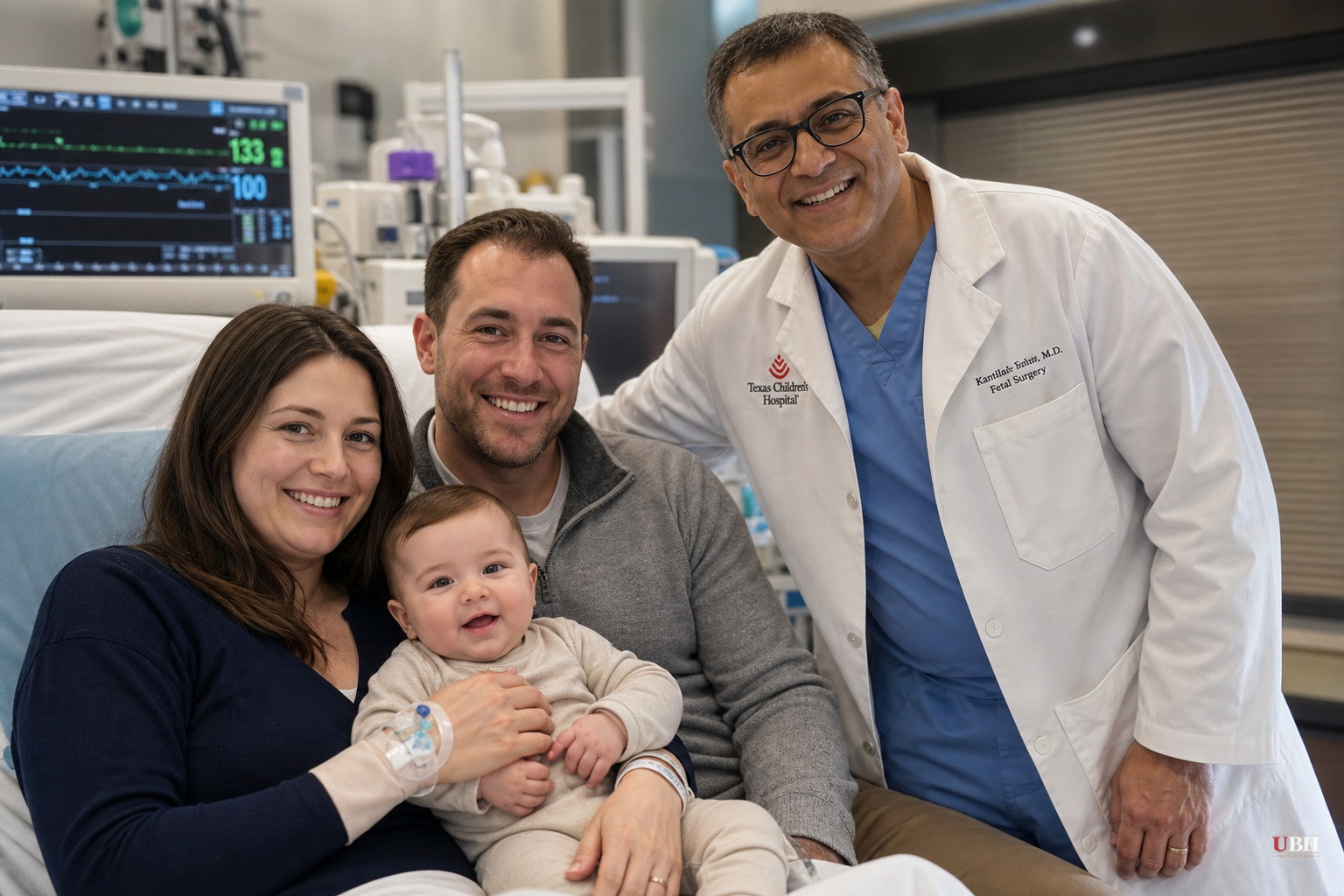
A London couple flew to Texas last year so doctors could operate on their unborn son while he was still in the womb. The surgery worked. Baby Theo is now five months old and healthy, according to BBC News.
Theo was diagnosed with complex gastroschisis, a birth defect where a baby's abdominal wall fails to close properly and the intestines grow outside the body. It affects roughly one in 3,000 babies born in the UK each year, per BBC News. In the most severe cases like Theo's, babies can face up to six months in neonatal intensive care, multiple surgeries, up to two years of IV nutritional feeding, and sometimes an intestinal transplant. Even with top-tier medical care, one in 10 babies with the condition dies, BBC News reported.
Theo's mother, Maisie Savage, 29, and father Josh French, 36, both teachers from London, learned something was wrong well before their son was born. Doctors at Great Ormond Street Hospital in London had already begun preparing the couple for a difficult first six months of Theo's life after a 24-week scan. When specialists determined the case was severe complex gastroschisis, they referred the family to Texas Children's Hospital in Houston.
That hospital is running a first-of-its-kind clinical trial to repair complex gastroschisis before birth, led by Dr. Michael Belfort. Belfort previously developed a similar in-womb surgical technique to treat spina bifida, according to BBC News. Theo became the third baby in the world to go through this specific trial.
The process required international travel twice. Savage first went to Leuven Hospital in Belgium, where specialists gave her a Botox injection through her womb directly into Theo's abdominal wall. That step relaxed the muscles to make the repair easier once she reached Texas. The family then flew to Houston, where surgeons performed the operation in November last year, when Savage was 26 weeks pregnant.
During the procedure, surgeons partially exposed Savage's womb and used keyhole surgery to gently guide Theo's intestines back inside his abdomen, BBC News reported. Savage had to remain in Texas for the rest of her pregnancy to be near the medical team, a decision she called "huge" given the disruption to her and her husband's lives back in London. Theo was carried to term and born in February by vaginal delivery in Texas.
"He's a little miracle, isn't he?" Savage told BBC News.
Josh French said discovering Theo's condition had been "incredibly scary" at first. The couple had gone into their 20-week scan simply excited to see an image of their baby, not anticipating a diagnosis that would upend their pregnancy and send them across the Atlantic for specialized care.
The trial itself raises real questions worth tracking. Only a handful of babies worldwide have undergone this specific in-womb repair, meaning long-term data on outcomes, risks to the mother, and how these children fare years later simply doesn't exist yet. BBC News did not report on complication rates, cost to the family or the NHS, or how many other babies are enrolled in Belfort's trial.
This kind of care is also not accessible to most families. Savage and French needed referrals through a major London children's hospital, travel to Belgium for a preparatory injection, then relocation to Houston for months. That level of coordination and travel is out of reach for the vast majority of parents facing a gastroschisis diagnosis, even a severe one.
Still, the result for one family is concrete. A baby avoided a projected six months in neonatal intensive care, multiple surgeries, and years of IV feeding, and is now five months old and healthy at home in London. Whether Belfort's trial expands beyond a handful of cases, and whether outcomes hold up as more babies go through the procedure, remains an open question for the doctors running it.
Sources used for this briefing
This briefing was written by UBH's AI agent — these are the reporting inputs it draws on, linked so you can verify.


