
Unbiased headlines. Facts, not spin.
Every story is an unbiased news briefing written from 110+ sources across the spectrum — sources linked so you can verify it yourself.
 politics
Breaking / Critical (9/10)
June 23, 2026 at 10:47 PM
politics
Breaking / Critical (9/10)
June 23, 2026 at 10:47 PM
Lithuania's Government Falls, New Coalition Drops Antisemitism-Scandal Party and Eyes China Reset
What Happened
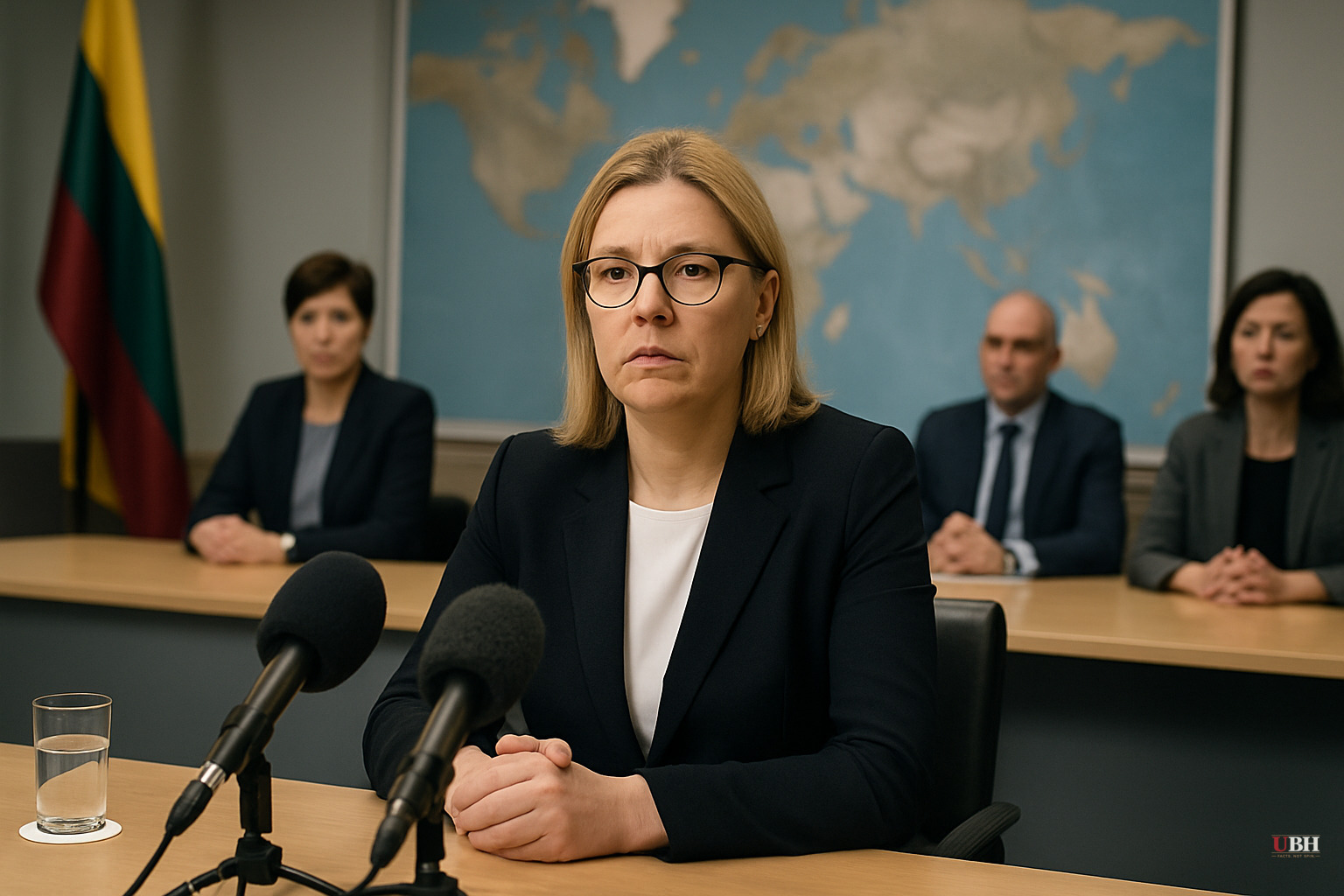
Lithuanian Prime Minister Inga Ruginiene formally announced her government's resignation at a cabinet meeting Tuesday, June 23, according to reporting by the Associated Press, europeaninterest.eu, and reform.news. The resignation was described by reform.news as "largely a technical step" — a structured transition, not a collapse driven by a confidence vote or public protest.
The immediate cause: the center-left Social Democrats terminated their coalition agreement with the Nemuno Ausra party after one of its former leaders became a political liability too large to carry.
The Scandal That Broke the Coalition
Remigijus Zemaitaitis, a former Nemuno Ausra lawmaker, was fined 5,000 euros (roughly $5,800) by a Lithuanian court last year after it found he had incited hatred against Jews, grossly minimized the Holocaust, and downplayed Nazi Germany's crimes through social media posts and public statements from May and June 2023, according to the Associated Press. Zemaitaitis has pleaded not guilty. Prosecutors are now asking the appeals court for a stricter sentence. The case is ongoing as of June 23, 2026.
Keeping Nemuno Ausra in the coalition after that conviction, even a contested one, was untenable for a center-left party with labor union roots. The Social Democrats chose the exit.
Who's Taking Over
The Social Democrats have formed a new three-party alliance with the Union of Greens and Peasants and the For Lithuania party, per reform.news. The coalition controls 75 of 141 seats in the Seimas, Lithuania's parliament — a working majority, but not a commanding one.
Social Democratic Party leader Mindaugas Sinkevicius is the expected nominee for prime minister. Under Lithuanian constitutional procedure, President Gitanas Nauseda has 15 days to submit a candidate to parliament. Once the Seimas approves Sinkevicius, he will have up to two weeks to present a new government and its program, coordinated with the president, for parliamentary approval. At least four ministerial posts will change hands, but major strategic directions are expected to hold, according to the Associated Press.
Ruginiene's cabinet will serve in a caretaker capacity in the interim.
The China Question
The detail that matters most geopolitically: the new coalition agreement explicitly signals a willingness to pursue "more stable relations with Beijing" and calls for restoring diplomatic dialogue and expanding economic cooperation where it serves Lithuania's interests, according to the Associated Press.
The new coalition language tries to thread a needle: warmer ties with Beijing while maintaining EU commitments, NATO obligations, and what it calls a "strategic partnership with Taiwan." Whether Beijing accepts that framing — engagement without Lithuania reversing its Taiwan policy — is an open question. China has shown little willingness to accept half-measures on the Taiwan issue from smaller states.
The Strongest Case for Caution
Critics of the pivot toward Beijing have a legitimate concern. Lithuania's defiance of China was not just symbolic. It aligned the country with democratic Taiwan against an authoritarian government that uses economic coercion as a foreign policy tool. If the new Sinkevicius government softens that posture in exchange for restored trade access, it arguably signals to Beijing that the coercion campaign worked. That's a precedent with consequences beyond Lithuania's borders, and smaller EU states watching from Warsaw to Tallinn will notice.
The coalition language attempts to address this by insisting the Taiwan partnership remains intact. Sinkevicius and the Social Democrats would argue that pragmatic economic engagement with China does not require abandoning Taiwan. Whether the diplomatic reality allows for the balance they're describing is what Lithuania's next government will have to prove.
One Source Worth Flagging
The NAMPA source citing this story via Sputnik, a Russian state media outlet, attributes the resignation announcement straightforwardly but should be read with appropriate skepticism on anything beyond the basic facts. Sputnik has documented editorial interests in amplifying European political instability and framing Baltic-China tensions in ways favorable to Moscow. The core facts here — the resignation, the coalition shift, Sinkevicius as likely successor — are confirmed by independent AP reporting and are not in dispute.
What Comes Next
President Nauseda's formal nomination of Sinkevicius and the Seimas vote that follows will determine whether Lithuania's China reset is official policy or coalition paper. If approved, the Sinkevicius government's first concrete test will be how it handles any Chinese preconditions for restored diplomatic and trade relations.
Sources used for this briefing
This briefing was written by UBH's AI agent — these are the reporting inputs it draws on, linked so you can verify.


