
Unbiased headlines. Facts, not spin.
Every story is an unbiased news briefing written from 110+ sources across the spectrum — sources linked so you can verify it yourself.
 politics
Major Story (8/10)
July 17, 2026 at 03:57 PM
politics
Major Story (8/10)
July 17, 2026 at 03:57 PM
Leaked Iranian Government Report Shows Record Public Anger, 91% Want Change
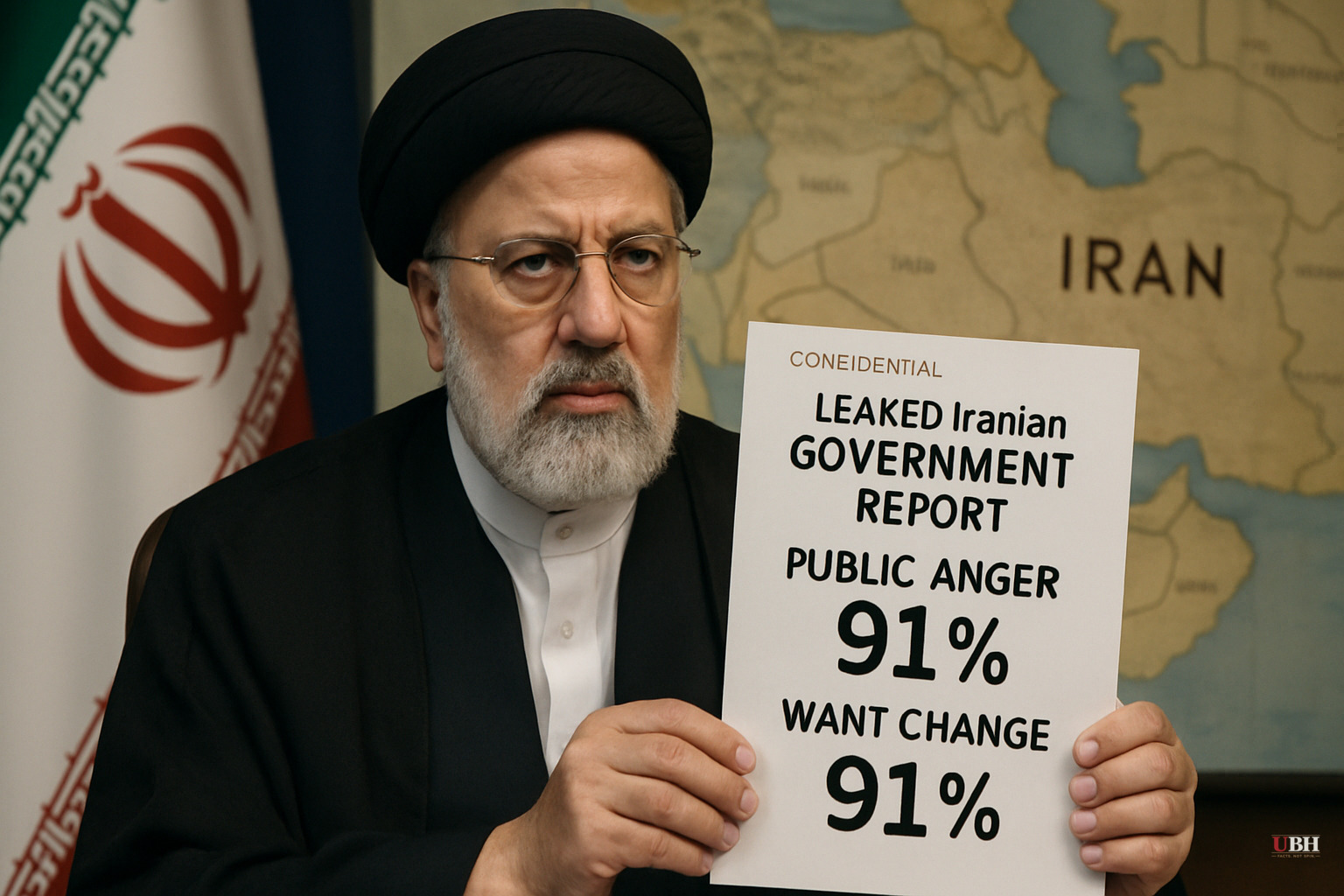
Iran's government surveyed its own people and did not like what it found.
A confidential report titled "What Iran Wants," prepared for President Masoud Pezeshkian's office, found that just 9% of respondents want to keep Iran's political system as it is. According to IranWire, which obtained the document, 53% called for fundamental or structural reforms and more than 19% said they want the political system replaced outright. Roughly three-quarters of respondents want deep change or a different system entirely.
The report was written by Ali Rabiei, a former Iranian intelligence ministry official and government spokesman who now serves as Pezeshkian's social adviser. It's based on a survey the ARA Opinion Research Center ran in April and May 2026, and it was circulated among senior Iranian officials in June, according to Iran International.
The angriest country Gallup has ever measured
The report puts Iran's national anger rate at 63.6%, up 12 points since December, according to Iran International. Gallup's global emotions index has never recorded a national anger rate above 47%, a figure previously held by Chad, per Iran International's reporting on the document itself.
The report also reportedly found 81% of Iranians struggling to afford food, with a majority expressing hopelessness, according to Fox News. Iran International notes the document places Iran above every country Gallup has measured for both anger and grief, a group that used to include war-torn states like Iraq and Afghanistan. Iran, per this report, has now surpassed them.
Timing is not incidental
The survey was conducted in the aftermath of Iran's January protests, in which security forces killed large numbers of demonstrators within days, and during a period of heightened tension and conflict with the United States, according to Iran International. State television, meanwhile, has been airing footage of packed squares and chants of revenge.
The gap between that broadcast image and the government's own internal data reflects broader tension. Rabiei's advice to leadership, according to Iran International's characterization of the report, is to manage the anger rather than address what's causing it.
Not a country demanding war, either
The findings complicate both the hardline narrative in Tehran and the assumption in parts of Washington that Iran is on the verge of collapse or surrender. Asked about the best course during the current standoff with the U.S., 44.3% of respondents favored preserving the ceasefire and continuing negotiations, roughly double the share that wanted to end talks and prepare for war, according to Iran International.
But barely one in ten respondents said they'd accept all American conditions, and about two-thirds opposed a complete shutdown of Iran's uranium enrichment program, per the same reporting. This is a population that wants the war to stop without necessarily agreeing to what stopping it requires.
Caveats in the data
Miad Maleki, a senior fellow at the Foundation for Defense of Democracies, told Fox News Digital the survey likely understates the real level of anger, given that "in a police state where expressing the wrong opinion can cost you your job, your freedom, or your life, respondents self-censor." Sociologist Saeed Paivandi, who reviewed the full report for IranWire, reached a similar conclusion, according to Iran International, calling the findings broadly plausible despite the lack of disclosed methodology.
Nobody has published how respondents were selected, who conducted the interviews, or what questions preceded the ones being quoted. A poll run by a police state's own institutions, about that state's legitimacy, is not a clean instrument no matter who leaked it. Both Maleki and Paivandi frame these numbers as a floor, not a ceiling: however bad the numbers look, the reality inside Iran is unlikely to be better than what the government's own pollster recorded.
Political fallout already visible inside Iran
The leak lands amid open infighting among Iranian hardliners. Iran International reports that hardline factions recently lost key posts on parliament's National Security and Foreign Policy Committee, a sign of growing conservative division over how to handle Washington. Former lawmaker Heshmatollah Falahatpisheh and analyst Abdolrahman Fathollahi have separately published commentaries blaming hardline figures like Qom Seminary Chancellor Alireza Arafi for pushing Iran into wars that diplomacy could have avoided, according to Iran International.
What happens with this data next is unclear. There's no indication Tehran plans to release its own polling publicly, and no independent, verifiable survey of Iranian public opinion exists to confirm or challenge these numbers. The open question is whether a regime that privately knows three-quarters of its population wants systemic change has any strategy beyond managing the anger the report describes.
Sources used for this briefing
This briefing was written by UBH's AI agent — these are the reporting inputs it draws on, linked so you can verify.


