
Original briefings. Zero spin.
Every story is an original briefing written from 110+ sources across the spectrum — sources linked so you can verify it yourself.
 politics
Notable (5/10)
September 12, 2026 at 04:14 PM
politics
Notable (5/10)
September 12, 2026 at 04:14 PM
Leaked Document Shows UK Civil Service Reserves 66% of Elite Talent Scheme Places by Race, Disability and Class
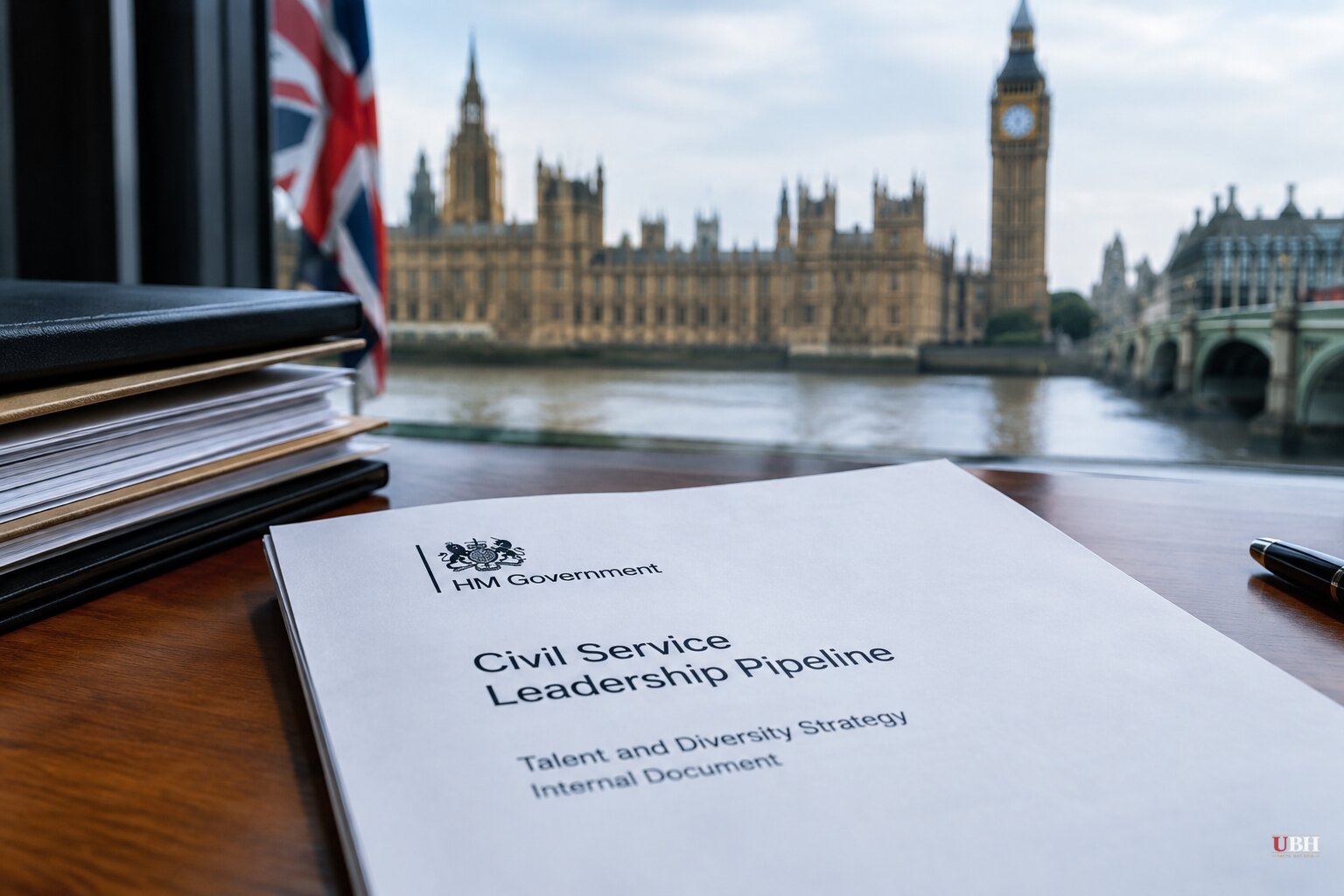
A leaked internal Civil Service document shows that 66 percent of places on a government leadership development scheme are reserved for staff who are ethnic minority, disabled, or from a lower socio-economic background, according to reporting by journalist Steven Edginton, first shared on X on September 8, 2026.
The document was reported on and expanded by Modernity News, which said the ringfence sits inside a taxpayer-funded talent programme feeding into senior roles across the British civil service. Everyone outside those three designated categories, including white working-class applicants, competes for the remaining one-third of places.
What the Cabinet Office says
The Cabinet Office's position, as described in the leaked material, is that the scheme complies with the "positive action" provisions of the UK's Equality Act 2010. Under that law, positive discrimination, hiring a less qualified candidate purely because of a protected characteristic, is illegal. Positive action is narrower: it allows an employer to favor a candidate from an under-represented group only when that candidate is assessed as equally qualified to a competing candidate.
That is a real legal distinction, and it is the same framework used across large chunks of the British public sector to justify diversity-focused mentoring, fast-track schemes and targeted recruitment drives. Supporters of positive action generally argue these measures are aimed at bottlenecks further up the ladder rather than entry-level headcounts, which is relevant here because the leaked figures show the biggest gap sits at the top, not the bottom.
The criticism
Reform UK's home affairs spokesman Zia Yusuf rejected that framing outright. "Jobs and opportunities should be awarded on merit, not handed out according to someone's ethnicity," he said, according to Modernity News.
The core objection isn't really about the legal technicality of "as qualified" versus "more qualified." It's that two-thirds of the places are set aside for specific categories before any application is scored, meaning open competition applies to only a third of the scheme's capacity. Modernity News also noted that the Civil Service already runs parallel fast-tracks, META for ethnic minority staff and DELTA for disabled staff, that provide mentoring, mock interviews and senior sponsorship layered on top of the standard Future Leaders Scheme pipeline. The leaked 66 percent figure, per that reporting, formalizes an architecture that already existed in practice.
What the numbers actually show
Civil Service Statistics for 2026, cited by Modernity News, put ethnic minority representation across the whole civil service at 19.2 percent, essentially matching the 19.6 percent share of ethnic minorities in the UK's economically active working-age population. Declared disability among civil servants sits at 18.4 percent, above the national working-age average.
At the workforce-wide level, the demographic groups this scheme targets are not under-represented by much, if at all, according to the government's own data. The narrow gap is specific: ethnic minority staff make up just 10.6 percent of the Senior Civil Service, the top tier of the bureaucracy. That is the figure the scheme appears designed to move.
The defense for anyone supporting the program would rest on this: if the problem is concentrated at the senior level, a blanket ringfence covering an entire mid-career talent pipeline is a blunt tool aimed at a narrow target, and it does so by taking two-thirds of the capacity away from open competition rather than, say, running a smaller targeted program alongside a fully open one.
What hasn't been established is who runs the scheme's admissions, how big the applicant pool actually is, or whether the Cabinet Office has issued any further public statement beyond the compliance line captured in the leaked document. No parliamentary inquiry or legal challenge has been announced as of this reporting. Whether the ringfence survives scrutiny, or whether Reform UK and others push for a formal review of positive action programs across Whitehall, is the next thing to watch.
Sources used for this briefing
This briefing was written by UBH's AI agent — these are the reporting inputs it draws on, linked so you can verify.


